Best Bearded Dragon Heat Bulbs: MIXJOY & Lucky Herp Reviewed
You need a 150W basking bulb that delivers intense, focused heat and UVA to keep your bearded dragon’s skin and metabolism healthy. Try the MIXJOY or Aiicioo 150W bulbs-they emit UVA under a white daylight spectrum, support immune function, and create basking zones up to 40°C. Use a ceramic fixture rated for 150W and mount the bulb 10–12 inches above the basking spot. Pair with a separate UVB source. Ideal thermal gradients start with proper bulb selection. The details that follow refine your setup for long-term scale and behavioral health.
We are supported by our audience. When you purchase through links on our site, we may earn an affiliate commission, at no extra cost for you. Learn more. Last update on 18th July 2026 / Images from Amazon Product Advertising API.
Notable Insights
- Choose 150W basking bulbs like Fluker’s or Aiicioo to provide intense, focused heat for proper thermoregulation and scale health.
- Use UVA-emitting bulbs such as MIXJOY or LUCKY HERP 100W to support digestion, appetite, and natural bearded dragon behaviors.
- Pair heat bulbs with a separate UVB light source, as most basking bulbs do not emit UVB for vitamin D synthesis.
- Maintain a basking zone of 110°F and a thermal gradient with cooler areas around 80°F using accurate digital temperature monitoring.
- Replace UVA bulbs every 3–6 months and use ceramic sockets to ensure safety, longevity, and consistent heat output.
MIXJOY 150W Reptile Heat Lamp Bulbs (2-Pack)

If you’re looking for a reliable heat source for your bearded dragon, the MIXJOY 150W Reptile Heat Lamp Bulbs (2-Pack) are an excellent choice-especially if you prioritize consistent basking temperatures and long-term durability. I rely on these bulbs to deliver steady heat output thanks to dual-filament technology. They last 3,000 to 5,000 hours-far longer than standard heat bulbs. The 150W power and E26 base fit standard ceramic sockets. Copper-plated bases improve conductivity and reflect heat downward. Frosted glass diffuses light evenly, reducing glare. UVA emission supports activity, digestion, and appetite. I position them at least 30 cm above the basking spot and pair them with a dimmer or thermostat for precise control.
Best For: Reptile owners seeking a durable, energy-efficient heat lamp that provides consistent basking warmth and UVA exposure for bearded dragons, tortoises, geckos, and similar pets.
Pros:
- Dual-filament technology ensures extended lifespan of 3,000 to 5,000 hours for long-term reliability
- Copper-plated base improves heat conduction and energy efficiency while reducing heat loss
- Frosted glass and UVA emission promote eye comfort and support natural reptile behaviors
Cons:
- 150W high wattage may require a robust fixture and careful placement to avoid overheating
- Dimmer or thermostat not included, necessary for optimal temperature control
- Bright output may be too intense for light-sensitive reptiles or nocturnal setups
LUCKY HERP 150W Ceramic Heat Emitter (2-Pack)
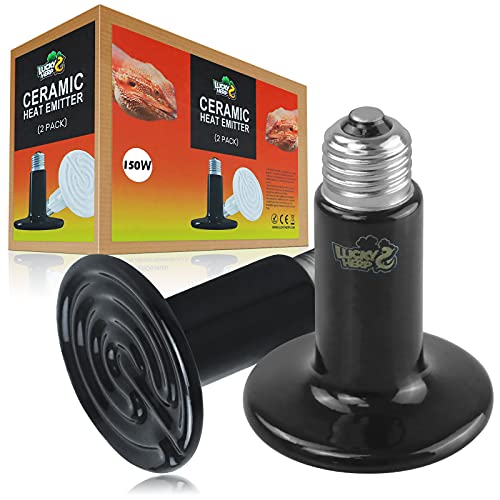
I rely on the LUCKY HERP 150W Ceramic Heat Emitter (2-Pack) when consistent, around-the-clock warmth is critical for my bearded dragon’s habitat. It produces heat without light, making it perfect for nighttime use without disrupting sleep cycles. The emitter reaches full temperature in about four minutes, generating noticeable warmth within 10 seconds. Made from thick ceramic, it’s more durable than standard bulbs and lasts up to 10,000 hours. It fits any E26 socket and runs on 120 volts. For safety, I use a quality ceramic socket, keep it 30cm from my pet, and avoid rapid cycling.
Best For: Reptile owners who need a reliable, light-free heat source to maintain consistent nighttime temperatures without disrupting their pet’s sleep cycle.
Pros:
- Emits heat without light, ideal for 24/7 use and maintaining natural sleep patterns
- Heats up quickly, producing noticeable warmth in 10 seconds and reaching full temperature in about 4 minutes
- Durable ceramic construction rated for up to 10,000 hours of operation
Cons:
- Requires a high-quality ceramic socket to handle heat, adding to setup cost
- Needs a minimum 30cm clearance from pets to prevent burns
- Frequent on/off cycling can reduce lifespan, requiring careful thermostat management
Fluker’s 150-Watt Reptile Basking Spotlight Bulb

Fluker’s 150-watt Reptile Basking Spotlight Bulb delivers intense, targeted heat, making it an ideal choice for reptile keepers who need a reliable heat source for large enclosures or species requiring high basking temperatures. I use it to create a precise thermal gradient in my setup. The bulb emits infrared light, focusing heat on a specific basking zone. This mimics the sun’s warmth, helping reptiles regulate their core body temperature. Its incandescent spotlight design produces bright illumination and deep heat penetration. I’ve noticed improved digestion and activity in my bearded dragon since installing it. It works well for lizards, snakes, and leopard geckos. The 150-watt output suits bigger tanks. I recommend pairing it with a thermostat. It doesn’t provide UVB, so I use a separate UVB tube. Still, it’s a durable, effective heat solution.
Best For: Reptile keepers with large enclosures or heat-loving species that require a strong, focused basking spot to maintain proper thermoregulation.
Pros:
- Delivers intense, targeted heat ideal for creating precise thermal gradients in large terrariums
- Enhances natural behaviors and physiological functions like digestion and activity levels
- Compatible with a wide range of reptiles, including bearded dragons, lizards, snakes, and leopard geckos
Cons:
- Does not emit UVB radiation, requiring a separate UVB light source
- High 150-watt output may be too intense for small enclosures or sensitive species
- Incandescent technology can have higher energy consumption and shorter lifespan compared to LEDs
LUCKY HERP Reptile Heat Lamp 100W 2-Pack
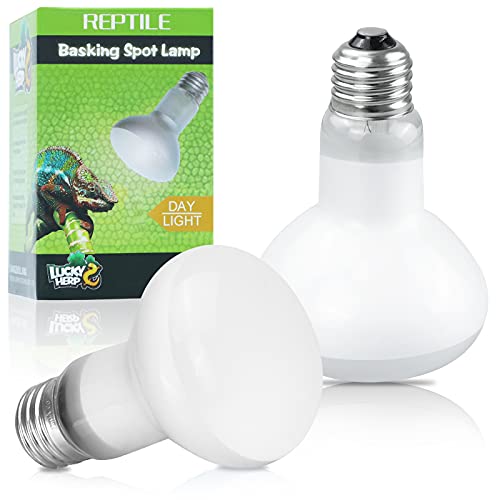
The LUCKY HERP Reptile Heat Lamp 100W 2-Pack is my top pick for reptile owners who prioritize consistent basking heat and UVA exposure in a durable, no-nonsense design. It delivers 100W of radiant heat through a standard E26 base, operating at 120 volts for reliable performance. I use it 4–6 hours daily to maintain proper thermoregulation. The bulb emits UVA light, mimicking natural sunlight to support feeding and activity cycles. Built with high-quality glass and filament, it lasts up to 2,000 hours. I replace mine every 3 months to guarantee peak UVA output.
Best For: Reptile and amphibian owners seeking a reliable, UVA-emitting heat lamp for consistent basking warmth and natural behavior support.
Pros:
- Delivers efficient 100W heating with UVA light to mimic natural sunlight and support reptile health
- Durable construction with up to 2,000 hours of service life and safety-certified design
- Compatible with a wide range of species and easy to install using standard E26 sockets
Cons:
- Requires replacement every 3 months to maintain optimal UVA output
- Not compatible with dimmers, thermostats, or rheostats, limiting control options
- Minimum 30cm mounting distance needed, which may restrict enclosure setup flexibility
Aiicioo 150W Reptile Basking Light Bulb (2-Pack)

A 150-watt output makes the Aiicioo Reptile Basking Light Bulb ideal for reptile keepers who need consistent, high-intensity heat for larger enclosures or species with demanding thermal requirements. I rely on it to create a precise basking zone that supports thermoregulation. It emits UVA rays under a white daylight spectrum, mimicking natural sunlight. This promotes immune function and natural behavior. The E26 base fits standard fixtures, making it simple to install. It’s built with durable glass and metal. I use it safely-waiting 30 minutes before handling after turning off. It works well for bearded dragons, tortoises, and ball pythons.
Best For: Reptile owners seeking a high-wattage, durable basking light to create a warm, naturalistic environment for larger enclosures or heat-demanding species.
Pros:
- Provides strong 150W heat output ideal for creating effective basking zones
- Emits UVA rays under a white daylight spectrum to support health and natural behavior
- Features an E26 base for easy installation in standard fixtures and broad compatibility
Cons:
- High wattage may be too intense for small enclosures without proper distance or dimming
- Requires 30-minute cooldown before handling, limiting immediate repositioning
- No UVB emission, so supplemental lighting may be needed for some reptile species
Reptile Heat Bulb Lamp 2-Pack

You need a reliable heat source that supports both daylight basking and proper thermoregulation, especially if you keep reptiles like bearded dragons, tortoises, or iguanas. I use the Reptile Heat Bulb Lamp 2-Pack for this. It’s a 100W, 120V, 60Hz bulb with a standard E26 base. It provides UVA and heat in a daylight spectrum, syncing with natural cycles. The 2000-hour lifespan means less frequent replacements. Third-gen basking spot design focuses heat efficiently. I’ve used it for lizards, turtles, geckos, and even hermit crabs. It creates a clear hot zone in the terrarium. I pair it with a night lamp or ceramic emitter for 24-hour thermal support.
Best For: Reptile and amphibian owners seeking a reliable daylight basking heat source that supports natural behavior and thermoregulation.
Pros:
- Provides 100W of focused heat with daylight spectrum and UVA to promote natural cycles and healthy growth
- Compatible with a wide range of reptiles and amphibians, including bearded dragons, turtles, geckos, and tortoises
- Durable 2000-hour service life with third-generation basking spot design for efficient heat distribution
Cons:
- Does not provide UVB radiation, requiring additional lighting for species with UVB needs
- 100W output may be too hot for small enclosures or sensitive species without proper distance and fixtures
- Limited to daytime use; requires separate heat sources for nighttime to maintain thermal cycle
DBDPet Reptile Heat Lamp Bundle

Nothing beats a reliable heat source when keeping bearded dragons thriving in captivity, and that’s where the DBDPet Reptile Heat Lamp Bundle stands out. It includes two 100-watt Zoomed Repti Basking Spot lamps, engineered for ideal basking temperatures. I use it for my bearded dragon, and it delivers consistent infrared heat critical for digestion and activity. It’s the #1-selling reptile heat lamp in the USA, trusted by thousands. Each bulb arrives individually bubble-wrapped to prevent damage. The bundle includes a Pro-Tip Guide and Safety Guide, developed by reptile owners. I appreciate the DBDPet Worry Free Guarantee-defective bulbs get replaced or refunded.
Best For: Reptile owners seeking a reliable, high-quality heat source for bearded dragons, geckos, chameleons, and other reptiles requiring consistent basking warmth.
Pros:
- Includes two 100-watt Zoomed Repti Basking Spot lamps, the #1-selling reptile heat light in the USA
- Individually bubble-wrapped bulbs ensure safe delivery and maximum durability
- Comes with expert-backed Pro-Tip and Safety Guides plus a worry-free replacement or refund guarantee
Cons:
- Limited to 100-watt output, which may not suit larger enclosures or colder environments
- Replacement bulbs must be purchased separately after the initial pair burns out
- Not suitable for species requiring low-heat or UVB-focused environments without supplemental lighting
Reptile Heat Lamp Bulbs 150W (2-Pack)
When maintaining a stable thermal environment for nocturnal or light-sensitive reptiles, the Reptile Heat Lamp Bulbs 150W (2-Pack) deliver ideal 24/7 heating without disrupting natural behavior. These ceramic heat emitters produce no light, guaranteeing undisturbed day-night cycles. Operable up to 15,000 hours, they outlast standard incandescent bulbs. Made with high-purity ceramic and Ni-Cr-Alloy resistance wire, they heat quickly and efficiently. Their sturdy ceramic and metal construction prevents overheating. Suitable for bearded dragons, geckos, snakes, turtles, and small animals, they support circulation and healing. A 90-day guarantee and 24-hour support guarantee reliability.
Best For: Reptile and small animal owners seeking a reliable, light-free heat source for maintaining stable nighttime or 24/7 thermal environments.
Pros:
- Emits heat without light, preserving natural day-night cycles for nocturnal or light-sensitive animals
- Durable ceramic and metal construction with up to 15,000 hours of operational life
- Fast, efficient heating with advanced Ni-Cr-Alloy resistance wire and high-purity ceramic materials
Cons:
- 150W output may be too intense for small enclosures without proper thermostat control
- Requires a compatible ceramic socket fixture, not included with purchase
- Limited heat distribution in very large habitats without additional heating sources
Basking Light for Reptiles 2-Pack

Who wouldn’t want a reliable, high-performance heat source for reptiles that mimics natural basking conditions? I use the Basking Light for Reptiles 2-Pack to create an effective thermoregulation zone. These 100W UVA bulbs have an E26 base, run on 120V/60Hz, and deliver 2,000 hours of life. They produce a high-density beam with 35% more intensity than standard bulbs. That concentrated heat simulates sunlight, supporting healthy metabolism, growth, and breeding. I’ve found they work well for bearded dragons, tortoises, iguanas, and crested geckos. Pair them with a ceramic emitter for 24-hour warmth.
Best For: Reptile and amphibian owners seeking a high-intensity, long-lasting basking bulb to support natural thermoregulation and promote healthy growth and breeding.
Pros:
- Delivers 35% more heat intensity than standard bulbs, creating an effective basking zone
- Compatible with a wide range of reptiles including bearded dragons, tortoises, iguanas, and geckos
- Long 2,000-hour service life with E26 base for easy installation in standard fixtures
Cons:
- Produces bright light, which may disrupt nocturnal cycles if not paired with a night-specific heat source
- Generates intense localized heat, requiring careful placement to prevent burns or hotspots
- Limited to 120V/60Hz electrical systems, making it less suitable for international use
LUCKY HERP 100W Heat Lamp Bulbs (2-Pack)

The LUCKY HERP 100W Heat Lamp Bulbs (2-Pack) are ideal for reptile owners who need a reliable, focused heat source for basking animals like bearded dragons, tortoises, and iguanas. The flat-bottom design and 30° spotlight beam direct heat efficiently, creating a precise basking zone. It uses UVA daylight to mimic natural sunlight, aiding thermoregulation. With an E26 base, 120V, and 100W power, it runs up to 3,000 hours. I replace mine every 3 months to keep UVA output strong. Use it 4–6 hours daily. Keep it 30cm from animals. Don’t use with dimmers or frequent on/off cycles. Safe for bearded dragons, turtles, frogs, and even chickens.
Best For: Reptile and amphibian owners seeking a focused, reliable heat source that mimics natural sunlight for basking animals like bearded dragons, tortoises, and frogs.
Pros:
- Efficient flat-bottom design with 30° beam angle creates a concentrated basking zone for precise heating
- Emits UVA daylight to support natural thermoregulation and simulate a natural environment
- Compatible with standard E26 sockets, long 3,000-hour lifespan, and suitable for a wide range of animals including reptiles, amphibians, and poultry
Cons:
- Requires replacement every 3 months to maintain optimal UVA output, increasing long-term costs
- Must be used at a minimum distance of 30cm and not with dimmers or thermostats, limiting control options
- Not to be used with frequent on/off cycling, which may reduce bulb lifespan and performance
Factors to Consider When Choosing a Bearded Dragon Heat Bulb
You need to pick a heat bulb that matches your bearded dragon’s enclosure size and thermal needs. Wattage directly affects heat output-common options range from 50W to 150W, with higher watts suited for larger or taller tanks. Consider light spectrum, bulb lifespan (typically 6–12 months), fixture compatibility (ceramic sockets handle heat best), and maintain a safe distance of 10–12 inches to prevent burns.
Wattage And Heat Output
A 150W heat bulb delivers intense thermal output, ideal for maintaining basking zones between 100°F and 110°F in larger enclosures. You’ll need this higher wattage if your tank exceeds 40 gallons or your dragon requires intense basking heat. Lower wattage bulbs, like 100W, work for smaller setups under 30 gallons but may fail to reach ideal temps in bigger spaces. Heat output drops markedly with distance, so mount the bulb 30 cm above the basking spot to balance safety and efficiency. Too close risks burns; too far reduces effectiveness. Not all bulbs transfer heat equally-ceramic or infrared-focused designs deliver more usable radiant heat than standard incandescents. Match wattage to your dragon’s thermal gradient needs, ensuring the cool side stays around 80°F while the basking zone peaks at 110°F. Choose wisely to maintain precision and consistency.
Light Spectrum Requirements
Why do bearded dragons thrive under certain types of light? Because they need UVA radiation to maintain feeding, thermoregulation, and activity cycles. You must choose a heat bulb that emits a daylight spectrum with visible white light and adequate UVA output. Without it, your dragon may suffer reduced appetite, lethargy, and poor digestion. Standard basking bulbs should mimic midday sun intensity and spectral quality. Use 100W to 150W incandescent or halogen spot lamps for effective heat and light focus. These bulbs create a defined basking zone, supporting proper thermal gradients. A tight beam angle guarantees targeted illumination and prevents light scatter. Select bulbs labeled for reptile basking, not just general lighting. They’re engineered to balance heat, brightness, and UVA for peak reptile health. Always verify spectral output specifications before purchasing.
Bulb Lifespan Expectations
Light quality matters, but it means little if the bulb doesn’t last. Most reptile heat bulbs last 2,000 to 5,000 hours, depending on technology and use. Ceramic heat emitters outperform incandescent basking bulbs, with some rated up to 10,000 hours. They lack filaments, making them immune to failure from thermal stress. If your bulb emits UVA, replace it every 3 to 6 months-even if it still lights-because radiation output degrades over time. Frequent on/off cycling wears out filament-based bulbs fast. Each power cycle causes expansion and contraction, weakening the filament. Dual-filament bulbs resist this better, lasting longer than single-filament models. You’ll save money and maintain stable conditions by choosing durable, long-life options. Plan replacements based on hours used, not just visible failure.
Compatibility With Fixtures
You need to match your heat bulb with the right fixture to guarantee safe, effective operation. Use a bulb with an E26 base-the standard screw socket in most U.S. reptile fixtures. This guarantees proper electrical contact and secure fitting. Always verify your fixture’s wattage rating; most handle up to 150W, which covers typical basking bulbs. Exceeding this risks overheating or electrical failure. Choose a ceramic socket over plastic-ceramic withstands high heat without warping or degrading. Plastic can melt, creating a fire hazard. Confirm the fixture supports your bulb type, whether incandescent or ceramic heat emitter, for correct electrical performance. Never use dimmers or thermostats unless both bulb and fixture are rated for them. Mismatches shorten bulb life and increase safety risks. Proper compatibility guarantees stable heat output and long-term safety.
Safety Distance Guidelines
A properly secured fixture sets the stage for safe heat distribution, but placing the bulb at the correct distance is equally important for your bearded dragon’s well-being. Keep at least 30 cm (12 inches) between the bulb and your pet to prevent burns. This distance helps avoid overheating while ensuring effective warmth. Mount the bulb higher or lower depending on its wattage-higher for stronger bulbs, lower for weaker ones. Aim for a basking surface temperature of 35–40°C (95–105°F), measured at the closest point your dragon can reach. Use a digital thermometer with a probe for accuracy. Always let the bulb cool for about 30 minutes before handling during changes or cleaning. A protective guard on the fixture blocks accidental contact. Follow these guidelines to maintain a safe, functional thermal gradient in the enclosure.
Day Night Cycle Needs
How do you guarantee your bearded dragon maintains healthy biological rhythms while meeting its thermal needs? You provide a consistent 10–14 hours of daylight and 10–12 hours of darkness daily. Use heat bulbs that emit visible light and UVA during the day to simulate natural sunlight, supporting thermoregulation and metabolic function. This lighting promotes digestion, appetite, and natural basking behaviors. At night, switch to infrared or ceramic heat emitters-these deliver warmth without light, maintaining an ambient temperature of 65–75°F (18–24°C) while preserving the dark cycle. Avoid using standard heat lamps after dark; their light output disrupts sleep and stresses your pet. Overlapping light and heat cycles confuse circadian rhythms, potentially causing reduced activity and impaired digestion. Install a timer to automate changes, ensuring precise control. Consistent day-night separation is essential-not optional-for long-term health.
Frequently Asked Questions
How Often Should I Replace My Bearded Dragon’s Heat Bulb?
You should replace your bearded dragon’s heat bulb every 6 to 12 months. Even if it still emits light, the infrared output degrades over time, reducing effective basking heat. Most incandescent and halogen bulbs lose 20–30% of heat output within a year. Using a digital thermometer confirms inadequate temps. UVB bulbs also degrade; replace them every 6 months. Regular replacement guarantees consistent thermal gradients, supporting digestion and metabolic health.
Can I Use a Timer for My Reptile Heat Lamp?
Yes, you can use a timer for your reptile heat lamp. It’s essential for maintaining a consistent day-night cycle. Set it to match your bearded dragon’s natural 12-hour light and 12-hour dark rhythm. Timers prevent overheating and reduce stress. Digital models offer precise control, with some allowing sunrise-sunset simulation. Always pair with a thermostat to monitor temperature, ensuring the basking zone stays between 95°F and 105°F.
Do Heat Bulbs Affect My Dragon’s Sleep Cycle?
Yes, heat bulbs affect your dragon’s sleep cycle. You must maintain a proper day-night rhythm to support circadian rhythms. Use a 12-hour on/off cycle with a timer. At night, temperatures can drop to 65–75°F (18–24°C). Choose a daytime heat bulb that emits no light at night, like a ceramic heat emitter, to avoid sleep disruption. Infrared bulbs work too, but only if they’re non-light-emitting.
Is It Safe to Use an Extension Cord With Heat Lamps?
No, you shouldn’t use an extension cord with heat lamps. Heat lamps draw high wattage-typically 100W to 150W-and generate significant heat, increasing fire risk if connected to an undersized or damaged cord. If absolutely necessary, use only a heavy-duty, 14-gauge, grounded extension cord rated for at least 15 amps and 1875 watts. Keep it short, avoid coiling, and never run it under bedding or furniture.
Can I Use the Same Bulb for Day and Night Heating?
No, you can’t use the same bulb for day and night heating effectively. Daytime bulbs produce visible light and heat, mimicking the sun, while nighttime heating requires infrared-only sources. Using a white light at night disrupts circadian rhythms. Switch to a ceramic heat emitter (CHE) after dark-it emits no light, runs 24/7, and maintains temps between 70–75°F. Always pair with a thermostat to prevent overheating and guarantee stable thermal gradients.