Humidity Requirements by Species in Captive Breeding Environments for Amphibians
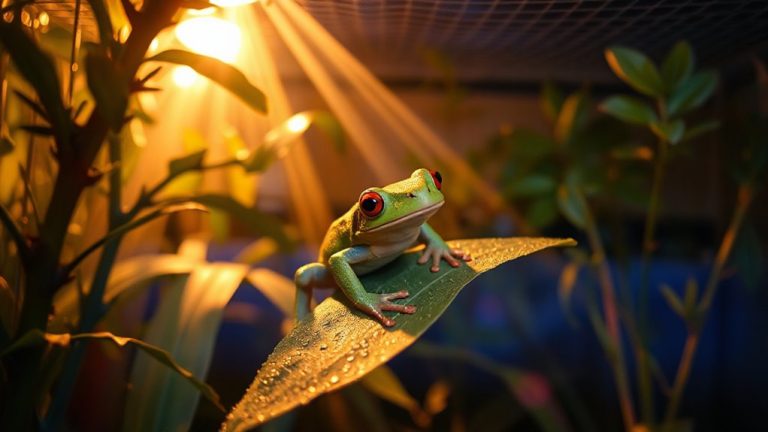
You need to maintain species-specific humidity levels for successful amphibian breeding. Red-eyed tree frogs require 70–80% RH, rising to 90% at night, while axolotls need constant 100% RH. Pacman frogs thrive at 60–70% but risk edema if over-humidified. Use calibrated digital hygrometers (±2% accuracy) at mid-height for precise monitoring. Pair misting systems with live plants and proper ventilation. Slight nocturnal dips help prevent mold. Maintaining these conditions supports hydration signaling and gamete development-key factors in reproductive success. Adjusting these parameters correctly leads to improved breeding outcomes.
Notable Insights
- Red-eyed Tree Frogs require 70–80% RH, with nighttime spikes to 90% to stimulate breeding behavior.
- Axolotls need constant 100% RH due to their fully aquatic lifestyle and lack of waterproof skin.
- Pacman Frogs thrive at 60–70% RH; higher levels increase risk of edema and respiratory issues.
- Fire-bellied Toads prefer 60–70% RH with access to water for soaking and humidity regulation.
- Species-specific humidity supports hydration signaling, hormonal balance, and successful gamete development.
Why Correct Humidity Matters for Breeding Success
While you can’t control every variable in captive amphibian breeding, maintaining proper humidity is one you absolutely must get right. Correct humidity directly influences breeding success through hydration signaling, a physiological trigger that stimulates reproductive behavior. When humidity levels fall outside ideal ranges, amphibians may fail to initiate courtship or oviposition. Hydration signaling relies on moisture-sensitive skin receptors, which detect environmental humidity and cue hormonal shifts necessary for breeding. Temperature synergy further affects this process-humidity and temperature must align to support metabolic function and gamete development. For most species, a relative humidity (RH) of 70–90% combined with stable thermal gradients (typically 18–26°C) creates ideal conditions. Deviations disrupt endocrine responses, reduce fertility rates, and increase egg desiccation risk. You need reliable hygrometers and misting systems to maintain precision. Without this control, even genetically viable pairs often fail to reproduce. Proper humidity isn’t optional-it’s a non-negotiable component of successful amphibian breeding programs.
Set the Right Humidity by Amphibian Species
Because different amphibian species evolved in distinct ecological niches, you’ll need to tailor humidity levels precisely to match their natural habitats. Species differences greatly influence survival and breeding success in captivity. Proper habitat mimicry guarantees physiological health and natural behavior. Ignoring these factors can lead to dehydration, poor skin function, or reproductive failure.
| Species | Ideal Humidity (%) | Notes |
|---|---|---|
| Red-eyed Tree Frog | 70–80 | Requires nightly rise to 90% |
| Axolotl | 100 (aquatic) | No terrestrial exposure needed |
| Pacman Frog | 60–70 | Susceptible to edema if too wet |
| Fire-bellied Toad | 60–70 | Semi-aquatic setup essential |
You must align enclosure conditions with each species’ native environment. Habitat mimicry isn’t optional-it’s essential for long-term success.
How to Measure Humidity Accurately in Enclosures
When maintaining amphibian habitats, you can’t rely on guesswork-accurate humidity measurement is essential for animal health and enclosure stability. Use a digital hygrometer with ±2% RH accuracy for reliable readings. Place the sensor at mid-enclosure height, away from water dishes and ventilation zones, to avoid skewed data. Hygrometer calibration is critical; perform monthly checks using the salt test method (75% RH at 20°C in a sealed container with saturated NaCl solution). Replace units that deviate more than 5% after calibration. Maintain ventilation balance by pairing hygrometer data with airflow assessment-too much airflow dries the environment, while too little causes stagnant, oversaturated air. Mesh lids and adjustable vents help fine-tune this equilibrium. Log readings daily to track trends and adjust conditions before problems arise. Consistent monitoring guarantees ideal humidity for species-specific physiological needs.
Safely Increase Humidity: Tools & Tips
| Tool | Output Range | Best Use Case |
|---|---|---|
| Ultrasonic Mister | 150–300 ml/hr | Small enclosures, low humidity |
| High-Pressure Fogger | 500–1000 ml/hr | Large, well-ventilated spaces |
| Drip System | Adjustable drops/min | Controlled moisture delivery |
| Automatic Timer | 1–24 hour cycles | Prevent over-misting |
| Hygrometer (Digital) | ±2% accuracy | Real-time monitoring |
Pair equipment with live plants to enhance retention.
Prevent Mold in Tropical Amphibian Enclosures
While maintaining high humidity is essential for tropical amphibians, failing to manage it properly can quickly lead to mold growth, which threatens both animal health and enclosure integrity. You must balance moisture retention with adequate air circulation to prevent stagnant conditions. Poor air circulation traps humidity near surfaces, creating microclimates ideal for mold. Use small, quiet fans or passive vents to guarantee gentle airflow without drying the enclosure. Your substrate choice directly impacts moisture control-avoid materials like coconut fiber that retain excess water unless monitored closely. Instead, opt for well-draining blends with sphagnum moss or cork bark, which resist compaction and inhibit fungal growth. Clean organic debris daily and monitor humidity with calibrated hygrometers. Maintain levels between 70–85%, allowing slight dips at night. Proper husbandry prevents biofilm formation and keeps your amphibians healthy.
Low-Humidity Amphibians: Adjusting for Breeding Success
How do you trigger breeding behavior in low-humidity amphibians when moisture levels are at odds with reproductive cues? You simulate seasonal changes through controlled dry periods and precise thermal shifts. Species like spadefoot toads rely on water conservation to survive arid phases, storing moisture in their bladders for weeks. Their skin adaptation minimizes evaporation, featuring thicker epidermal layers and lipid-rich granular glands. Initiate breeding by reducing ambient humidity from 60% to 30% for four to six weeks, then introduce a sudden spike in moisture to mimic seasonal rains. Use moisture gradients in enclosures-offer damp retreats while maintaining overall dry conditions. Temperatures should shift from 18°C to 26°C to signal seasonal shift. These cues activate hormonal pathways linked to reproduction. Avoid constant high humidity, which suppresses natural breeding triggers and can cause stress. Success lies in balancing physiological limits with environmental precision.
Daily Humidity Checks for Breeding Success
Why do some low-humidity amphibians fail to breed despite proper temperature cycling? You’re likely overlooking daily humidity checks. Even slight deviations can disrupt hormonal triggers essential for reproduction. You need to monitor microclimates at multiple points within the enclosure each morning and evening. Hygrom游戏副本with ±2% RH accuracy are non-negotiable. Ventilation control is critical-excessive airflow dries substrates too quickly, while poor airflow promotes mold. Adjust vents or use mesh covers to maintain consistent humidity gradients. Substrate selection directly impacts moisture retention; choose coconut fiber or sphagnum moss for buffered hydration. These hold 70–80% of applied moisture and release it slowly. Check substrate dampness at 2–3 cm depth-surface dryness can be misleading. Daily logs help identify patterns. Consistent RH between 60–70% during breeding phases increases ovulation and spermatogenesis rates by up to 40%. For reliable monitoring, consider using a best hygrometer for reptiles that offers stable readings and resistance to environmental fluctuations.
On a final note
You must maintain precise humidity levels to guarantee successful amphibian breeding. Species-specific requirements vary: tropical frogs need 70–100% RH, while desert toads thrive at 30–50%. Use digital hygrometers with ±2% accuracy for monitoring. Achieve target humidity with misting systems, foggers, or water features. Prevent mold with daily ventilation and substrate rotation. Consistent, data-driven adjustments support reproductive health and larval development.