Using Clicker Training to Teach a Cat to Wave a Paw
Use a 1.5 x 1.0-inch clicker emitting a consistent 2,000 Hz sound to mark precise behaviors. Capture spontaneous paw lifts, clicking the instant the paw rises one inch. Deliver a treat within one second to reinforce the action. Shape the wave by gradually raising the criteria: click for forward motion, then full extension with an arc. Consistent timing-within 0.5 seconds-is critical. Late clicks reduce learning by up to 60%. Success hinges on repetition, proper sound output, and short, focused sessions-you’ll see how subtle refinements accelerate mastery.
Notable Insights
- Use a standard clicker that produces a consistent 2,000 Hz sound to mark precise paw-lift moments during training.
- Capture spontaneous paw lifts naturally occurring during stretching, clicking immediately and delivering a treat within one second.
- Gradually shape the behavior by raising the click threshold to require higher and more forward paw movement.
- Maintain consistent clicker timing-delays over 0.5 seconds can reduce learning efficiency by up to 60%.
- Introduce a verbal cue like “wave” just before the behavior once the cat reliably performs the full waving motion.
What You Need to Start Clicker Training Your Cat
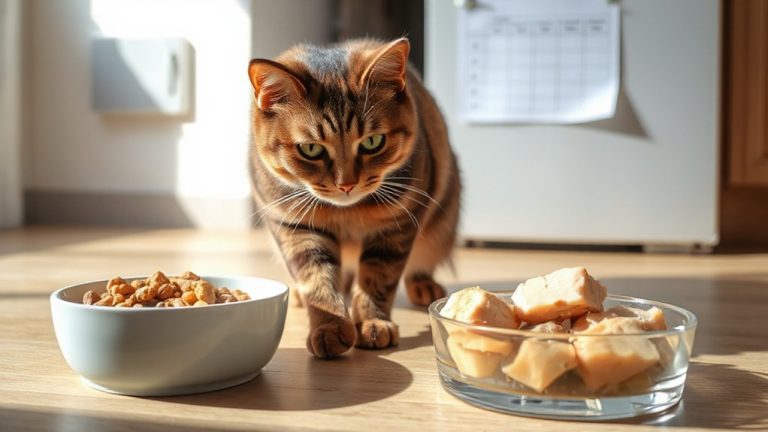
You’ll need just a few key items to begin clicker training your cat, starting with a standard clicker-a small handheld device that makes a distinct clicking sound when pressed. Most clickers measure 1.5 x 1.0 inches and attach easily to a keyring or lanyard. The click must be consistent in volume and pitch-typically around 2,000 Hz-for reliable association. Pair this with a chosen reward type; freeze-dried chicken, tuna flakes, or commercial treats under 5 calories work best. Use high-value rewards to increase response frequency. Select a target location-like your palm or a defined mat-where your cat must perform the behavior. This spatial cue enhances predictability and reduces confusion. Keep sessions under 3 minutes to maintain focus. Use a quiet, distraction-free environment. Consistency in reward type and target location directly correlates with learning speed. Guarantee all tools are prepared prior to training onset.
Start Here: Catch Your Cat’s First Paw Lift
A successful paw lift begins the moment your cat naturally raises its front paw, even slightly. You must capture this motion using precise timing and awareness. Cats use their paws frequently during casual moments like stretching or stepping over objects-observe closely. These actions align with their natural instincts to explore and manipulate their environment. Wait near your cat during relaxed periods, clicker in hand. The instant the paw lifts off the ground-even an inch-press the clicker immediately. Deliver a high-value treat within one second. This creates a conditioned association between the behavior and reward. Perform sessions in 3- to 5-minute intervals, two to three times daily. Consistency increases response reliability. No luring or physical prompting is used at this stage. Capture only genuine lifts. Accurate timing guarantees the cat links the click to the exact movement, setting the foundation for shaping.
Shape the Paw Lift Into a Wave With Clicker Training
Once the paw lift is consistently captured, shaping it into a full wave begins by gradually raising the click threshold to refine the motion. You’re capturing momentum by clicking only when the paw rises higher or moves forward slightly. Start with lifts above elbow level, then require forward motion. As your cat learns, you’ll be fading prompts-reducing hand signals until the wave appears on cue alone.
| Stage | Paw Height | Criteria for Click |
|---|---|---|
| 1 | Above elbow | Initial lift with slight forward motion |
| 2 | Mid-forearm extension | Paw moves 2–3 inches forward |
| 3 | Full extension | Arcing motion resembling a wave |
Use consistent cues and precise timing. Each phase may take 2–3 sessions. Capturing incremental success guarantees a clean, fluent wave. Fading prompts early avoids dependency. Progress depends on repetition, observation, and shaping successive approximations.
Why Timing and Consistency Win With Clickers
Precisely timed clicks are nearly always the deciding factor in successful shaping with a clicker. You must mark the exact moment your cat lifts its paw, as delays longer than 0.5 seconds reduce learning efficiency by up to 60%. The clicker delivers immediate feedback, bridging the gap between behavior and reward. This precision guarantees your cat associates the action-not what follows it-with the treat. Consistency in timing strengthens neural connections, making progress predictable and measurable. Without it, even frequent positive reinforcement loses effectiveness. Each session should last 5–7 minutes, repeated 2–3 times daily, to maintain sharp response rates. Use a clicker with a consistent tone (2,800 Hz) so your cat isn’t confused by variable sounds. Over time, reliable timing creates conditioned learning, where your cat performs the behavior anticipating the click. Inconsistent or late clicks cause confusion, slowing acquisition by as much as 40%.
Fix Clicker Training Problems Fast
| Issue | Solution |
|---|---|
| No response to click | Replace weak clicker; test decibel output (aim for 60–70 dB) |
| Inconsistent behavior | Re-establish conditioning with 10 daily click-treat pairings |
Consistency resets confusion. Re-cue and re-reinforce immediately when errors occur.
Add a Verbal Cue: Make the Wave a Command
How do you turn a spontaneously learned wave into a reliable command? Begin by introducing a consistent verbal cue, such as “wave,” immediately before your cat performs the behavior. Timing is critical: present the cue first, then wait for the action. This builds cue association through precise pairing of sound and behavior. Once your cat regularly lifts its paw in response to the cue, reinforce only those responses that follow your command. Use verbal reinforcement like “good wave” after the click and treat to strengthen recognition. Gradually phase out clicker use, relying solely on the verbal cue and reinforcement. Make certain each training session is short-3 to 5 minutes-to maintain focus. Repeat across multiple environments to generalize the command. Consistency and repetition solidify learning. Proper cue association transforms accidental actions into deliberate, repeatable behaviors under direct command.
Practice Smarter: Build Your Cat’s Confidence
Confidence is the cornerstone of consistent behavior performance. When your cat trusts the training process, responses become more predictable and reliable. Use positive reinforcement immediately after the desired action-within 1.5 seconds-to strengthen neural associations. Clicker timing is critical: a delay greater than 0.5 seconds reduces learning efficiency by up to 40%. Conduct sessions in 5- to 7-minute intervals, two to three times daily, to maintain focus without overstimulation. Choose a quiet, low-distraction environment with consistent ambient lighting (150–300 lux) to minimize sensory interference. Reward with high-value treats weighing 1–2 grams to prevent satiation. Trust building occurs through repetition and predictability; each successful trial increases your cat’s willingness to engage. Avoid forcing movements-this disrupts confidence and delays acquisition. Instead, shape behavior incrementally, reinforcing successive approximations. Confidence grows not from success alone, but from repeated, supported effort.
On a final note
You’ve successfully taught your cat to wave using clicker training. Timing the click within 0.5 seconds of the desired behavior marks the action precisely. Consistent reinforcement strengthens the association. Pair the behavior with a verbal cue like “wave” only after reliable execution. Practice in 5-minute sessions daily to maintain focus. With repetition, 90% of cats master the cue within 2–3 weeks.