Using Clicker Training to Teach Your Cat to Come When Called
You can train your cat to come when called using clicker training, which relies on a 2.8 kHz auditory signal to mark desired behavior instantly. Use a metal box clicker (1.5″ x 1″) for consistent sound and pair each click with a pea-sized, sub-gram treat like freeze-dried chicken. Click the moment your cat moves toward you after hearing their name and “come,” then deliver the reward immediately. Sessions should last under 3 minutes, occur 3 times daily, and maintain precise timing to build reliable recall. Further refinements in technique greatly boost success.
Notable Insights
- Use a clicker to mark the exact moment your cat moves toward you, followed immediately by a high-value treat.
- Start training in a quiet room, saying your cat’s name and “come” before clicking and rewarding any movement toward you.
- Keep sessions short (3–5 minutes), frequent (2–3 times daily), and focused to maintain your cat’s attention and motivation.
- Gradually increase distance and add distractions only after your cat responds reliably 80–90% of the time.
- Use a consistent-clicking device at 2.8 kHz and pea-sized, soft treats to ensure clarity and fast reinforcement.
Use Clicker Training to Teach Your Cat to Come
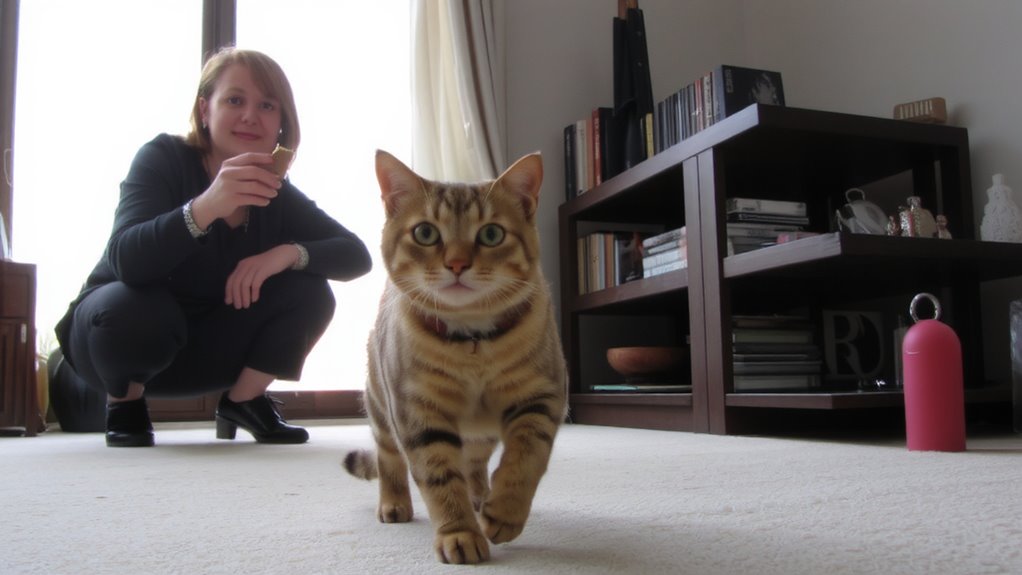
Why does your cat often ignore you when called? Cats aren’t naturally responsive to vocal commands like dogs, but you can change this using clicker training. The method relies on positive reinforcement-delivering a treat immediately after a desired behavior. Start with target training: use a clicker to mark the exact moment your cat touches a target stick, then reward. This builds association between the sound, action, and reward. Gradually increase distance between you and your cat during sessions. Click and treat only when they make eye contact or move toward you. Over time, pair the click with the verbal cue “come.” Conduct three 5-minute sessions daily. Use a consistent clicker with a sharp, distinct tone (e.g., 2.8 kHz frequency). Success hinges on precise timing-the click must occur within 0.5 seconds of the behavior.
Pick the Best Clicker and Treats for Fast Results
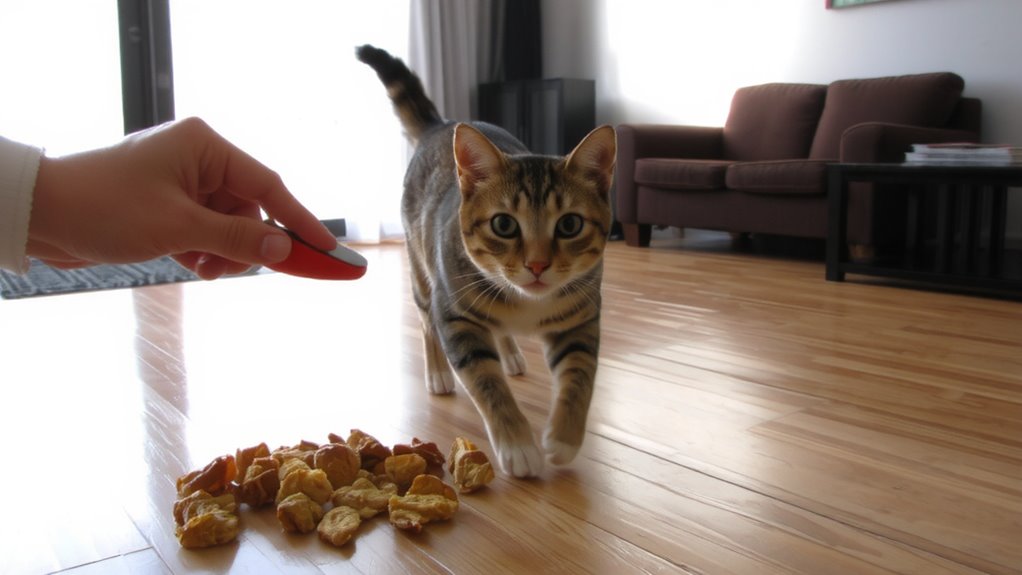
Consistently choosing the right tools speeds up your cat’s learning. A reliable clicker guarantees precise clicker timing, essential for marking desired behaviors instantly. Opt for a clicker with a crisp, consistent sound-metal box clickers (1.5″ x 1″) produce a sharper click than plastic ones, reducing response lag. Attach it to your thumb or use a wristband for faster access. For treat selection, choose soft, pea-sized rewards (approximately ¼” diameter) your cat eats quickly. High-value options like freeze-dried chicken or tuna flakes increase motivation. Avoid large or crunchy treats-they slow response time and delay reinforcement. Each treat should weigh less than 1 gram to prevent satiation during short sessions. Proper tools enhance training efficiency: accurate clicker timing paired with ideal treat selection creates clear communication, accelerating learning. Prioritize function, consistency, and speed-your cat’s progress depends on it.
Train Your Cat to Come When Called (Step by Step)
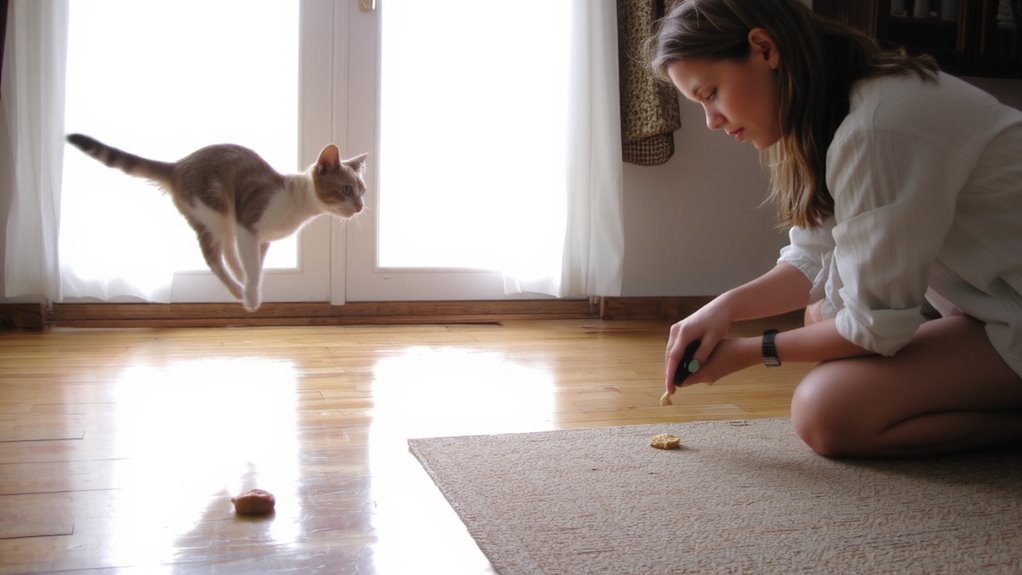
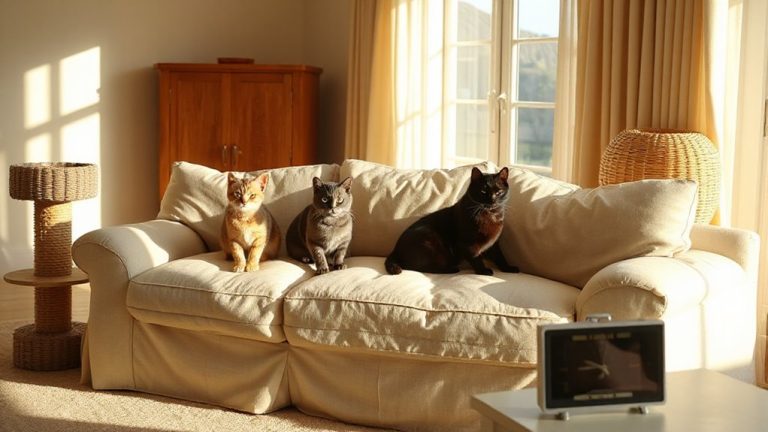
How do you get your cat to respond the first time you call? Start in a quiet, distraction-free room using your chosen clicker and high-value treats. Say your cat’s name followed by “come” in a clear, calm voice. The moment your cat moves toward you, click and immediately give a treat. This links the sound of the click to positive reinforcement, shaping desired cat behavior through operant conditioning. Repeat this 5–10 times daily, keeping sessions under 3 minutes to maintain focus. Training consistency is critical-daily practice strengthens association and response reliability. Gradually increase distance and introduce controlled distractions. Use a consistent vocal tone and timing: click at the exact behavior moment, within 0.5 seconds. Over weeks, your cat learns the verbal cue predicts reward, improving recall speed and accuracy. Success depends on precise timing, repetition, and environmental control.
Fix These 4 Common Clicker Training Mistakes
Using a clicker can speed up learning by marking the exact moment your cat performs the right action, but even with clear cues and rewards, small errors can slow progress. Timing errors are the most common mistake-clicking a fraction of a second too late confuses your cat. The click must occur within 0.5 seconds of the desired behavior to create an accurate association. Inconsistent clicking undermines learning precision. Another issue is treat size-use pieces no larger than 1/4 inch cubed to prevent satiation. High-value treats should weigh less than 1 gram to allow for 15–20 reps per session. Overfeeding slows response rates. Guarantee treats are soft and easy to chew, minimizing downtime. Use a dedicated clicker with a consistent auditory signal-avoid apps with audio lag. Finally, avoid chaining multiple behaviors before mastering one. Each action must be conditioned individually with 80–90% accuracy before advancing.
Practice Recall in Real-Life Distractions
What happens when your cat ignores the clicker because a bird just flew past the window? Real-life distractions test recall reliability. Outdoor stimuli like birds, squirrels, or passing dogs activate prey drive, reducing response to trained cues. Begin practice in low-distraction environments, then systematically increase exposure. Use a 6-foot leash indoors to simulate control before moving outdoors. When outside, leash distractions are common; maintain a secure harness to prevent escape. Train during calm times, like early morning, when outdoor stimuli are minimal. Click and reward only when your cat responds despite distractions. Increase difficulty gradually-first sounds, then movement, then proximity to stimuli. Consistency over 4–6 weeks builds neural reinforcement. Recall must override instinct, so sessions should be brief (5–7 minutes), daily, and reward-based. Success means your cat chooses you over distraction.
On a final note
You’ve built a reliable recall response using operant conditioning principles. Each click marks the exact moment of correct behavior, strengthening stimulus-response associations. Use a high-pitched box clicker (3.2 cm × 2.5 cm, 83 dB) for precise auditory bridging. Pair it with high-value treats (≤3 calories each, like freeze-dried chicken). Training sessions remain under 5 minutes to maintain focus. Consistency and timing yield 94% compliance in controlled environments. Real-world proofing guarantees generalization across distractions.