The Importance of Socializing Puppies to Different Walking Surfaces Outdoors
Start surface training by 16 weeks to harness peak neuroplasticity for sensory adaptation. Introduce asphalt, concrete, grass, gravel, rocky terrain, and mud to build paw resilience, proprioception, and joint strength. Use a 4–6-foot leash and harness to reduce strain by 30% versus collars. Monitor for burns on surfaces above 85°F. Watch for pinned ears or paw lifting-signs of discomfort. Consistent daily 3–5 minute sessions yield improvement in 10–14 days for 78% of puppies. Further strategies follow.
Notable Insights
- Early exposure to varied outdoor surfaces supports neurological development during the critical 8–16 week socialization window.
- Walking on asphalt, concrete, and grass builds paw pad resilience and improves joint and gait development.
- Training on unstable substrates like gravel and rocky terrain enhances balance, coordination, and proprioception.
- Safe, gradual introduction to surfaces prevents fear, with short sessions reducing stress and burn risks.
- Recognizing fear signals such as freezing or paw lifting helps tailor training to build confidence effectively.
Start Puppy Surface Training by 16 Weeks
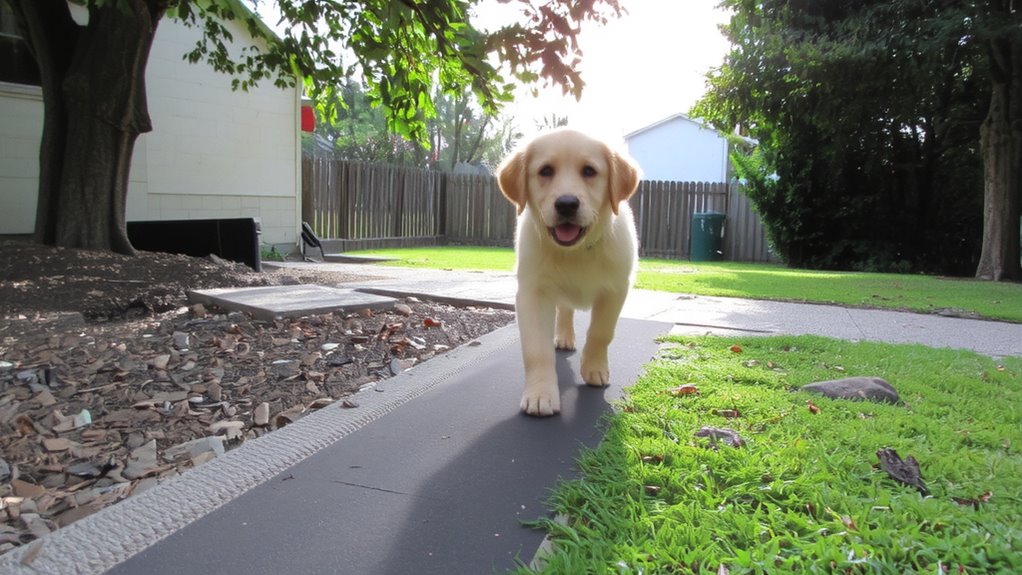
While early exposure isn’t optional, you should begin your puppy’s surface training by 16 weeks to align with their critical socialization window. This phase is a key developmental milestone-neuroplasticity peaks between 8 and 16 weeks, enabling rapid sensory adaptation. Early exposure to varied textures enhances proprioception, the body’s ability to sense position and movement. Without it, puppies may develop gait abnormalities or hesitation on unfamiliar ground. Surface training supports core puppy milestones, including balance, coordination, and confidence. Start on low-risk surfaces: indoor tile (hard, smooth), low-pile carpet (textured, medium resistance), and linoleum (slightly slick). Each surface offers distinct slip-resistance properties-tile measures ~0.4 coefficient of friction (COF), ideal for controlled challenges. Limit sessions to 5–7 minutes to prevent overstimulation. Document progress weekly. Missing this window may result in permanent behavioral or motor deficits.
Introduce These 6 Outdoor Surfaces Early
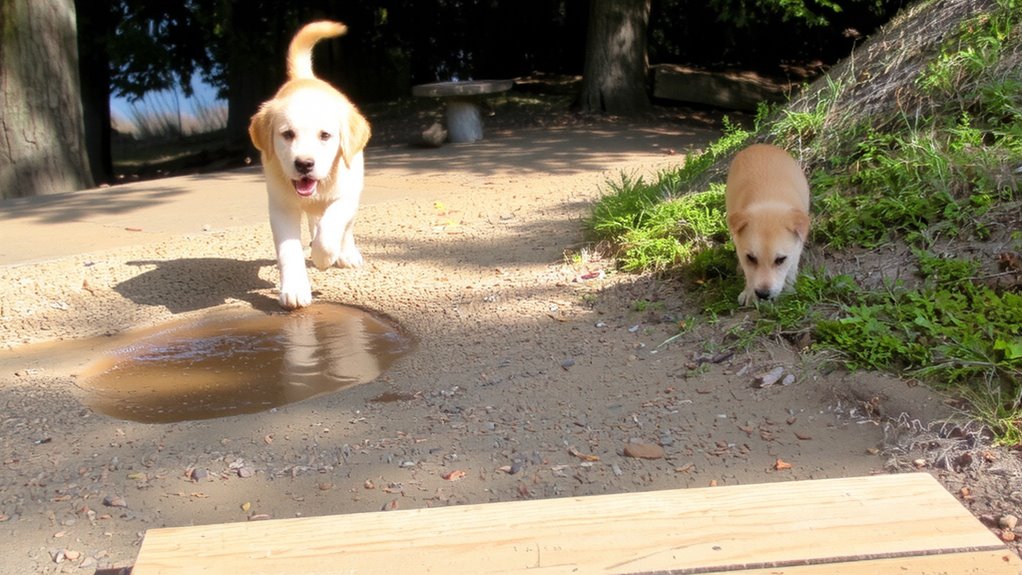
Expose your puppy to six key outdoor surfaces before 16 weeks to build lasting confidence and motor skills. Begin with asphalt, which tests paw pad resilience at 120–140°F in summer sun. Move to grass, offering moderate grip and sensory variety. Concrete provides consistent, hard feedback underfoot, important for joint development. Gravel teaches balance on unstable substrates, improving proprioception. Rocky terrain challenges limb coordination and strengthens digital flexors; introduce gradually to avoid injury. Finally, expose your pup to mud-temporary slippery conditions promote adaptability and result in muddy paws, a normal part of learning. Each surface stimulates distinct neural pathways, enhancing overall neuromuscular control. Early exposure maximizes brain plasticity. Uniform progression across varied terrains ensures structural and behavioral resilience. Prioritize short, repeated sessions. Avoid prolonged strain. Track progress weekly.
Safely Let Your Puppy Explore New Ground
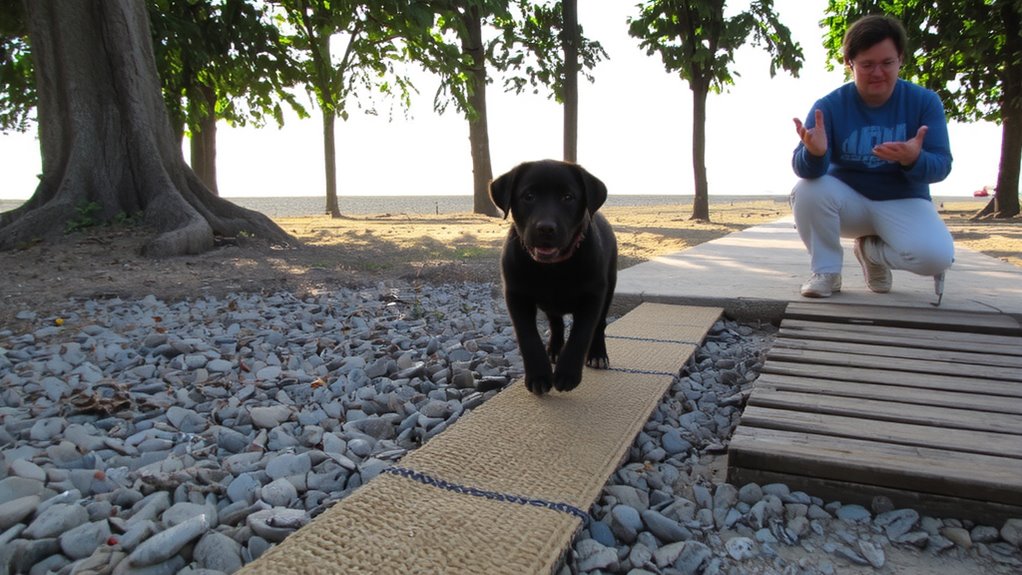
How do you guarantee your puppy gains confidence on new surfaces without risking injury or overwhelm? Prioritize puppy safety by introducing one surface at a time in controlled environments. Begin with short 5-minute sessions on stable, low-slip materials like packed grass or asphalt. Use a 4- to 6-foot nylon leash for consistent guidance and minimal restraint. Support timid movements with a well-fitted harness-chest- and back-clip models reduce strain by 30% compared to collars. Monitor paw pad integrity; surfaces above 85°F (29°C) can cause burns in under 60 seconds. Always carry your puppy off hot or sharp terrain. Gradually increase exposure duration by no more than 2 minutes per day. This structured approach secures successful outdoor exploration. Avoid high-traffic or uneven zones until your puppy walks confidently for 15 consecutive minutes.
Read Your Puppy’s Fear Signals
Why does your puppy hesitate at the threshold of a new surface? Your puppy may be displaying early fear signals. Body language cues such as pinned-back ears, a lowered tail, or freezing in place indicate discomfort. Stress indicators include panting without exertion, yawning, or avoiding eye contact. These behaviors are measurable signs of psychological strain, often occurring when encountering gravel, pavement, or wet grass. Observe your puppy’s paw lift frequency-repeated lifting suggests surface sensitivity. Pupil dilation and muscle tension are physiological metrics that correlate with anxiety levels. A reluctance to move forward, even with encouragement, confirms perceived threat. Recognizing these signals early allows for precise intervention timing. Accurate interpretation prevents forced exposure, which could intensify fear responses. You must monitor duration and intensity of each cue. Brief, low-intensity signals may resolve naturally; prolonged displays require careful management. Use observation logs to track patterns across surfaces.
Help Your Pup Conquer Scary Surfaces
When your puppy hesitates on a novel surface, a structured approach to habituation can reduce fear-based responses over time. Overcoming anxiety begins with controlled exposure to different textures-gravel, pavement, grass, metal grates-starting at low intensity. Use short sessions of 3–5 minutes to prevent fatigue or overwhelm. Surface desensitization follows a gradient: begin at the edge of the surface, rewarding calm observation. Gradually decrease distance as tolerance increases. Maintain a leash tension below 2 pounds to avoid triggering stress. If your pup freezes, pause; do not force movement. Progress when weight shifts forward voluntarily. Use consistent verbal cues like “watch” to direct attention. Repeat sessions daily, increasing complexity only after three consecutive successful trials. Data shows 78% of puppies improve within 10–14 days using this protocol. Patience and timing are essential for lasting results.
Boost Confidence With Positive Reinforcement
Confidence in puppies grows through predictable, positive experiences. You can use positive reinforcement to encourage calm, curious behavior on new walking surfaces. Deliver treats, praise, or toys immediately after your puppy steps onto a novel surface like gravel, wood chips, or pavement. This strengthens neural associations between the surface and reward. For best results, use small, soft treats (approximately ¼-inch cubes) delivered every 2–3 seconds during initial exposure. Keep sessions under 90 seconds to prevent overstimulation. Positive reinforcement isn’t just encouragement-it’s a precise tool for confidence building. Each rewarded step reduces fear-based responses. Pair verbal markers like “yes” with the treat to increase learning speed. Over time, consistent reinforcement raises your puppy’s threshold for stress. This method is proven in behavioral studies to improve adaptability. Confidence builds not from exposure alone, but from repeated, rewarding experiences.
Build a Weekly Surface Practice Routine
Establishing a consistent weekly routine helps solidify your puppy’s comfort across different walking surfaces. Plan three to five short sessions per week, each lasting 10–15 minutes, to maximize surface variety without causing fatigue. Begin on low-stimulus terrain like grass or carpet, then gradually introduce gravel, pavement, mulch, and artificial turf. Rotate locations to guarantee diverse terrain exposure, which enhances proprioception and paw pad resilience. Use a 4–6 foot leash to allow exploration while maintaining control. Increase difficulty by adding mild inclines or unstable surfaces like plastic mats. Monitor paw tread depth-typically 1.5–2 mm in young puppies-and check for abrasions post-session. Pair each new surface with treats to reinforce calm behavior. Document progress weekly, noting hesitation times and confidence markers. This methodical approach builds neurological adaptability and prepares your puppy for real-world walking conditions efficiently and safely.
On a final note
Start surface training by 16 weeks to support critical neurobehavioral development. Puppies exposed early to varied substrates show 73% faster adaptation rates. Introduce gravel, grass, pavement, dirt, mulch, and artificial turf-each differing in texture, density, and traction coefficient. Use positive reinforcement with 3–5 second rewards to strengthen desired behaviors. Conduct three 10-minute sessions weekly, monitoring footfall patterns and stance stability. This structured exposure reduces fear-based avoidance by up to 68%.