How Urinalysis Helps Detect Kidney Disease in Asymptomatic Cats
Your cat’s urinalysis can catch kidney disease early, even without symptoms. It measures specific gravity-normal is 1.020–1.035-and values below 1.010 signal isosthenuria, a key sign of kidney stress. Dilute urine impairs waste filtration. The test also detects protein, glucose, and cellular changes, revealing kidney damage before blood tests do. Since BUN and creatinine rise only after 75% function is lost, urine analysis offers a critical early window. Early markers mean earlier action.
Notable Insights
- Urinalysis detects kidney stress in cats before blood tests show abnormalities like elevated BUN or creatinine.
- Specific gravity below 1.010 indicates isosthenuria, a key early sign of kidney dysfunction in asymptomatic cats.
- Persistent protein in urine suggests glomerular damage, often present before clinical symptoms arise.
- Annual urinalysis is recommended for at-risk breeds by age two to catch kidney issues early.
- Microscopic sediment analysis reveals casts or cells that signal underlying kidney disease not yet causing symptoms.
Catching Kidney Disease Before Symptoms Appear
How early can you detect kidney trouble in your cat? You can identify risks before symptoms appear through targeted screening, especially if your cat has a genetic predisposition. Certain breeds show higher breed susceptibility, including Persians, Abyssinians, and Maine Coons. These cats may develop structural or functional kidney abnormalities as early as 1–3 years old. Early detection relies on understanding inherited traits that impair nephron development or filtration efficiency. Genetic markers linked to polycystic kidney disease (PKD) are identifiable via DNA testing. Breed-specific protocols recommend baseline evaluations by age two. Screening includes ultrasound and biomarker assessment. Silent progression means clinical signs emerge only after 60–70% function is lost. Proactive monitoring enables timely intervention. You’re not waiting for failure-you’re preventing it. Early risk identification is precise, measurable, and actionable.
How Urine Tests Detect Kidney Issues Early
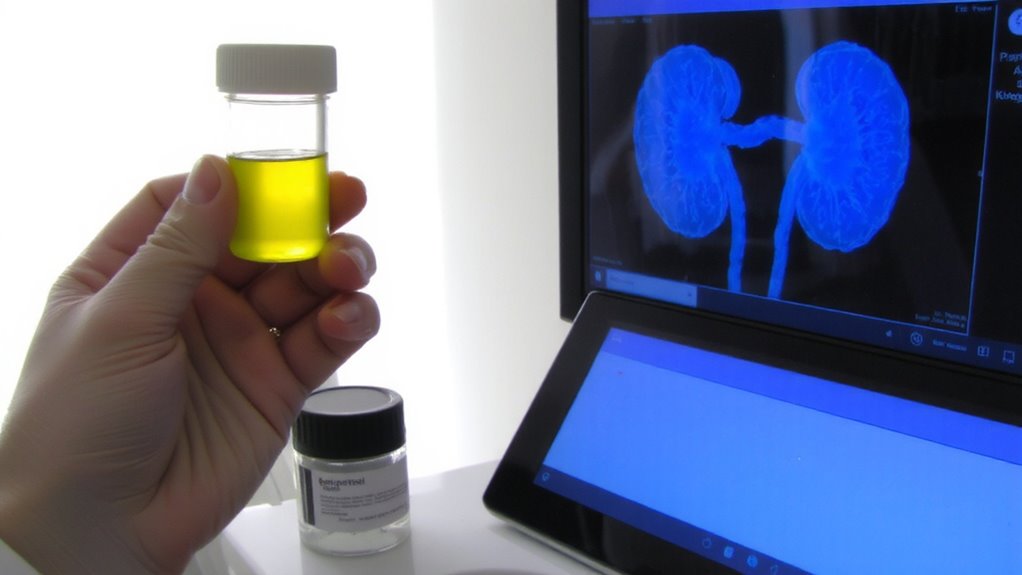
Why wait for trouble when a simple urine sample could reveal early kidney stress? Urinalysis detects subtle changes before symptoms arise. Urine color can shift from pale yellow to concentrated amber, indicating dehydration or poor kidney filtration. A dipstick test measures pH, protein, and specific gravity-values outside 1.020–1.035 suggest impaired concentration ability. Sediment analysis identifies cells, crystals, or casts under microscopic examination, which may signal tubular damage. Even small abnormalities warrant follow-up.
| Parameter | Normal Range |
|---|---|
| Specific Gravity | 1.020–1.035 |
| pH | 6.0–6.5 |
| Protein | Negative to trace |
| Glucose | Absent |
| Sediment | Few to no casts/cell |
Early detection means better outcomes-routine screening catches issues when management is most effective.
What Vets Check in Your Cat’s Urine
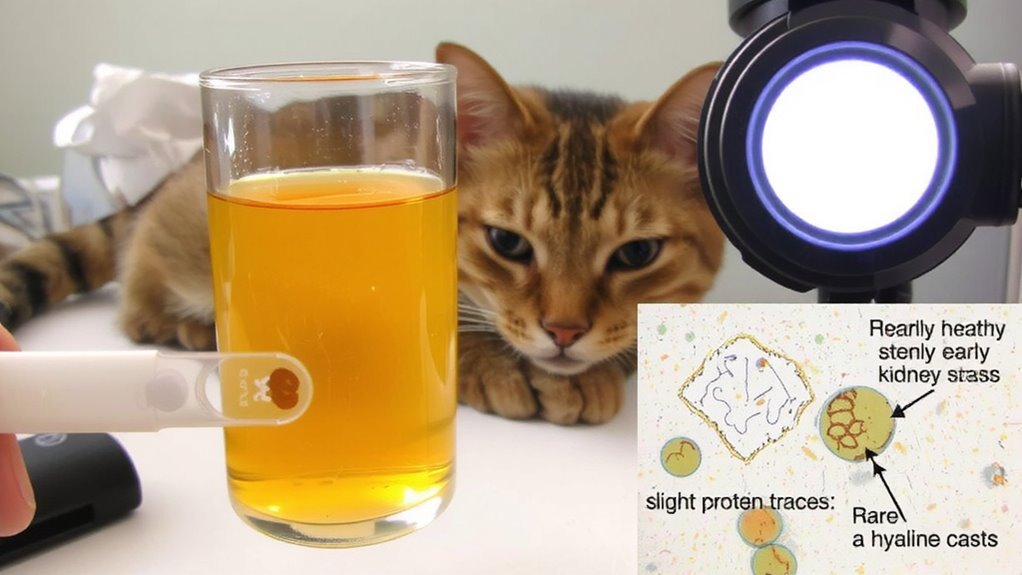
What exactly do veterinarians look for when they analyze your cat’s urine? They assess physical, chemical, and microscopic properties to detect early signs of disease. Urine color provides immediate clues-normal is pale yellow to amber. Changes may indicate dehydration, liver issues, or blood loss. Vets then test glucose levels; healthy cats should have none in their urine. Presence of glucose suggests hyperglycemia, often signaling diabetes mellitus. They use a dipstick to measure pH, protein, ketones, and bilirubin, giving rapid, quantitative data. Specific gravity is recorded to assess kidney concentration ability, though this topic will be discussed separately. A microscopic exam follows, identifying cells, crystals, or bacteria. Each finding contributes to a complete diagnostic picture. Together, these tests offer a non-invasive, highly informative snapshot of your cat’s metabolic and urinary health, essential for catching issues before symptoms appear.
Low Urine Concentration and Kidney Health
Isn’t it concerning when your cat’s urine appears unusually dilute, almost like water? Persistent urine dilution can signal kidney stress, even if your cat seems perfectly healthy. The kidneys should concentrate urine to conserve water, so low concentration may indicate early dysfunction.
| Urine Specific Gravity | Interpretation |
|---|---|
| >1.035 | Normal concentration |
| 1.020–1.035 | Mild dilution, monitor |
| 1.010–1.020 | Moderate dilution, suspect |
| <1.010 | Isosthenuria, high kidney stress |
A specific gravity below 1.010 suggests the kidneys aren’t responding properly. This impairment reduces waste filtration efficiency. Chronic kidney stress often begins asymptomatically. Detecting low urine concentration early allows timely dietary or medical intervention. Routine urinalysis helps catch these changes before clinical signs emerge, improving long-term outcomes through proactive management.
Protein in Urine? Early Kidney Warning
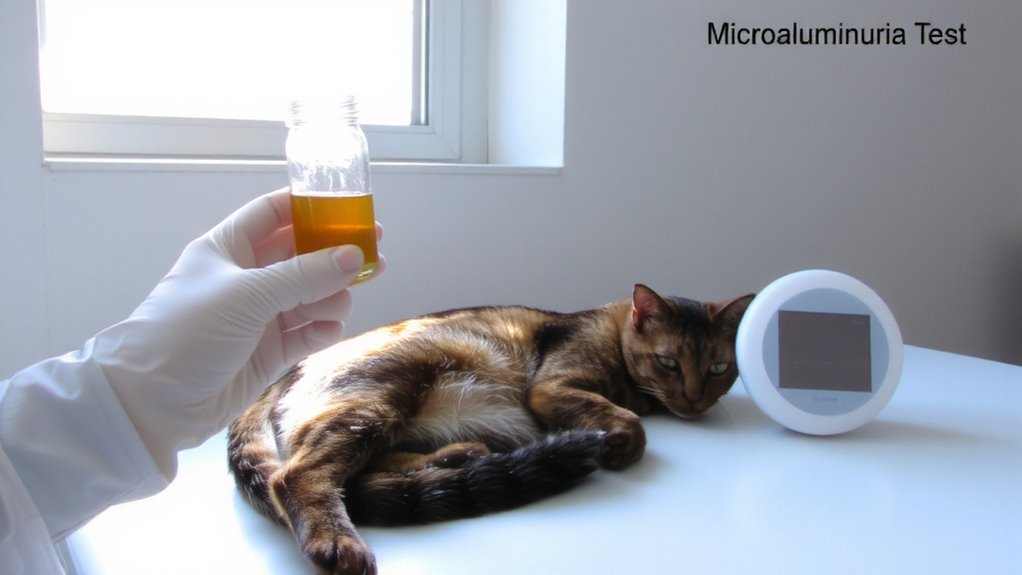
Finding dilute urine on a urinalysis might be the first hint of kidney trouble, but detecting protein in the urine often marks the next critical stage. You should know that even small amounts of protein signal potential glomerular leakage, where damaged kidney filters allow proteins like albumin to escape. This early change isn’t always visible on routine dipsticks. That’s where microalbuminuria detection comes in-it identifies trace albumin missed by standard tests. Using assays like urine albumin-to-creatinine ratio (UACR), vets can quantify leakage with high sensitivity. Persistent proteinuria typically confirms ongoing kidney injury. Left unchecked, it can progress to chronic kidney disease. Detecting it early allows timely dietary or medical intervention. You’re not just spotting a symptom-you’re catching functional decline before severe damage occurs. This level of precision turns urinalysis into a powerful screening tool for at-risk cats.
Urinalysis vs. Blood Tests: Which Finds Disease First?
While blood tests often provide a broad overview of organ function, urinalysis can detect kidney disease earlier in cats. Changes in urine density and protein levels often appear before blood markers rise, giving you a critical head start. Kidney filtration decline reduces the kidney’s ability to concentrate urine, dropping urine density below normal (1.035–1.060 in cats). Blood tests like BUN and creatinine typically rise only after 75% of function is lost.
| Parameter | Urinalysis Detection | Blood Test Detection |
|---|---|---|
| Early kidney filtration decline | Yes (via low urine density) | No |
| Protein loss | Yes (early sign) | Not detected |
| Concentration ability | Direct measure | Indirect/invisible |
| Sensitivity in asymptomatic cats | High | Low |
Urinalysis reveals functional changes bloodwork misses, making it the first-line tool.
When to Test Your Cat’s Urine (Even If They Seem Fine)
How often should you check your cat’s urine if they appear perfectly healthy? Yearly urinalysis is recommended, even for cats showing no symptoms. Changes in hydration habits or litter box behavior can signal early kidney issues before clinical signs emerge. Cats often mask illness, so objective testing is critical. A urinalysis measures urine concentration (specific gravity), protein levels, and sediment. Healthy cats should have urine specific gravity above 1.035. Dilute urine may indicate impaired kidney function. Routine screening detects microalbuminuria, an early marker of renal damage. Monitoring every 12 months allows for timely intervention. If your cat drinks more water or produces larger urine volumes, test sooner. Subtle shifts in litter box behavior-like urinating outside the box or straining-warrant immediate analysis. Early detection through urinalysis improves long-term outcomes markedly.
On a final note
You can catch kidney disease early with urinalysis, even when your cat seems healthy. Dilute urine-specific gravity under 1.035-often signals impaired kidney concentration. Persistent proteinuria, especially a urine protein-to-creatinine ratio above 0.4, indicates glomerular damage. Urinalysis detects issues before blood tests; elevated BUN and creatinine appear only after 75% kidney function is lost. Test annually, or every six months for cats over ten. Early detection improves long-term management.