How to Teach Your Cat to Play Fetch Using Motivational Toys and Rewards
You can teach your cat fetch by tapping into their natural prey drive with the right toys and rewards. Use a 1.5–2 inch rubber ball or feather wand to mimic small, moving prey. Keep sessions short-30 to 60 seconds-and offer a high-value treat, like 0.2g of freeze-dried chicken, within 1–2 seconds of retrieval. Use a consistent command like “fetch” and increase throw distance by 1–2 feet weekly. Add obstacles or varied toys to maintain engagement and build skills progressively. Further refinements in timing and toy selection reveal deeper levels of feline responsiveness.
Notable Insights
- Use lightweight, 1.5–2 inch rubber balls or fleece mice to match your cat’s natural prey preferences and encourage easy retrieval.
- Keep fetch sessions short (30–60 seconds) with 5–10 throws daily to align with your cat’s predatory focus and attention span.
- Immediately reward successful retrieval with a high-value treat (0.1–0.3g) within 1–2 seconds to strengthen associative learning.
- Introduce one obstacle at a time, like low barriers or short tunnels, to gradually increase challenge without overwhelming your cat.
- Pair each throw with a consistent verbal cue like “fetch” or a clicker to build clear communication and reinforce desired behavior.
Understand Your Cat’s Hunting Instincts
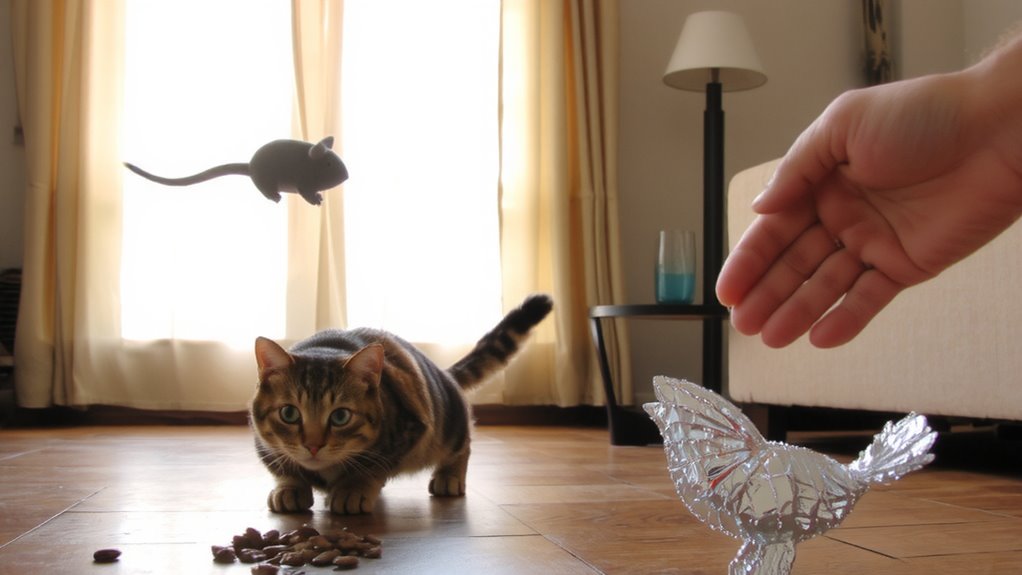
Hunting is hardwired into your cat’s DNA, a remnant of evolutionary survival mechanisms honed over thousands of years. This instinct shapes much of your cat’s behavior, particularly their prey drive. Prey drive refers to the intensity with which a cat pursues, captures, and “kills” moving targets. It’s governed by sensory triggers: rapid motion, small size, and unpredictable trajectories. Cats respond most to objects 1–3 inches in diameter, mimicking natural prey like mice or birds. Their visual system detects motion 10 times faster than humans, making flickering or darting movements highly stimulating. Elevated prey drive manifests in pouncing, stalking, and biting-behaviors not signs of aggression but survival programming. Understanding this drive lets you channel it positively. You’re not creating new behavior; you’re redirecting existing neural pathways. Recognizing these patterns improves training efficacy, especially in fetch, where mimicry of hunting sequences is essential.
Pick the Best Toys for Cat Fetch
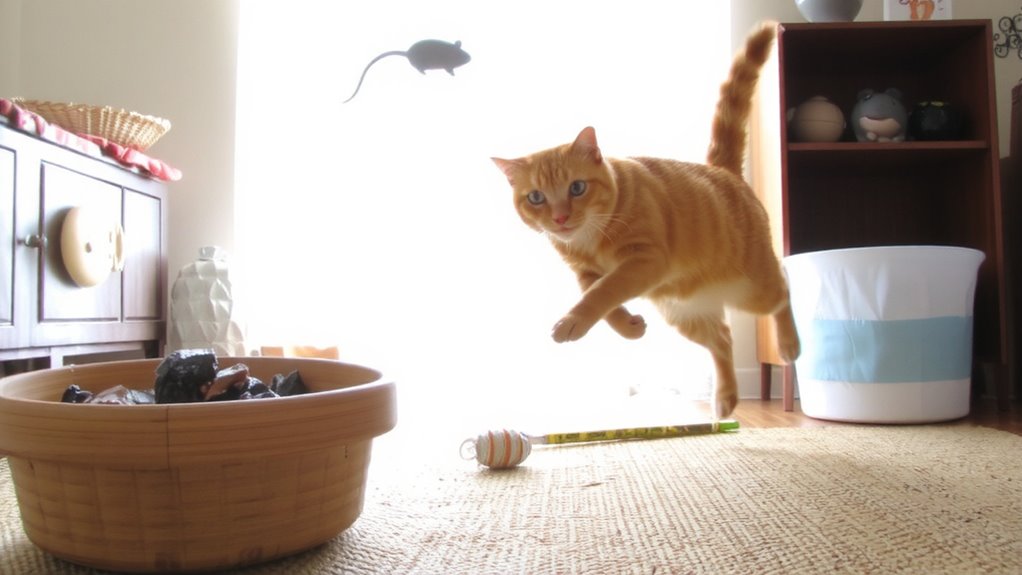
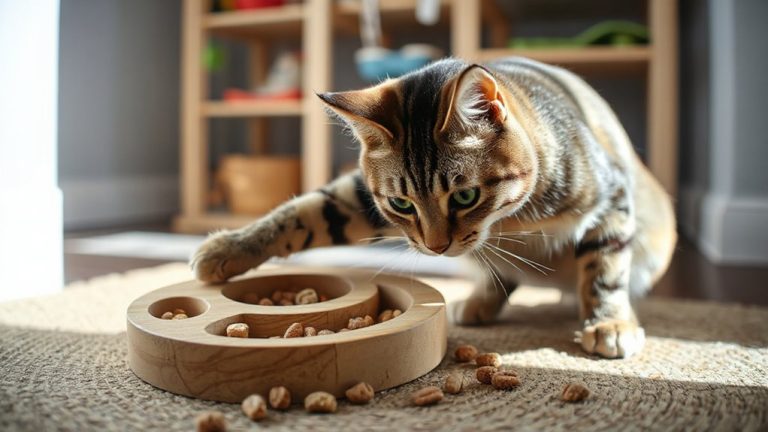
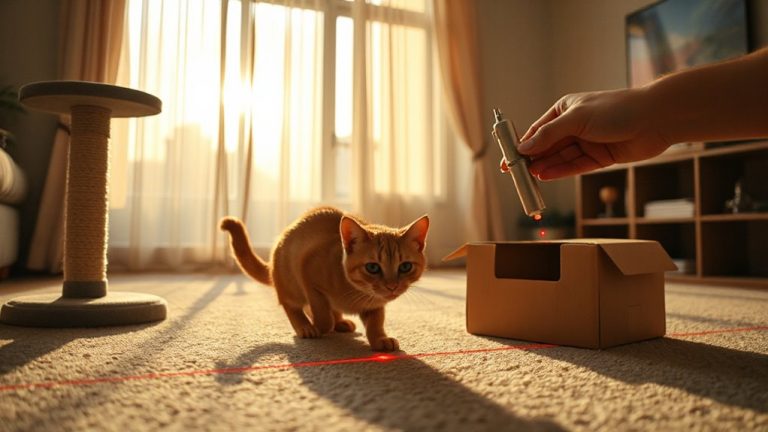
You’re already aware your cat’s behaviors stem from deep-rooted instincts, not random impulses. Choosing the right fetch toy means aligning with those predatory drives. Feather wands with articulated quills mimic fluttering prey, triggering high-intensity pursuit. Opt for models with 8–12 inch flexible rods and replaceable feather attachments for durability. Laser pointers elicit chasing but don’t satisfy the kill-catch-eat sequence-use them only as a precursor to tangible toys. For fetch, select lightweight rubber balls 1.5–2 inches in diameter, easily gripped in your cat’s jaws. Fleece mice with plastic beans inside provide audible rustling, simulating small mammal movement. Avoid strings or detachable parts that pose ingestion risks. High-contrast colors like red or blue boost visibility. Rotate toys weekly to prevent habituation. Effective fetch toys replicate natural prey size, sound, and motion-precision in design increases engagement and response reliability. Incorporating Top Cat Puzzle Toys can further stimulate your cat’s cognitive skills between fetch sessions.
Start With Quick Fetch Sessions
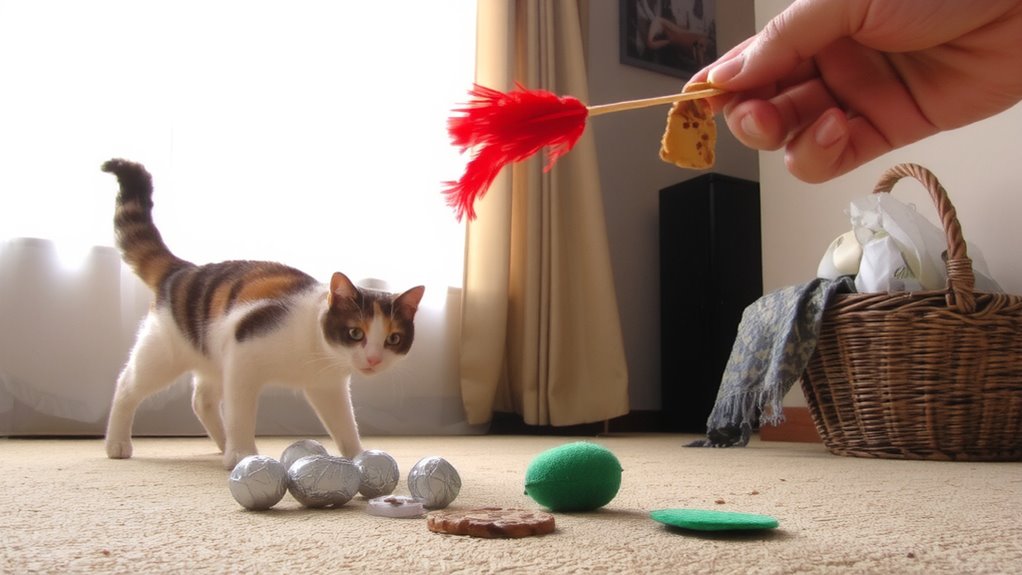
While your cat’s natural predatory sequence lasts just seconds, initial fetch sessions should mirror that brevity to maximize focus and minimize fatigue. Use short bursts of play, lasting 30 to 60 seconds, to align with your cat’s attention span and energy levels. These brief intervals prevent overstimulation and reinforce engagement without causing stress. Conduct two to three sessions daily, spaced several hours apart, to maintain novelty and mental sharpness. Pair each throw with consistent cues-use the same verbal command like “fetch” or a distinct clicker sound. Repetition of consistent cues builds associative learning, helping your cat link the command to the action. Limit each session to five to ten throws, ensuring high success probability. Over time, these structured routines condition reliable behavioral responses. Short bursts with precise timing increase retention and reduce habituation, making training efficient and sustainable over weeks.
Reward Immediately for Success
Timing your reward within one to two seconds of your cat retrieving the toy is critical for effective associative learning. Positive reinforcement works best when timing consistency is maintained, strengthening the link between action and reward. Delayed treats confuse cats, weakening learning efficacy. Deliver the reward immediately to solidify that fetch behavior leads to positive outcomes. Use high-value treats weighing 0.1–0.3 grams each to avoid satiation during short sessions.
| Treat Type | Weight (g) | Delivery Time (s) |
|---|---|---|
| Freeze-dried chicken | 0.2 | 1 |
| Tuna pellet | 0.1 | 1 |
| Soft gel treat | 0.3 | 2 |
Maintain timing consistency across all trials. This structured approach guarantees reliable conditioned response development. Use a clicker or consistent verbal marker if treats aren’t instantly deliverable. This technique mirrors operant conditioning protocols used in animal training research.
Make Fetch More Challenging Over Time
Gradually increasing the difficulty of fetch exercises enhances your cat’s cognitive engagement and physical performance. To increase difficulty, start by extending the throw distance by 1–2 feet weekly, up to 10 feet, using a consistent arc of 30–45 degrees for predictability. Replace low-bounce toys with medium-resilience rubber balls (diameter: 1.5–2 inches) to introduce controlled unpredictability. Then, add obstacles such as low cardboard barriers (4–6 inches high) or tunnels (length: 12–18 inches) to require navigation. Position obstacles 3–5 feet from the throw origin to maintain task feasibility. Use only one added challenge per session to isolate variables and monitor progress. Rotate obstacle configurations every three days to prevent habituation. Reinforce successful trials immediately with high-value rewards. These incremental adjustments improve problem-solving and motor coordination without inducing frustration. Maintain session length at 5–7 minutes to sustain focus and optimize learning retention.
Fix Common Fetch Training Problems
Why isn’t your cat returning the toy after a successful fetch? This often stems from ingrained chasing habits, where the thrill of the pursuit outweighs the return. Cats prioritize the hunt’s climax-the pounce-over delivery. To correct this, use toys that weigh 5–10 grams with soft, tossable materials like polyester fiberfill. Immediately reward with high-value treats (at least 3 kcal per piece) upon retrieval. If toy fixation occurs-where your cat hoards or refuses to release the object-introduce a second identical toy to distract and swap. Rotate fetch toys every 10–15 minutes to maintain novelty. Limit sessions to 5–7 minutes to prevent overstimulation. Use consistent verbal cues like “drop” paired with gentle pressure on the jaw. Reinforce desired behavior within 2 seconds to establish clear associations. Addressing these issues systematically guarantees sustained progress. Incorporating a best laser cat toy can also help redirect focus and enhance engagement during training transitions.
On a final note
You now understand how to harness your cat’s natural hunting drive for fetch training. Use lightweight toys, like 10–15 gram felt mice or rubber balls under 1.5 inches, to match feline strength. Reinforce success with immediate, high-value rewards-such as 1/4 teaspoon freeze-dried chicken. Short, consistent sessions of 3–5 minutes yield ideal engagement. Gradually increase difficulty using variable distance throws up to 6 feet, enhancing motor skill development and cognitive stimulation effectively over time.