How to Teach Your Cat to Follow a Laser Pointer Without Frustration
Use a Class II laser under 1 milliwatt to safely guide your cat’s focus without eye risk. Move the dot in 2–5 second bursts at ground level, mimicking real prey with quick stops and zigzags. Keep sessions under 10 minutes in a room lit to 50–100 lux, using carpet or matte surfaces to reduce glare. End each chase by guiding the dot to a small, high-value treat-like a 0.25-inch chicken cube-to complete the hunt. This method aligns with natural behavior and prevents frustration. More details on optimizing each step follow.
Notable Insights
- Use a low-power Class II laser under 1 milliwatt to ensure eye safety during play.
- Move the laser in short 2–5 second bursts with erratic changes to mimic real prey behavior.
- End each session by guiding the dot to a physical toy or treat for a satisfying capture.
- Conduct play in a dimly lit, uncluttered room with carpet or matte surfaces to reduce glare.
- Limit sessions to 5–10 minutes, offering a high-value treat within two seconds of stopping.
Why Laser Play Frustrates Cats (And How to Fix It)
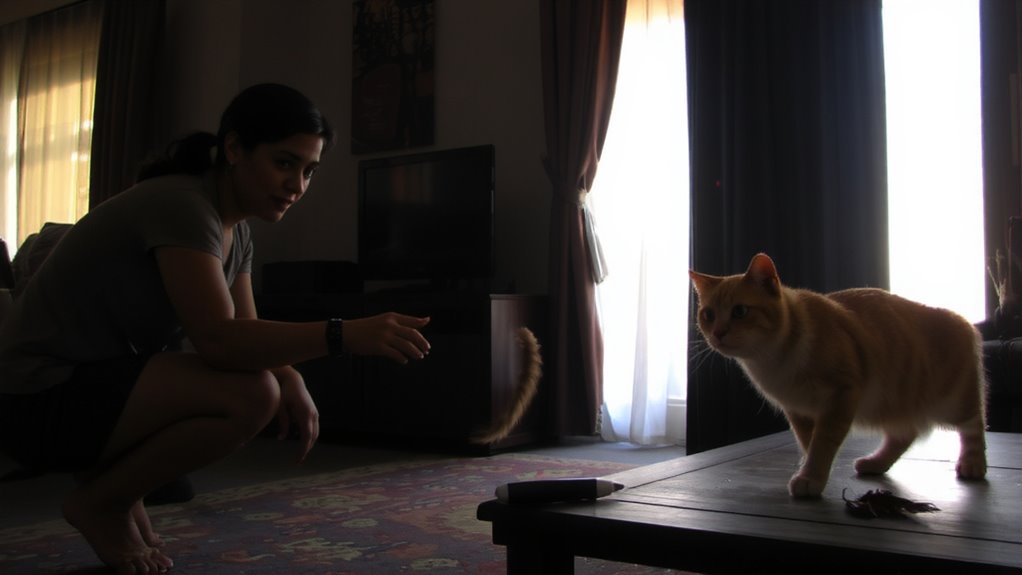
Why does your cat seem excited one moment and agitated the next during laser play? Rapid light reflection from surfaces disrupts target continuity, causing confusion. Cats have a short attention span, typically 10–15 seconds per stimulus, making sustained focus difficult. When the laser dot vanishes abruptly, your cat cannot complete the predation sequence, leading to frustration. The lack of a tangible catch violates natural hunting instincts. To fix this, align the laser’s movement with your cat’s tracking ability-move it slowly, then stop over a physical toy. This allows your cat to “capture” something real, satisfying the hunt. Use consistent, predictable paths rather than erratic motions. Limit sessions to 5–7 minutes, matching their peak attention span. End each session with a physical reward to create closure. This method reduces stress and supports behavioral stability by aligning play with natural feline cognitive patterns.
Choose a Cat-Safe Laser for Reward-Based Training
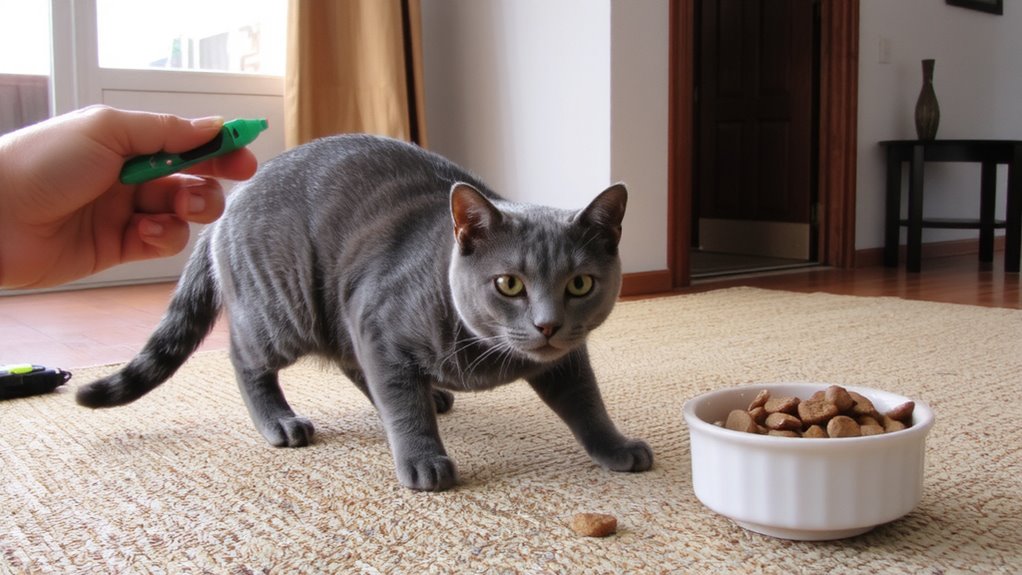
Many commercially available laser pointers emit light at unsafe power levels, risking permanent eye damage to both cats and humans. Choose a Class II laser under 1 milliwatt to guarantee safety during training. These emit visible red light but lack the intensity to harm retinas when used correctly. Laser brightness should appear bright enough to see in low light but not overpowering in normal indoor lighting-typically 1–5 lumens. Avoid green lasers, which often exceed safe limits and appear brighter due to human and feline eye sensitivity. Prioritize models with consistent output and a stable beam diameter under 2mm. Check for FDA compliance and proper labeling. Opt for laser toys designed specifically for pets, as they include safety features like automatic shutoffs. Battery life matters-select LED-powered models with at least 5 continuous hours of use to support regular sessions. Rechargeable options reduce long-term costs and waste.
Prepare the Room for Focused Laser Chase Sessions
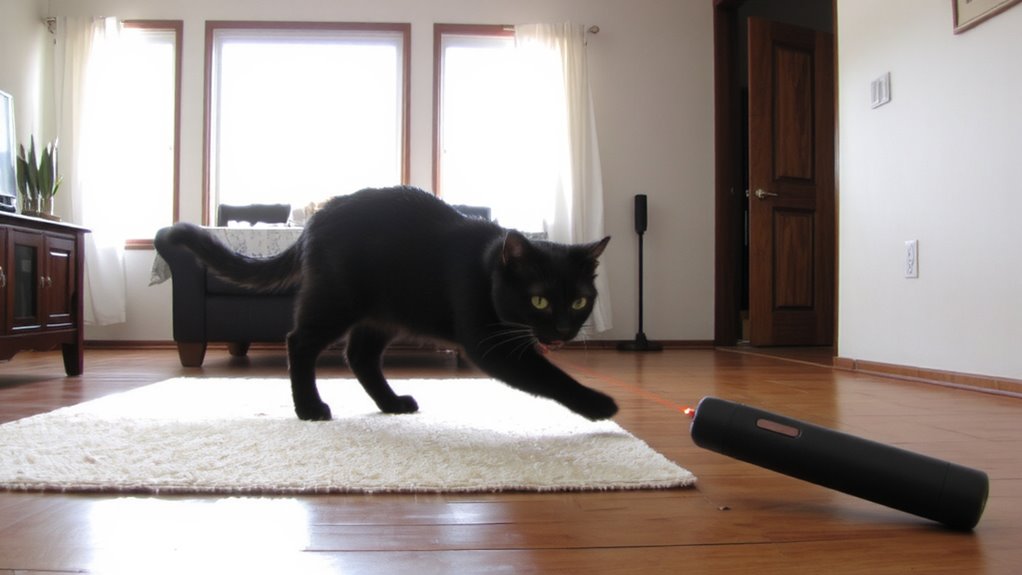
Once you’ve selected a safe, low-power laser under 1 milliwatt, you’re ready to set up the environment for effective training. Proper room layout and lighting control are essential for visibility and focus. Clear obstacles to create an uncluttered chase zone. Use dimmable overhead lights to reduce ambient brightness-ideal illumination is 50–100 lux, ensuring the red dot remains visible without glare.
| Surface Type | Reflectivity (%) | Effect on Laser Visibility |
|---|---|---|
| Hardwood | 15 | High clarity, minimal scatter |
| Carpet | 5 | Reduced bounce, precise tracking |
| Tile | 30 | Risk of glare, moderate scatter |
| Laminate | 20 | Balanced visibility, slight reflection |
| Matte Paint | 10 | Low reflection, best contrast |
Maintain consistent lighting control to avoid visual distractions. A controlled room layout increases target acquisition and reduces frustration during sessions. For best results, choose one of the best laser cat toys that combines safe brightness with ergonomic design for extended play.
Move the Dot Like Prey: Not a Scared Mouse
While a laser dot can mimic movement patterns of live prey, you must control its motion to sustain your cat’s hunting instinct without causing frustration. Move the dot in short, deliberate bursts of 2–5 seconds, simulating natural movements of insects or small rodents. Avoid rapid, erratic sweeps across floors or walls-these disrupt predatory behavior by appearing unnatural and unpredictable. Instead, incorporate quick stops, zigzags, and sudden changes in direction to mirror prey evasion. Use horizontal sweeps close to the ground, then pause the dot briefly to trigger stalking and pouncing. Keep movements below 3 feet in height, aligning with your cat’s typical strike zone. Maintain a distance of 6–10 feet between pointer and surface for ideal dot clarity and tracking ease. Consistent speed changes and lifelike trajectories enhance engagement without overwhelming your cat’s cognitive response.
End Every Game With a Real Treat Reward
Closure matters in laser play, and ending each session with a tangible reward prevents psychological frustration. You must provide a physical treat to simulate prey capture, satisfying your cat’s instinctual hunt-kill-eat sequence. Treat timing is critical: deliver the reward within two seconds of the laser stopping. This immediate feedback links the end of the chase to food acquisition. Use small, palatable treats-approximately 1 to 2 calories each-like dehydrated chicken bits (0.25-inch cubes) to avoid overfeeding. Reward consistency guarantees your cat anticipates fulfillment, reducing anxiety. Conduct sessions no longer than 10 minutes daily, offering one treat per session. Inconsistent outcomes confuse behavioral conditioning. The treat acts as the final stimulus in the operant conditioning loop, closing the hunting sequence. Without it, your cat may exhibit stress behaviors like excessive meowing or restlessness. Always pair the laser’s disappearance with the treat’s appearance. A well-groomed coat supports overall play readiness, and using the right brush for border collies can help maintain your cat’s coat if they enjoy grooming sessions.
Fix Common Laser Play Mistakes and Keep Your Cat Engaged
You’ve learned to close each laser session with a treat, reinforcing your cat’s natural hunting sequence and preventing frustration. Now, correct common mistakes to maintain engagement. Use varied chasing patterns-avoid erratic, unpredictable movements. Instead, mimic prey with sudden stops, zigzags, and slow approaches, enhancing realism. Limit sessions to 5–7 minutes per round; cats have short attention spans, typically 3–5 minutes before disengaging. Conduct 2–3 rounds daily with breaks to prevent habituation. Use a laser with a 630–670 nm wavelength and <5mW output-safe and visible to felines. Never shine near eyes. Pair light motion with subtle verbal cues to strengthen response. Rotate toys weekly to sustain interest. Consistent structure with technical precision guarantees behavioral reinforcement without overstimulation. Replace random sweeping with targeted sequences. Track session duration and response frequency to assess effectiveness. Adjust chasing patterns biweekly to align with shifting attention spans and maintain peak cognitive engagement.
On a final note
You must end each laser session with a tangible reward. Use a treat or toy your cat can physically grasp. This closes the predatory loop, preventing learned frustration from unmet chase outcomes. Laser-only play mimics hunting without fulfillment. Opt for a 650nm red laser under 5mW power for safety. Keep sessions under 10 minutes. Always pair light motion with a final real target. This guarantees psychological completion and sustained engagement.