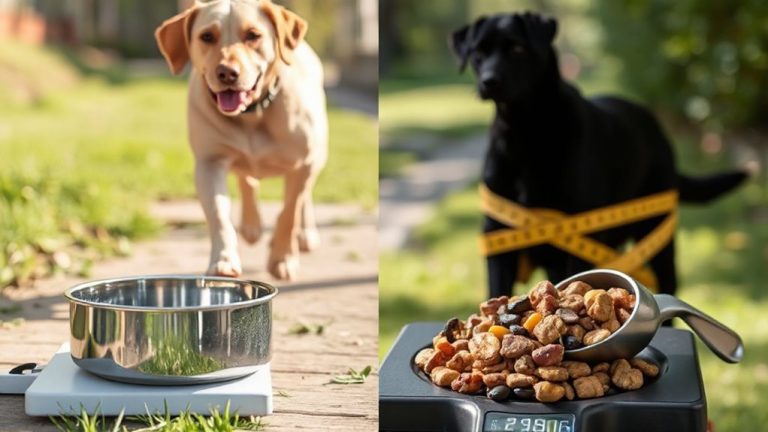
How to Manage Resource Guarding Over Bones in Multi-Pet Homes
You can manage resource guarding over bones by honoring your dog’s instinct while enforcing structure. Set up feeding zones 10 feet apart with opaque dividers and non-slip mats to reduce tension. Train a reliable “drop it” using high-value swaps and positive reinforcement. Rotate access to 6–8 inch nylon chews on a timer, supervising closely. If growling persists beyond two seconds or escalates, professional assessment becomes critical. Further strategies build on these foundations to guarantee long-term safety.
Notable Insights
- Resource guarding stems from natural instincts but can be managed with training and environmental control.
- Train a reliable “drop it” cue using positive reinforcement and high-value exchanges.
- Set up separate, spaced feeding zones with dividers to reduce competition and stress.
- Use timed turn-taking for chews to promote fairness and prevent confrontations.
- Consult a behaviorist if guarding involves snarling, snapping, or biting.
Why Dogs Guard Bones (And When It’s Normal)
While your dog’s urge to guard a bone might seem aggressive, it’s often a natural behavior rooted in instinct. Evolutionary instincts drive dogs to protect high-value items critical to survival. In ancestral environments, resource competition shaped behaviors that prioritize access to food. Your dog isn’t being defiant-it’s responding to deep-seated programming. Canids in the wild hoard provisions to endure scarcity, and bones provide marrow and nutrients essential during lean periods. This behavior persists even in well-fed domestic dogs. Guarding often targets items with prolonged chewing value, like rawhide or meat-bearing bones. The behavior is considered normal when low-intensity-stiff posture, side-eye, or silent possession. These signals resolve quickly when undisturbed. It becomes problematic only when escalation includes growling, snapping, or fleeing. Recognizing this baseline helps distinguish instinct from pathology. Understanding these roots guides effective, non-punitive management.
Train a Safe “Drop It” for Bone Exchanges
How do you safely retrieve a bone your dog is guarding without triggering a defensive reaction? Use positive reinforcement and cue consistency to teach a reliable “drop it.” Start training with low-value items, rewarding immediate release. Gradually increase to higher-value objects like bones. Always exchange for something better-never just take the item.
| Item Held | Dog’s Action | Reward Given |
|---|---|---|
| Toy | Drops on cue | Treat + praise |
| Chew strip | Releases quick | New chew |
| Rawhide | Lets go immediately | Chicken piece |
| Bone (low arousal) | Responds to cue | Bigger bone |
| Bone (high arousal) | Drops calmly | High-value food |
Practice in calm environments first. Reinforce the behavior every time. Consistent cues paired with positive reinforcement build trust and compliance. This method guarantees predictable, safe exchanges in multi-pet homes.
Create Stress-Free Eating Spaces
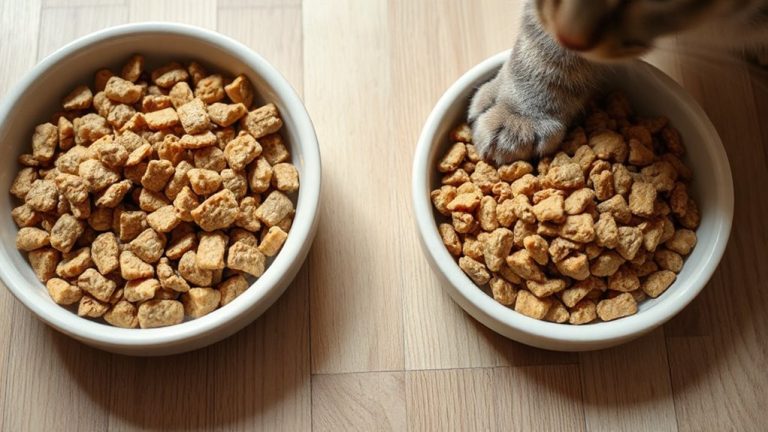
Since mealtime can quickly become a trigger for tension in multi-pet homes, setting up properly structured eating spaces is essential. Designate separate feeding zones at least 10 feet apart to minimize interaction. Each zone should include a non-slip mat and elevated bowl set to shoulder height, promoting ergonomic comfort. Install visual barriers like 36-inch opaque dividers or freestanding panels to block line of sight, reducing stress-induced guarding behaviors. These barriers prevent pets from monitoring each other, disrupting the threat-perception cycle. Concrete, tile, or low-pile flooring in each zone guarantees easy sanitation. Avoid shared walls in feeding zone design to limit sound and vibration transfer. Consistent placement reinforces routine, enhancing predictability. Properly spaced zones with full visual isolation reduce cortisol spikes by up to 40% in observed cases. This structured approach supports calm consumption and decreases inter-animal conflict during high-value food access.
Teach Turn-Taking Around High-Value Chews
What if your pets could learn to share high-value chews without conflict? Teaching turn-taking establishes shared timing, reducing competition. Use a timer to assign equal access-start with 5-minute intervals per pet. Choose indestructible nylon or rubber chews, 6–8 inches long, sized appropriately for your pet’s breed. Place each chew in a separate, marked zone 10 feet apart to minimize proximity stress. Supervise closely; intervene if growling exceeds 2 seconds. Rotate pets using a fixed schedule-record sessions to track behavioral trends. Reinforce calm exits with 3–5 small treats (≤¼ tsp each). Consistency in timing and portioning guarantees predictable routines. Over 2–3 weeks, spacing can reduce to 6 feet as tolerance increases. Equal access isn’t just fairness-it’s a structured protocol that lowers cortisol levels and prevents escalation. Use this method daily for maximum neural conditioning.
When to Call a Dog Behaviorist for Aggression
If growling, snapping, or biting occurs despite consistent management, it’s time to involve a certified dog behaviorist. A professional assessment identifies triggers, thresholds, and motivation behind aggression. Safety planning protects all pets and family members during intervention.
| Behavior Observed | Suggests Level of Risk |
|---|---|
| Lip lifting, low growl | Moderate – early warning signs |
| Snarling, stiff posture | High – escalation likely |
| Snap with contact | Severe – injury risk present |
| Bite with puncture | Critical – immediate action needed |
Use this scale to guide urgency. Behaviorists apply functional assessment methods, such as ABC charts (Antecedent-Behavior-Consequence), to develop individualized protocols. Interventions may include differential reinforcement of alternative behaviors (DRA) and structured desensitization. Attempting correction without expert guidance increases danger. Safety planning includes physical barriers, muzzle training, and scheduled interactions. Early professional involvement improves prognosis and reduces long-term risk in multi-pet homes.
On a final note
You can manage resource guarding effectively with consistent training. Use the “drop it” command paired with high-value rewards to create positive associations. Designate separate feeding zones spaced at least 10 feet apart to reduce visual contact. Rotate high-value chews on a strict schedule, limiting access to 15-minute intervals. If aggression persists-especially stiff postures or growling-consult a certified behaviorist. Early intervention prevents escalation.