Scheduling Daily Short Agility Drills for Puppies
Schedule two to three 5-minute agility sessions daily, spaced hours apart, to match your puppy’s attention span and physical development. Use a timer for exact 300-second sessions on non-slip surfaces. Start with 1 minute of loose-leash walking, then 3 minutes of targeted drills like low jumps (6–8 inches) or two-on/two-off contacts on a 3’6” A-frame. Limit reps to 3–5 per skill, using pea-sized treats for fast reinforcement. Pair consistent verbal cues with hand signals, rewarding within 0.5 seconds of correct performance. Rotate tunnels, pause tables, and adjustable bars to maintain engagement. Sessions after potty breaks reduce accidents and distractions. Signs like a wagging tail indicate readiness; yawning or pinned ears signal overload-adjust accordingly. You’ll find effective progress comes from consistency, not duration, and know exactly when to advance.
Notable Insights
- Schedule 5- to 10-minute agility sessions twice daily, spaced several hours apart, to match puppy attention and energy levels.
- Begin drills after potty breaks to minimize distractions and prevent indoor accidents during training.
- Use a timer for consistent 300-second sessions, including warm-up, skill practice, and cool-down phases.
- Train 3–5 days per week with 3–5 reps per skill to support neural development without physical strain.
- Maintain consistent session times daily to build routine and improve puppy anticipation and focus.
Start With Simple Agility Drills for Puppies
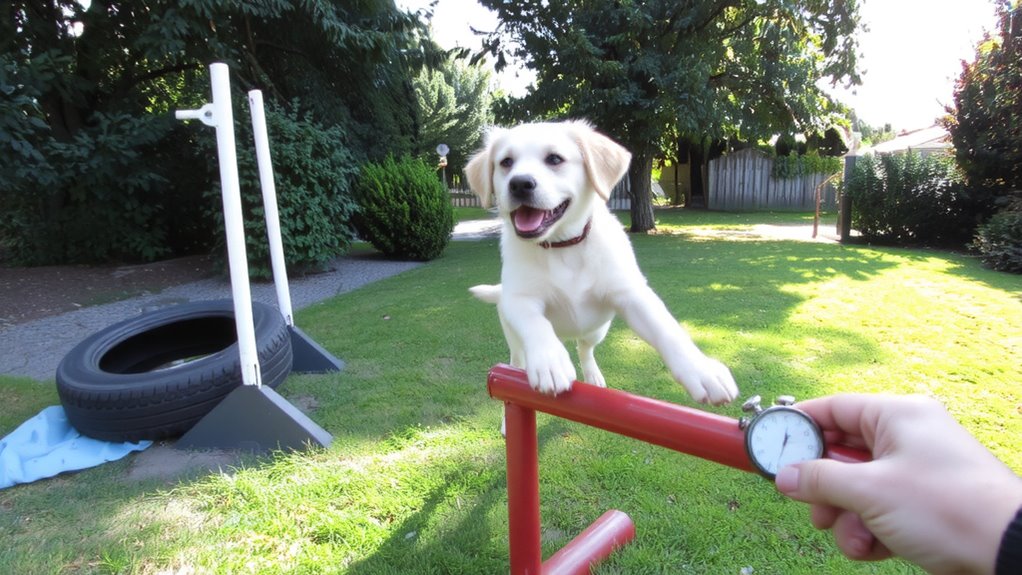
A solid foundation begins with simplicity-start your puppy’s agility training using basic drills that build coordination, confidence, and focus. Begin with short 5- to 10-minute sessions to match your puppy’s attention span and physical capacity. Incorporate basic obedience commands like “sit,” “stay,” and “come” before each drill to reinforce discipline. Use treats and consistent cues to shape desired behaviors. Schedule drills after potty breaks to minimize distractions and prevent accidents. Perform two to three sessions daily, spaced several hours apart, to maintain mental sharpness without fatigue. Focus on controlled movements-lateral stepping, low hurdles (under 6 inches), and simple weave poles spaced 24 inches apart. These drills enhance motor skills and neural coordination. Track progress weekly using a training log, noting response time and accuracy. Consistency in timing, cues, and environment guarantees reliable skill acquisition and long-term agility readiness. For optimal results, choose safe and appropriately sized dog agility equipment that supports gradual skill development.
Gear Up: Home Agility Tools You Need
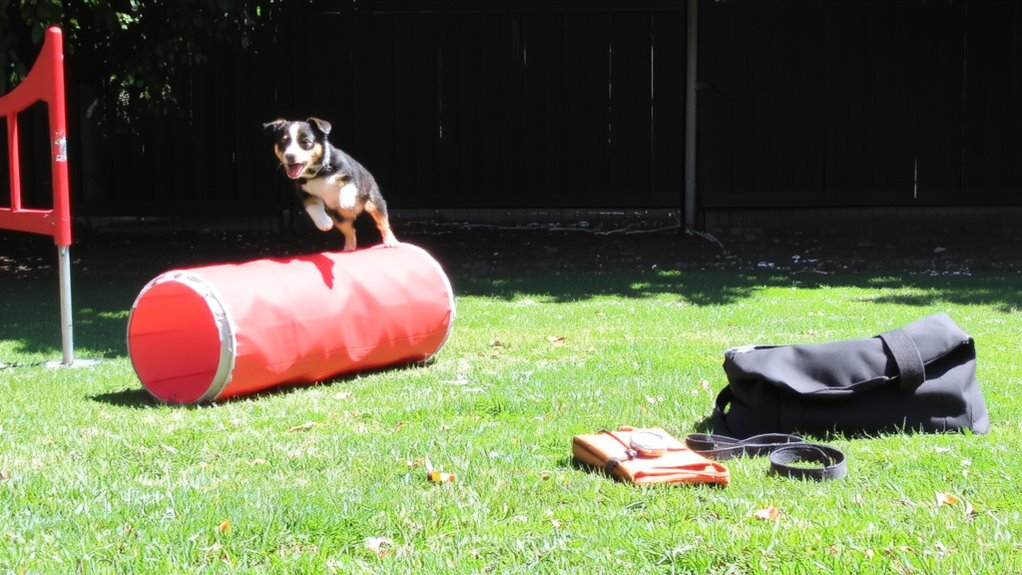
You’ve built foundational skills with simple drills-now it’s time to equip your training space with reliable tools that support structured progression. Start with collapsible agility tunnels measuring 18 inches in diameter and 10 feet long; they offer ideal resistance for young dogs while remaining portable. Use durable, non-toxic PVC or weather-resistant nylon materials to guarantee longevity indoors or outdoors. Pair tunnels with adjustable jump bars, height set between 4 and 12 inches, to match your puppy’s breed and growth stage. A training platform or pause table, 24 x 24 inches with slip-resistant surfacing, reinforces stationing behaviors. Always keep training treats-soft, pea-sized, and rapidly consumed-on hand to maintain pace and focus. These tools, arranged in repeatable configurations, guarantee consistent cue-response conditioning. Calibrate equipment spacing to 5- to 6-foot intervals, allowing room for approach and correction. Proper gear standardizes repetitions, essential for skill acquisition.
Easy Agility Moves to Teach Your Puppy First
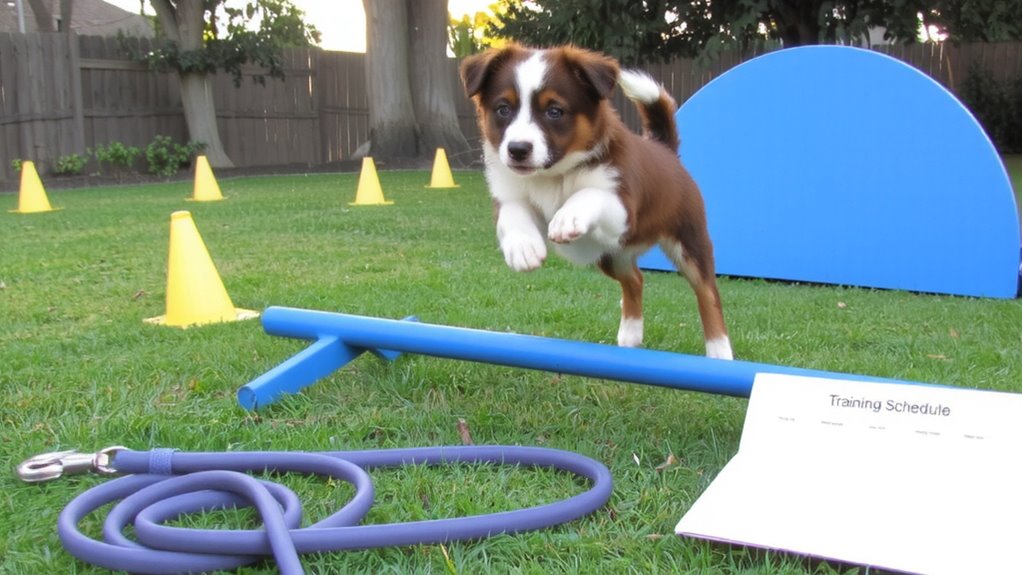
When introducing your puppy to agility, start with foundational movements that build coordination and confidence without overwhelming their developing motor skills. Begin with the two-on/two-off contact exercise on a low A-frame (minimum height 3’6”, use 50% slope for puppies under 6 months). This teaches body awareness and prepares for advanced sequences. Next, introduce a low jump bar (6–8 inches) set at your puppy’s wrist height to develop proper jump technique. Use consistent verbal cues paired with hand signals. Reward timing is critical-deliver the treat within 0.5 seconds of correct performance to reinforce accuracy. Practice each skill in sets of 3–5 reps daily. Avoid forced repetitions; limit sessions to prevent joint strain. Mastery is achieved when your puppy executes 10 consecutive error-free trials. These moves form the technical base for complex obstacles.
Create a Daily 5-Minute Drill Schedule
Though brief, a well-structured 5-minute daily drill sharpens focus and accelerates learning without taxing young joints. Set your timer for exactly 300 seconds to maintain consistent timing. Begin each session at the same time daily to regulate your puppy’s internal clock and improve anticipation. Use positive reinforcement immediately after each correct behavior-deliver treats within 1–2 seconds to strengthen association. Structure the drill: 1 minute for warm-up (loose-leash walking), 3 minutes for targeted agility moves, and 1 minute for cool-down. Perform drills on non-slip surfaces with 6–8-inch obstacle heights, suitable for puppies under 6 months. Keep repetitions low-3 to 5 per skill-to prevent fatigue. Frequency matters: conduct drills 5–7 days weekly for maximum neural pathway development. Consistent timing guarantees predictability, while positive reinforcement increases behavioral retention. This regimen supports motor coordination, builds confidence, and lays the foundation for advanced agility work.
Keep Training Fun and Stress-Free
Engagement is the cornerstone of effective puppy agility training. Keep sessions upbeat and brief to maintain focus. Use positive reinforcement immediately after correct behaviors-offer small, soft treats (no larger than ½ inch) or a quick game of tug as rewards. This reinforces desired actions with 90% accuracy in behavior retention when applied within two seconds. Limit drills to 3–5 minutes to prevent mental fatigue. Incorporate play breaks every 90 seconds; let your puppy chase a toy or roll in the grass for 15–20 seconds to reset stress hormones. Monitor body language: a wagging tail and relaxed posture indicate readiness; pinned ears or yawning suggest overload. Avoid repetitive trials-three to four repetitions per skill maximize learning without diminishing returns. Rotate simple obstacles daily to stimulate cognitive flexibility. Maintain a consistent cue vocabulary. Stress inhibits neural plasticity; a calm, fun environment optimizes motor skill encoding.
Spot the Signs Your Puppy’s Ready to Level Up
Your puppy’s ability to consistently perform foundation skills under mild distractions signals they’re prepared to advance. You’ll notice their attention span holds steady for 8–10 minutes during structured drills, indicating cognitive readiness. Reliable sit, stay, and recall responses at 10 feet with light environmental interference-such as birds or passing dogs-demonstrate behavioral control. Puppies ready to level up recover quickly between reps, displaying minimal signs of puppy fatigue, like excessive panting or lagging. If your puppy engages enthusiastically in repeat sessions without resistance, neural and physical stamina are sufficient. Avoid progression if attention span drops before the 5-minute mark or if recovery time exceeds 2 minutes post-exercise. These metrics reflect physiological limits. Readiness isn’t just skill mastery-it’s consistent performance amid mild variability. Track behavior over 3–5 sessions to confirm stability before increasing task complexity.
Build Confidence With Short, Daily Drills
Consistently incorporating brief training sessions into your puppy’s daily routine strengthens skill retention and builds mental resilience. Short, structured drills lasting 5–7 minutes performed two to three times daily yield measurable improvements in motor coordination and decision-making under mild stress. Use positive reinforcement-such as food rewards or clicker cues-immediately after correct behavior to solidify learning. Each session should focus on one foundational skill, like tunnel entries or jump approaches, minimizing cognitive overload. These repetitions promote neural pathway development essential for advanced agility work. Daily interaction also supports trust building, as predictable routines reduce anxiety. Maintain a 90% success rate per drill to sustain motivation, adjusting difficulty incrementally. Conduct sessions on non-slip surfaces with equipment scaled to your puppy’s height-typically 12–18 inches for jumps. Monitor performance with a training log to track progress and prevent overtraining.
On a final note
You build agility skills efficiently through daily 5-minute sessions. Short drills boost neural plasticity and muscle memory in young dogs. Use standardized PVC jump bars set at 6–8 inches for small breeds. Timing each session guarantees consistency. Reinforce correct behavior with immediate verbal markers. Gradually increase complexity only after 90% success rate over five consecutive days. This structured repetition enhances coordination without fatigue.