Incorporating Balance Discs Into Rehab Exercises for Arthritic Dogs Seeking Stimulation
Use a 12-inch balance disc with high-density anti-burst PVC and a slightly textured, nonslip surface to support your arthritic dog safely. The disc should compress 1–2 inches under load, providing controlled instability. Begin with the disc deflated on a non-slip floor, letting your dog explore it at their pace. Introduce inflation gradually over 2–3 days, starting at 25% and increasing as balance improves. Perform foundational exercises like front-paw stands and slow sit-to-stand reps to build joint stability and muscle strength. Combine physical effort with cognitive tasks-such as staying on command or reaching for delayed treats-to engage the mind. Track progress weekly by measuring stance duration and wobble reduction. A 10° decrease in limb splay indicates improved proprioception. For dogs over 50 lbs, guarantee full inflation reaches 12 inches to maintain proper weight distribution. Adjust difficulty only after three successful sessions at each level. More advanced techniques follow.
Notable Insights
- Use a 12-inch balance disc with high-density PVC for proper support and weight distribution in arthritic dogs over 50 lbs.
- Introduce the disc gradually, starting deflated, to build confidence and reduce joint stress during initial contact.
- Perform slow sit-to-stand exercises on the disc to enhance hind-limb strength and joint stability with low impact.
- Combine balance tasks with cognitive cues like “stay” or scent detection to engage mental stimulation alongside physical rehab.
- Progress intensity only after three stable sessions, monitoring wobble reduction and limb alignment for safe advancement.
Choose the Right Balance Disc for Your Arthritic Dog
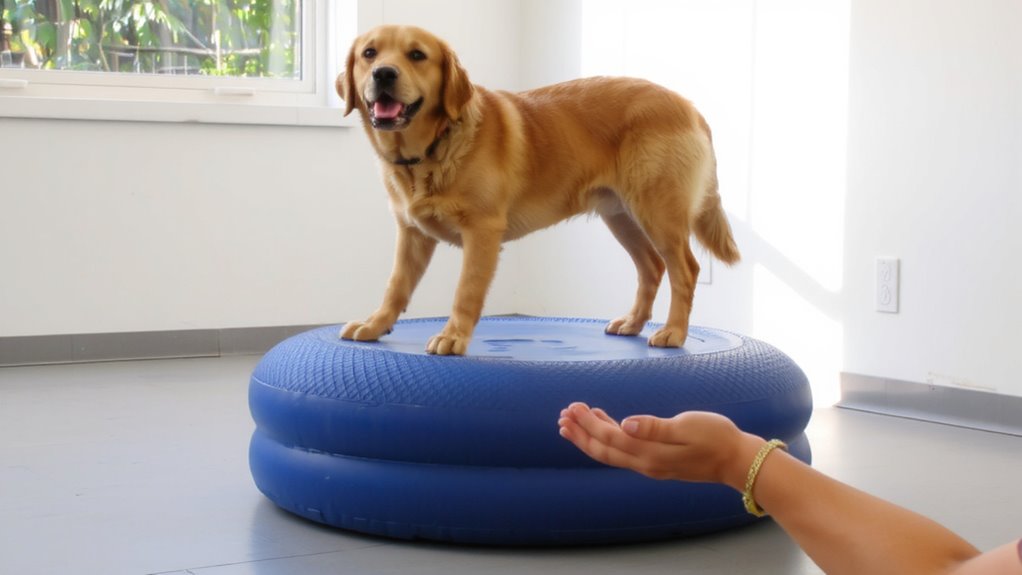
While not every balance disc suits arthritic dogs, selecting the right one can substantially support joint health and mobility. Choose the correct disc size based on your dog’s weight and limb length. Larger dogs-over 50 pounds-need a 12-inch diameter disc for proper weight distribution, while smaller breeds benefit from an 8- to 10-inch model. The disc size must allow four-square paw placement without overreaching. Surface texture is equally critical; opt for a slightly textured, nonslip cover to prevent paw sliding and reduce joint strain. A smooth surface increases instability, raising injury risk. High-density anti-burst PVC supports up to 300 pounds and maintains controlled deflection. Firmness should permit 1 to 2 inches of compression under load, enabling safe proprioceptive training. Precision in disc size and surface texture guarantees therapeutic effectiveness without compromising safety.
Introduce the Balance Disc Safely and Stress-Free
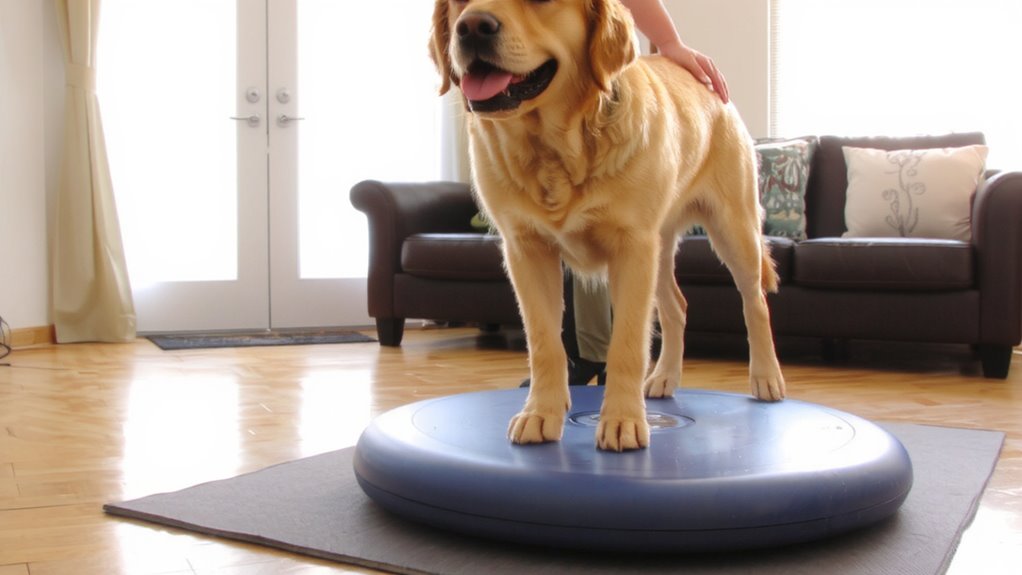
How do you get your arthritic dog to confidently step onto an unstable surface? Introduce gradually to avoid fear and resistance. Begin by placing the deflated disc on a non-slip surface so it feels solid under paw. Let your dog sniff and investigate-this first contact builds familiarity. Reward curiosity with treats and praise. Over 2–3 days, inflate the disc slightly each session, increasing instability only after your dog shows confidence. Always maintain comfort by monitoring weight distribution and joint alignment. Use verbal cues consistently to reinforce positive behavior.
| Inflation Level | Surface Stability | Recommended Duration |
|---|---|---|
| 25% | Very Stable | 5 minutes |
| 50% | Moderately Stable | 7 minutes |
| 75% | Slight Give | 10 minutes |
| 100% | Fully Functional | 15 minutes |
Try These 5 Balance Disc Exercises for Arthritic Dogs
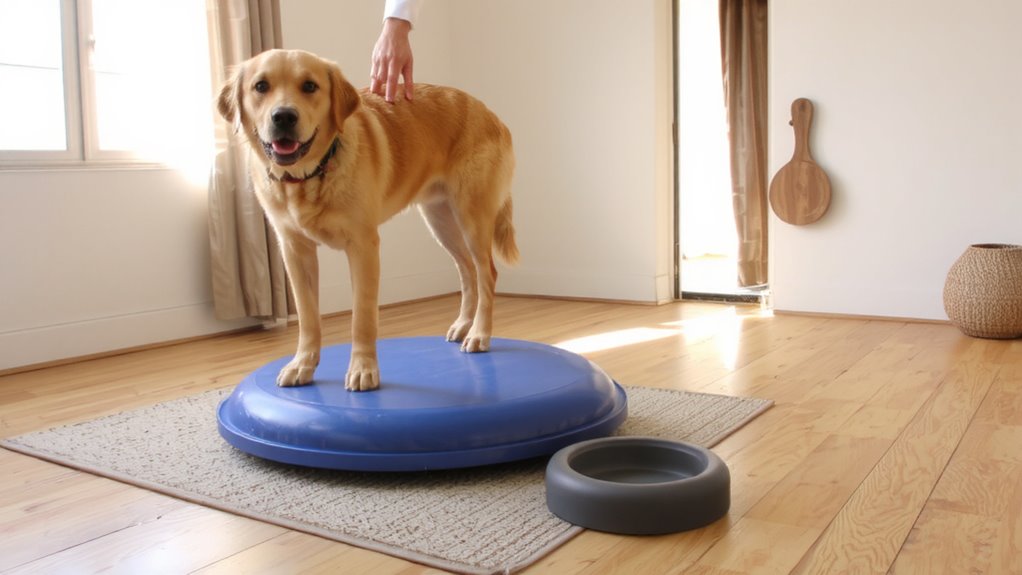
Start with five foundational balance disc exercises designed specifically for arthritic dogs, focusing on joint support, proprioception, and controlled weight shifting. Stand on the disc with your dog’s front paws; this improves forelimb stability and promotes neuromuscular coordination. Hold for 15 seconds, repeat 3 times. Next, place all four paws on the disc; the unstable surface enhances proprioceptive feedback, reducing joint stress over time. Perform slow, controlled sit-to-stand shifts-5 reps build hind-limb strength safely. Try lateral weight shifts: gently nudge your dog side-to-side to activate stabilizing muscles without impact. Use a 24-inch diameter disc with moderate inflation (80–90% firmness) to balance challenge and support. These movements aid pain management by improving synovial fluid circulation and decreasing stiffness. Always monitor for discomfort. Exercises should last 10–12 minutes daily. Consistent use delivers measurable gains in joint support and mobility.
Boost Focus: Add Mental Challenges to Balance Training
Why limit balance training to physical benefits when cognitive engagement can amplify results? You can enhance your arthritic dog’s rehabilitation by integrating mental challenges during balance disc sessions. Cognitive enrichment improves focus, slowing cognitive decline associated with aging. Pair disc exercises with command-based tasks-like “sit” or “stay”-to demand attention and coordination. Introduce novel textures or scents on the disc surface to increase sensory engagement, activating neural pathways linked to motor control. Use treat-release toys off-balance to prolong concentration. These tasks require prolonged postural control, increasing time under neurological demand. Research shows combined physical and mental training improves neuroplasticity in senior canines. You’re not just building stability-you’re reinforcing brain-muscle communication. Simple additions like delayed reward retrieval or auditory cues challenge processing speed. Guarantee sessions remain low-impact, limiting each to 5–7 minutes. Consistent cognitive enrichment reduces compensatory movement patterns. Sensory engagement sustains interest, improving compliance.
Track Mobility Gains and Adjust Difficulty
Consistent progress monitoring guarantees your arthritic dog gains maximum benefit from balance disc training. Use progress tracking to measure improvements in joint range of motion, weight distribution, and stance duration. Record each session’s duration, wobble frequency, and limb corrections weekly. Baseline metrics typically include 10–15 seconds of stable standing; aim for 30–45 seconds before advancing. Implement structured difficulty progression based on observed stability. Start with a deflated disc (6-inch height, 25% air) for maximal support. Progress to full inflation (12-inch height, 100% air) only after three consecutive successful sessions. Introduce movement only when static balance is sustained for 60 seconds. Adjust surface compliance and disc diameter-larger diameters (24” vs. 18”) reduce instability. Track limb splay angles using video analysis; a reduction of 10° indicates improved proprioception. Never increase difficulty faster than weekly.
Keep Your Dog Engaged With Regular Balance Disc Sessions
A well-structured routine keeps your dog engaged and guarantees lasting therapeutic benefits from balance disc sessions. Consistency reinforces neuromuscular adaptation, improving joint stability and proprioception. Integrate short play breaks to prevent fatigue and sustain motivation. These pauses allow your dog to reset, reducing the risk of overexertion. Ideal reward timing-immediately after correct performance-strengthens desired behaviors and enhances learning.
| Session Element | Benefit |
|---|---|
| 3–5 minute play breaks | Prevent mental fatigue, promote recovery |
| 1–2 second reward timing | Reinforces precise movement execution |
| 2–3 sessions/week | Balances stimulation with tissue recovery |
Use a textured, anti-slip disc with 12″ diameter and 3″ height for safe, effective training. Progressively increase duration from 5 to 10 minutes as strength improves. Maintain controlled movements to protect arthritic joints.
On a final note
You’ve made progress. Balance disc therapy supports joint stability and neuromuscular control in arthritic dogs. Use discs with non-slip surfaces, 12–18 inches in diameter, and load-rated for your dog’s weight. Start with 5-minute sessions, 3 times weekly. Monitor limb placement and weight distribution. Adjust height or instability level gradually. Track stride length and stance time monthly. Consistency yields measurable improvements in proprioception and muscle symmetry.