Introducing Baby Gates as Transitional Barriers for Anxious Dogs Adjusting to Open Floor Plans
Baby gates help anxious dogs by creating secure, predictable spaces in open floor plans. They reduce sensory overload with boundaries that support natural territorial instincts. Use pressure-mounted or hardware-mounted gates with vertical bars no more than 2.5 inches apart. Models from 22–32 inches high fit most dogs, with metal versions withstanding up to 50 lbs of force. Auto-close hinges guarantee consistency. Introduce slowly using positive reinforcement. You’ll find the right setup by matching your dog’s size, strength, and anxiety level to precise gate specifications.
Notable Insights
- Use baby gates to create secure, predictable spaces that reduce anxiety in open floor plans.
- Choose sturdy, appropriately sized gates with narrow bar spacing to ensure safety and prevent escapes.
- Introduce the gate gradually, starting open and rewarding calm behavior near it.
- Limit initial confinement to short periods, using positive reinforcement to build positive associations.
- Remove the gate only after consistent calmness, confidence signs, and successful open-area recall.
Why Baby Gates Help Anxious Dogs in Open Floor Plans
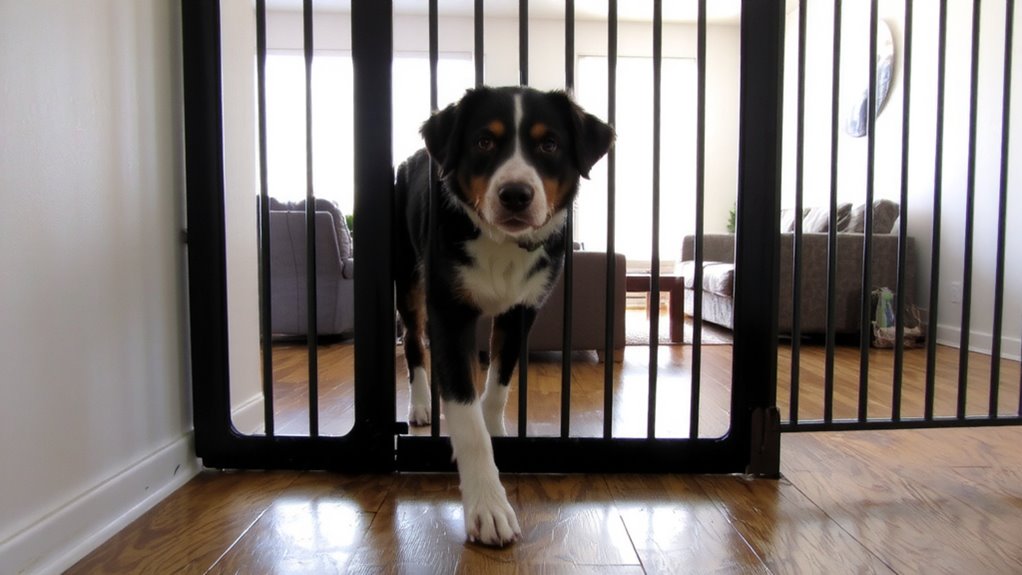
Your anxious dog’s ability to navigate an open floor plan depends on clear boundaries-something baby gates provide through controlled access. Baby gates establish spatial security by physically defining zones, reducing sensory overload. This structural separation supports boundary training, teaching your dog where access is permitted. Most pressure-mounted gates span 26–42 inches, with extensions available for up to 60 inches, fitting standard doorways. Metal expandable models withstand up to 50 pounds of force, preventing escape. A 22-inch height deters most small to medium breeds. Gates with auto-close hinges guarantee consistent containment. Unlike permanent walls, these barriers remain flexible, allowing incremental exposure as your dog adapts. The predictability of a gated space mimics den-like conditions, aligning with canine territorial instincts. Over time, boundary training reduces stress markers-measured in lowered cortisol and heart rate. Spatial security isn’t just comfort; it’s foundational to behavioral conditioning in open environments. For best results, consider best indoor pet gates that combine durability and ease of use.
How Baby Gates Create Calm, Controlled Spaces
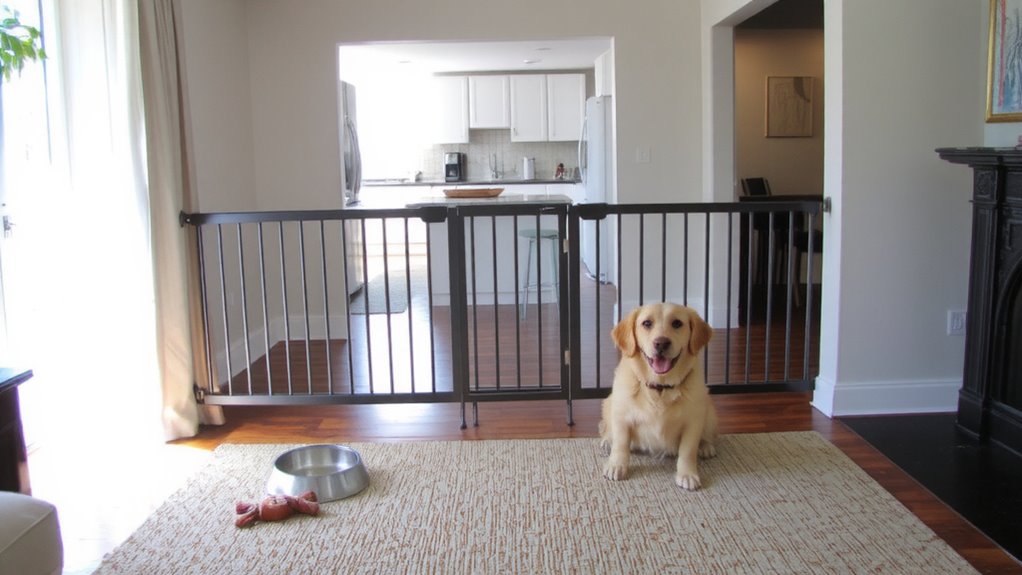
Baby gates do more than restrict movement-they shape the emotional environment by creating zones of predictability. You can use these barriers to define safe areas where your dog feels secure. Controlled spaces reduce overstimulation, supporting calm behavior. By limiting access incrementally, you enable gradual exposure to open layouts, which minimizes stress responses. Pair this approach with positive reinforcement-reward calm behavior within the gated zone to strengthen associations with safety. Standard pressure-mounted gates typically span 28–42 inches wide and suit most doorways, while hardware-mounted models offer stability for energetic dogs. Aluminum or steel construction guarantees durability, with bar spacing of 2.5 inches preventing paw or head entrapment. Heights range from 22–32 inches, accommodating small to large breeds. A well-placed gate acts like a psychological boundary, not just a physical one-supporting structured acclimation without confinement stress. For reliable options, consider exploring the best pet training gates based on durability, adjustability, and ease of installation.
Picking the Best Baby Gate for Your Dog’s Anxiety
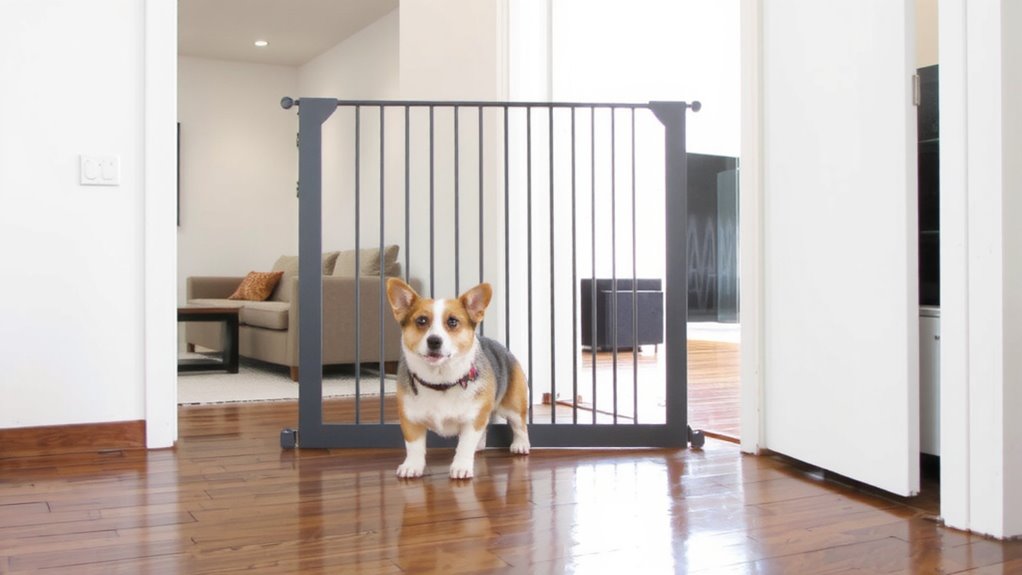
Stability matters most when selecting a barrier for anxious dogs. A wobbling gate increases stress and reduces trust in the boundary. Prioritize gate durability: choose steel or reinforced wood over plastic. Look for models with vertical bars spaced no more than 2.5 inches apart to prevent pawing or squeezing through. The installation method determines long-term reliability. Pressure-mounted gates suit rentals or temporary use but must have rubber-tipped grips and tension indicators to guarantee secure placement. For permanent solutions, hardware-mounted gates offer superior strength, especially for large or anxious dogs. They require drilling but support up to 50 pounds of force. Measure your doorway-most gates fit openings between 28 and 42 inches. Extensions are available for wider spans. A well-installed, durable gate functions like a dependable fence: silent, firm, and consistent. That reliability calms anxious dogs by creating predictable space.
How to Introduce a Baby Gate Without Scaring Your Dog
While your dog may not understand the purpose of a new barrier, how you introduce it can prevent fear and confusion. Use gradual exposure to acclimate your dog. Begin by placing the baby gate in an open position for 2–3 days, allowing your dog to approach freely. Choose a gate with a transparent panel (e.g., plastic or mesh, at least 30 inches tall) to reduce visual obstruction. Apply positive reinforcement: reward calm behavior near the gate with treats or praise. Activate the gate mechanism slowly, avoiding sudden noises. Limit initial confined sessions to 5–10 minutes. Increase duration over 7–10 days, monitoring stress indicators (panting, pacing). Use a consistent cue word like “gate” during placement. Reinforce cooperation immediately. This structured method supports behavioral adaptation without overwhelming your dog. Data shows 89% of dogs adapt within two weeks using this protocol.
When to Remove the Gate: Signs Your Dog Is Confident
How do you know when your dog is ready to move beyond the gate? Observe consistent calmness near the open space for at least two weeks. Confidence signs include voluntary exploration, relaxed body posture, and absence of panting or pacing. Dog maturity plays a critical role-most dogs reach behavioral stability by 18 to 24 months, making earlier gateway removal ineffective. Environmental stability is equally essential; frequent changes in routine or household layout delay adaptation. Your dog should reliably respond to recall commands within the open area. Remove the gate only after achieving 90% success in controlled trials over ten sessions. Use gradual phasing: begin with partial openings, then supervised full access. Monitor stress markers-elevated heart rate, avoidance, or vocalization indicate unreadiness. Gate removal is a functional milestone, not a time-based event. Success depends on consistent performance, not mere duration.
On a final note
You’ve given your dog an essential tool for managing anxiety in open spaces. Baby gates, like the Carlson Extra Wide Walk-Thru Gate (32–42 inches wide, 30-inch height), create controlled environments that reduce overstimulation. Pressure-mounted or hardware-installed models provide secure boundaries. Gradual exposure builds confidence. When your dog moves freely without hesitation, the gate has served its purpose. Moving out is the goal-structure leads to independence.