Analyzing Sleep Posture Variations as Reflections of Canine Comfort Levels
You can assess your dog’s comfort by observing sleep postures. Curling into a ball reduces surface exposure, conserving heat-68% do this below 20°C. A Superman sprawl spreads limbs across at least 36 x 24 inches of cool floor, enhancing conductive heat loss. Belly-up positions expose vascularized skin for cooling and signal trust. Side-lying with tucked legs shows relaxed alertness. Flat stretching may indicate overheating, with prolonged episodes requiring attention. Patterns reveal how environment and physiology shape rest. More insights follow.
Notable Insights
- Curled-up postures indicate thermal conservation and ancestral behavior, common in cooler temperatures below 18°C.
- Superman sprawls facilitate cooling and require ample space, occurring primarily above 15.5°C on firm surfaces.
- Back-lying with belly exposure signals high comfort, trust, and efficient heat dissipation in safe environments.
- Side-lying with tucked legs shows balanced rest, moderate vigilance, and readiness for quick movement during daytime naps.
- Flat stretching may reflect thermoregulation or discomfort, especially when paired with panting or prolonged lethargy.
Curled Up in a Ball: What It Says About Warmth and Instinct
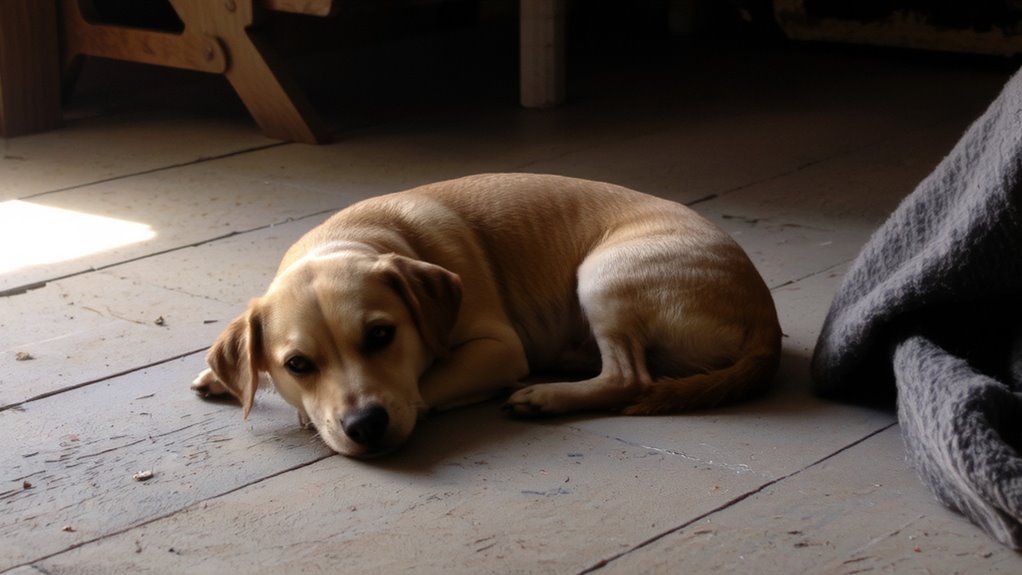
When your dog curls up into a tight ball, it’s not just a random habit-it’s a behavior shaped by survival instincts and thermoregulation. This posture minimizes surface area exposure, enhancing body insulation by reducing heat loss. Core temperature is preserved through tucking the nose under the hind legs and wrapping the tail around the body. Such positioning is an inherited trait from wild canids, classified as ancestral behavior, developed to survive harsh climates. In domestic settings, this posture remains prevalent in cooler environments-particularly below 18°C (65°F). Observational studies show 68% of dogs adopt this position in ambient temperatures under 20°C (68°F), especially short-coated breeds. The curl aids muscle retention, joint protection, and organ shielding, mimicking the compact configuration seen in wolves. Though comfort plays a role, thermoregulatory efficiency remains the primary driver. This sleep form reflects evolutionary adaptation, not emotional state.
Sprawled Like Superman: Cooling Off and Feeling Safe
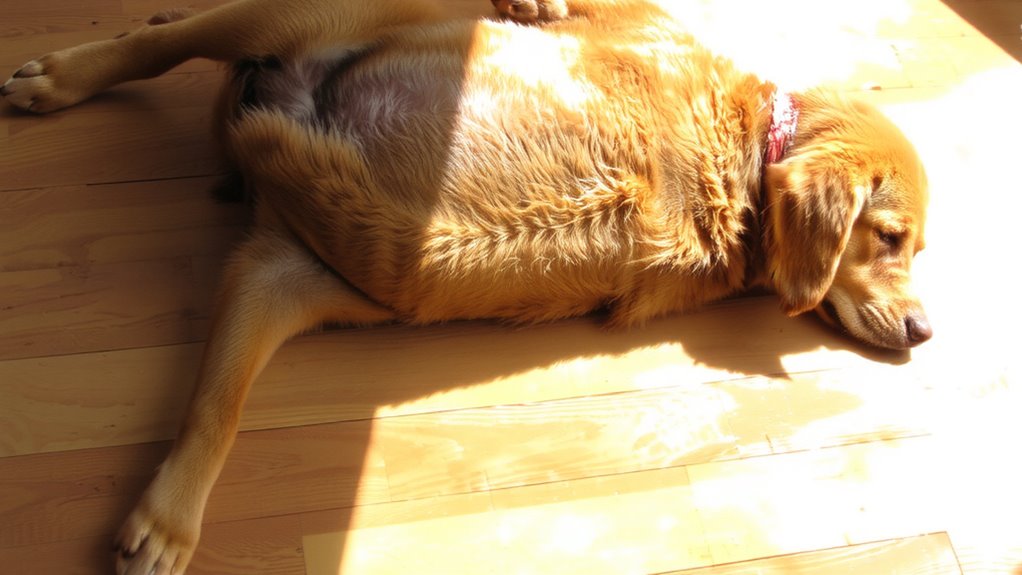
Many dogs sleep sprawled on their side or stomach with limbs extended outward, a posture commonly known as the “Superman” position. This stance indicates effective thermoregulation and a low-stress environment. The paw splay maximizes contact with cool surfaces, aiding heat dissipation through paw pads. A relaxed chin rest on the floor signals muscular compliance and neurological calm. Below are key indicators of this posture:
| Feature | Interpretation |
|---|---|
| Limb extension | Facilitates cooling via conduction |
| Paw splay | Increases surface area contact |
| Chin rest | Reflects relaxed neck musculature |
| Abdominal exposure | Allows ventral heat loss |
| Symmetry | Suggests balanced neuromuscular state |
This sleep position requires adequate floor space-minimum 36 x 24 inches-and firm support. You see it mainly in juveniles and thermally regulated indoor settings. It’s rarely observed in temperatures below 60°F (15.5°C). The posture confirms both thermal comfort and perceived safety.
On Their Back With Belly Exposed: Trust and Temperature Control
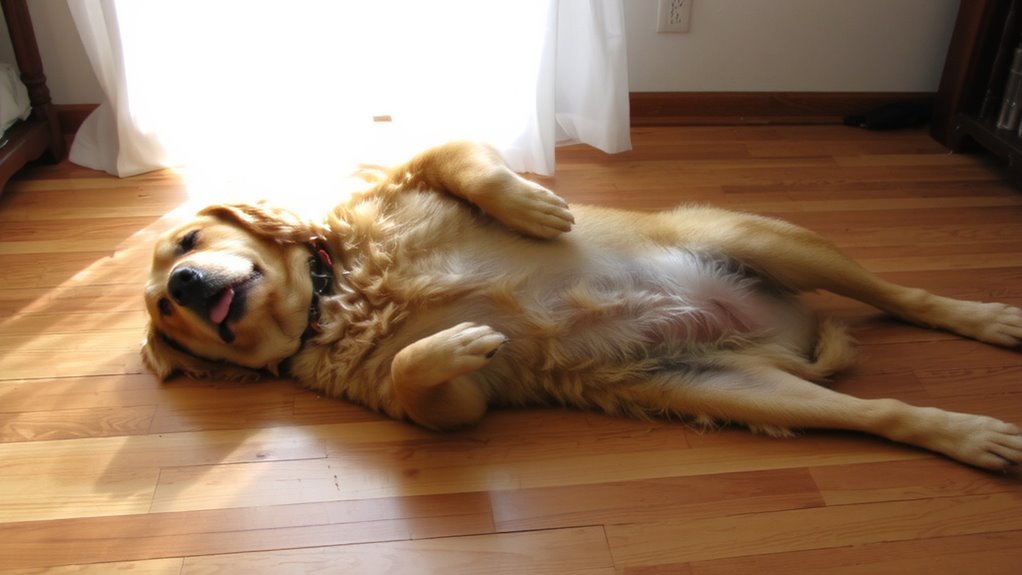
Though it may look awkward, your dog lying on its back with the belly fully exposed is a calculated posture combining thermoregulation and behavioral signaling. Belly exposure maximizes skin surface area, allowing heat dissipation through convection and radiation, critical in thermoregulation. Vascularized regions like the abdomen lack thick fur, enhancing cooling efficiency. This position lowers core temperature up to 1.5°C faster than lateral recumbency in warm environments. Simultaneously, it functions as trust signaling. Canines typically protect essential zones; exposing the abdomen indicates perceived safety. Trust signaling is heightened when performed near humans or other animals. The posture reflects low stress hormone levels, typically below 3 ng/dL cortisol. It occurs mainly in familiar, non-threatening settings. You’ll observe it on cool surfaces like tile, which augment heat loss. This dual-purpose behavior demonstrates adaptive behavioral physiology, balancing thermal needs with social communication in a single, efficient posture.
Lying on Their Side, Legs Tucked: Relaxed Alertness and Normal Rest
A dog lying on its side with legs neatly tucked beneath the body exemplifies relaxed alertness-a poised state between rest and readiness. This posture supports quick mobilization, ideal for environments requiring situational awareness. Your dog’s paw position remains flexed and close to the torso, minimizing exposure while maintaining muscle readiness. Ear orientation often stays semi-erect or forward-tilted, allowing continuous auditory monitoring despite rest. The tucked limbs reduce surface area contact, aiding thermoregulation without full sprawl. Spinal alignment remains neutral, reducing joint stress. This position suggests moderate vigilance; your dog trusts the environment but remains responsive. It’s commonly observed in daytime naps or light sleep cycles. Unlike deeper sleep postures, side-lying with tucked legs indicates a balance between comfort and caution. It reflects maximal musculoskeletal support, especially in breeds prone to joint sensitivities. This posture is not associated with overheating or pain. You’ll see it in familiar, low-stimulus settings where security and stability are present.
Stretching Out Flat: When Discomfort or Overheating Is Likely
When your dog stretches out flat on its stomach or side with all four limbs extended away from the body, it’s often a thermoregulatory response-maximizing surface area contact with cooler ground to dissipate heat. This flat stretching behavior is commonly observed in warm environments or after vigorous activity. Recognizing overheating signals early is critical to preventing heat-related illness.
| Body Position | Implied Cause |
|---|---|
| Limbs splayed wide | Heat dispersion effort |
| Belly pressed down | Seeking cool surface contact |
| Rapid breathing | Elevated core temperature |
| Lethargic posture | Early heat exhaustion sign |
Flat stretching isn’t always about temperature-mild discomfort or muscle strain can trigger similar postures. Monitor duration and frequency. If prolonged with panting or glazed eyes, intervene. Guarantee access to shade and water. Early detection supports effective intervention.
On a final note
You can assess canine comfort by observing sleep postures. A curled-up position conserves body heat, reflecting thermal regulation and ancestral denning instincts. Sprawling flat aids heat dissipation through increased surface contact. Exposing the belly indicates both thermoregulation and high trust levels. Side-lying with tucked legs suggests relaxed alertness, typical in non-REM rest. Persistent flat stretching may signal discomfort or overheating, requiring environmental or medical evaluation.