How to Use Puzzle Feeders to Increase Mental Stimulation and Reduce Overeating in Cats
Use puzzle feeders to engage your cat’s natural foraging instincts and slow down eating. Start with low-difficulty models-wide openings (1–1.5 inches)-to build confidence. These feeders extend mealtime by up to 300%, releasing 10–15g per session, which supports satiety and reduces overeating. Rotate designs weekly and track retrieval times to maintain challenge. Gradually increase complexity to promote sustained cognitive engagement and ideal digestion. Consistent use strengthens problem-solving skills and supports long-term health. More advanced techniques follow.
Notable Insights
- Use puzzle feeders to engage natural foraging instincts, boosting mental stimulation and cognitive function in cats.
- Extend mealtime by up to 300%, slowing eating to improve digestion and reduce overeating risks.
- Start with low-difficulty feeders and gradually increase challenge to match your cat’s skill level.
- Introduce feeders using small food portions in quiet areas to encourage exploration without frustration.
- Rotate puzzle types weekly and use them for 70% of daily kibble to sustain engagement and control calorie intake.
Why Puzzle Feeders Sharpen Your Cat’s Mind
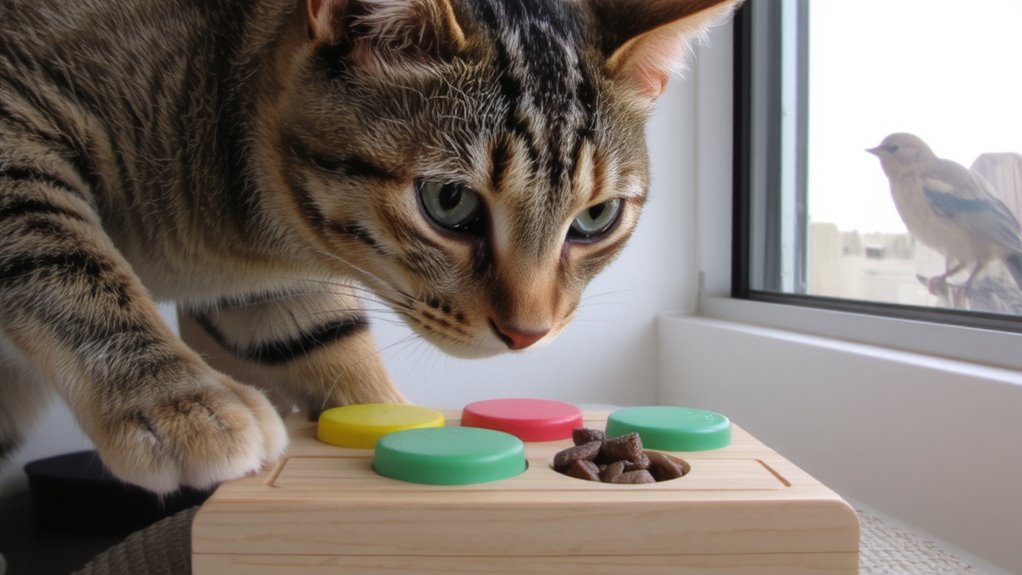
A puzzle feeder isn’t just a toy-it’s a cognitive workout tool designed to activate your cat’s natural hunting instincts. It promotes cognitive development by requiring sustained attention and memory recall during use. Cats must engage in problem solving to access food, mimicking wild foraging behavior. Devices vary in difficulty: Level 1 feeders dispense kibble with minimal manipulation, while Level 3 require sequential paw or nose actions. Studies show cats using puzzle feeders daily exhibit 30% faster learning in discrimination tasks. Most models are made from BPA-free plastic, 6–8 inches in diameter, with adjustable openings from 0.5 to 1.5 inches to control challenge level. These specifications guarantee mental engagement without frustration. Consistent use supports neural plasticity, especially in indoor cats. The feeder’s mechanical resistance and food-reward timing reinforce associative learning. You can track progress by noting reduced completion time over two-week intervals. This structured mental activity enhances overall brain function. Dog training puzzles can also provide similar cognitive benefits for canines, especially when tailored to their best dog training puzzles skill level.
How Puzzle Feeders Prevent Overeating and Obesity
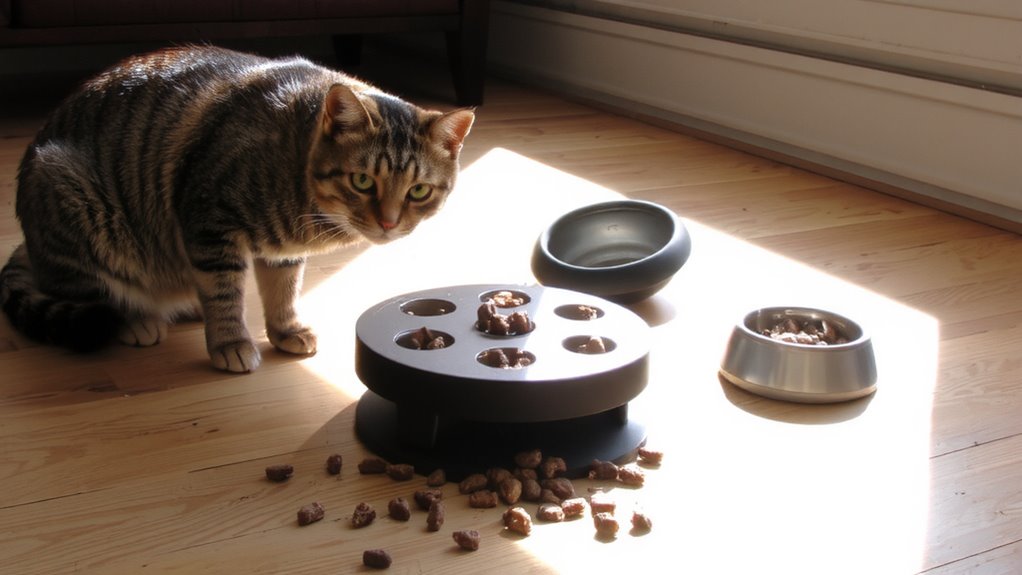
Something as simple as changing how your cat eats can greatly impact their health. Puzzle feeders support portion control and encourage slow eating, both critical in preventing overeating and obesity. These devices dispense food only after your cat solves a simple challenge, mimicking natural foraging behavior and extending mealtime duration by up to 300%. This slower consumption supports digestion and reduces the urge to gorge. Dogs using similar puzzle toys for smart dogs show improved mental engagement and reduced destructive behaviors.
| Feature | Benefit | Technical Detail |
|---|---|---|
| Portion control | Limits calorie intake | Dispenses 10–15g per session |
| Slow eating | Improves satiety signals | Increases meal time to 10–15 min |
| Interactive design | Reduces begging | Requires physical or cognitive effort |
Pick the Right Feeder for Your Cat’s Skill Level
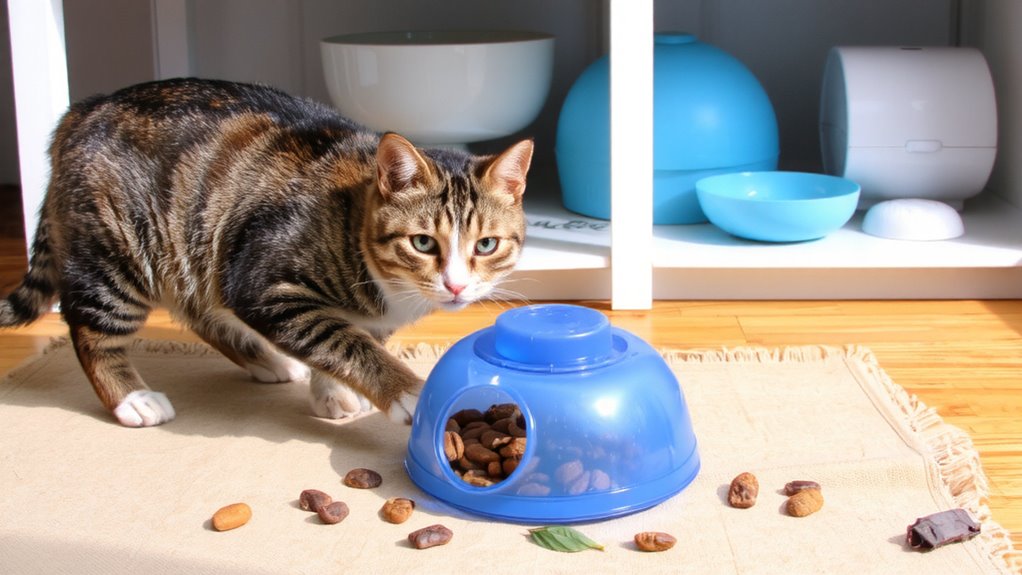
How do you know which puzzle feeder matches your cat’s abilities? Start by evaluating your cat’s problem-solving experience. For beginners, choose feeders with low food difficulty, such as flat mats or shallow trays with visible kibble. These have minimal barriers and wide openings, typically 1–1.5 inches wide, allowing easy access. As your cat masters the basics, introduce moderate-challenge feeders like rolling balls or rotary trays with narrower compartments, increasing food difficulty gradually. Skill progression is critical-advanced models feature multi-step mechanisms, locked compartments, or sliding parts requiring coordinated paw and nose actions. These can have opening sizes under 0.75 inches, demanding dexterity and persistence. Always match the feeder’s technical design to your cat’s cognitive level. Using appropriately challenging feeders sustains engagement without frustration, supporting long-term mental stimulation and effective weight management through structured foraging effort. Similar to the best puzzle toys for dogs, interactive design features play a key role in maintaining animal engagement and cognitive development.
How to Introduce a Puzzle Feeder Successfully
Why struggle through trial and error when introducing a puzzle feeder? Start by evaluating your cat’s food motivation-highly food-driven cats adapt faster. Place the puzzle feeder in a quiet, familiar area for initial trial placement, minimizing distractions. Begin with an easy model, such as a rolled towel with kibble tucked inside, to build confidence. Use 10–15% of the cat’s daily ration to avoid satiation. Monitor interaction time; most cats engage within 5–10 minutes if the challenge is appropriate. Gradually increase difficulty only after consistent success over three consecutive meals. Avoid forcing interaction-positive reinforcement encourages exploration. Make certain the feeder is stable and non-toxic, with no small detachable parts. After successful trials, shift to regular feeding. Proper introduction boosts engagement and prevents frustration, making certain of long-term use.
Turn Meals Into Games: Enrichment Ideas That Work
Where do you start when transforming your cat’s daily meals into engaging mental workouts? Begin by integrating puzzle feeders that mimic natural hunting simulation. Use feeders with adjustable difficulty-such as the Kong Classic or Outward Hound Nababall-that release kibble as your cat bats them. These devices encourage physical activity and cognitive engagement. Dispense meals in timed intervals using automated puzzles like the PetSafe Busy Buddy, which delays access by 3–5 seconds per treat, prolonging feeding duration up to 20 minutes. Rotate feeders weekly to maintain novelty and prevent habituation. Incorporate food variety by alternating between dry kibble, freeze-dried morsels, and moist treats to stimulate sensory exploration. Position multiple feeders in different rooms to simulate prey dispersion. This approach increases foraging time from under a minute to over 25 minutes daily, closely aligning with natural feline feeding behaviors.
Why Your Cat Ignores the Feeder (And How to Fix It)
Could it be that your cat’s disinterest stems from a mismatch between instinct and design? Cats rely on sensory cues to initiate feeding, and improper feeder placement or ignored food preferences may disrupt engagement. Make sure the puzzle feeder is located in a quiet, low-traffic area to reduce stress. Avoid high-activity zones or near litter boxes. Match food texture and size to the feeder’s mechanisms-kibble must fit the openings.
| Issue | Cause | Solution |
|---|---|---|
| No interaction | Poor feeder placement | Relocate to quiet zone |
| Paw rejection | Wrong food size | Use kibble under 12mm |
| Sniff and leave | Food preferences | Try freeze-dried chicken |
| Rapid disinterest | Low challenge level | Upgrade to multi-step design |
Adjust design complexity and food type to your cat’s hunting style. Success depends on alignment with natural behavior.
Fit Puzzle Feeders Into Your Cat’s Daily Routine
Introducing puzzle feeders into your cat’s day supports natural foraging behaviors while promoting mental engagement. Use your current feeding schedule to replace one or two bowl meals with puzzle sessions. Start with 10-minute intervals, gradually increasing to 20 as your cat adapts. Opt for timed release models with adjustable difficulty-begin at Level 1 to avoid frustration. Position the feeder in a low-traffic area, ensuring 36 inches of clearance for movement. Incorporate play integration by using the puzzle pre-play to stimulate focus or post-play to wind down. Distribute 70% of daily kibble via puzzles to reduce overeating. Monitor food retrieval time; if solved in under two minutes, advance to a higher complexity tier. Consistent use aligns with circadian foraging patterns, improving digestion and reducing begging. Track progress weekly using a behavior log. Adjust placement, difficulty, or timing if engagement drops.
On a final note
You substantially boost your cat’s cognitive function and eating regulation using puzzle feeders. These devices slow ingestion rates by 60–80%, reducing meal speed from 3 minutes to over 15. Choose feeder types based on difficulty ratings: level 1 (roll-out bowls) for beginners, level 3 (slider mazes) for advanced users. Introduce gradually, using ¼ of daily kibble. Monitor engagement; adjust difficulty to maintain problem-solving activity for 10–20 minutes per session.