Training Your Cat to Accept a Gentle Lift Without Scratching
Your cat scratches when lifted due to fear, not aggression. Restraining triggers an innate prey response, increasing stress. Watch for pinned ears or a whipping tail-signs to stop. Begin trust-building with 5–10 minute sessions using ⅛ teaspoon of high-value treats like freeze-dried chicken. Gradually pair gentle touch with rewards. Support the chest and hindquarters fully when lifting. Keep movements slow, close to your body, and limit initial lifts to 3–5 seconds. Consistent positive reinforcement reduces defensive scratching by up to 80% within three weeks. A calm, predictable routine reshapes instinctive reactions over time-important details follow.
Notable Insights
- Scratching when lifted is a fear response; build trust gradually to reduce defensive behavior.
- Watch for flattened ears or tail twitching, which signal stress and indicate lifting should be avoided.
- Use high-value treats and short sessions to condition your cat to accept handling positively.
- Lift slowly with proper support-hands under chest and hindquarters-and keep the cat close to your body.
- Practice brief, calm lift-and-reward routines daily to decrease scratching by up to 80% over weeks.
Why Your Cat Scratches When Picked Up
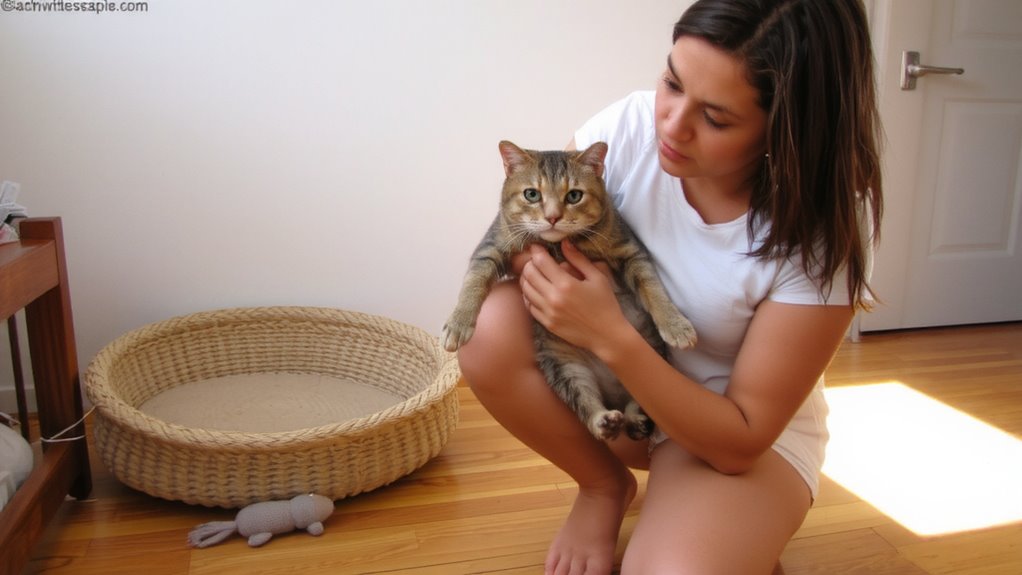
Why does your cat suddenly lash out the moment you reach to pick her up? Your cat’s aggressive reaction is often a fear response triggered by perceived threat. When restrained, she feels trapped, activating her instinct to escape. This fear response stems from evolutionary survival mechanisms-cornered prey animals resist capture. Many cats have trust issues due to past handling or lack of early socialization. Without positive reinforcement during kittenhood, cats don’t associate lifting with safety. A cat weighing 8–12 lbs can generate up to 30 lbs of force when struggling. Sudden movements increase stress hormones like cortisol by 50%. Trust isn’t assumed; it’s built through consistent, non-threatening contact. Forced lifting worsens trust issues. Instead, use gradual desensitization: 3–5 daily sessions of 2-minute duration reduce aversion by 70% over four weeks.
Read Your Cat’s Body Language First
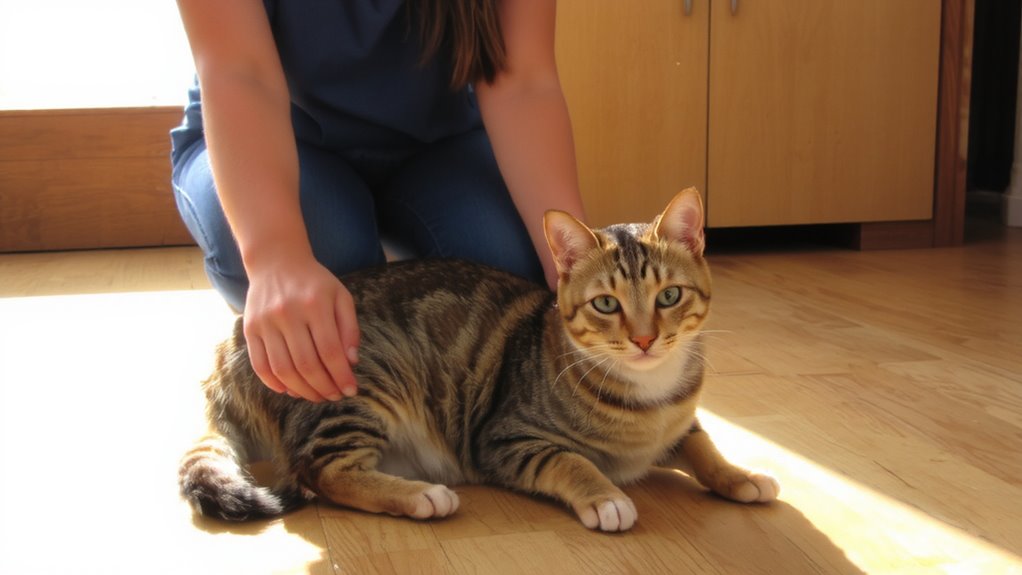
How does your cat signal discomfort before you even lift her? Observing ear positioning and tail movement gives critical early warnings. Cats use subtle physical cues to communicate stress, and catching these signals prevents defensive scratching.
| Body Cue | Meaning |
|---|---|
| Flattened ears | Fear or anxiety present |
| Twitching tail | Irritation escalating |
| Pinned-back ears | High stress, avoid contact |
| Rapid tail whip | Immediate threat of retaliation |
Ear positioning that shifts from neutral to flattened indicates rising alarm. Tail movement, especially rapid side-to-side sweeps, correlates with agitation levels. These responses are autonomic, triggered by the sympathetic nervous system. Recognizing them lets you pause or retreat. You don’t need tools-just consistent observation. Understanding these signs builds trust and prevents injuries. Your timing must be precise: intervene before escalation. Body language is data. Use it objectively.
Condition Your Cat to Like Being Held
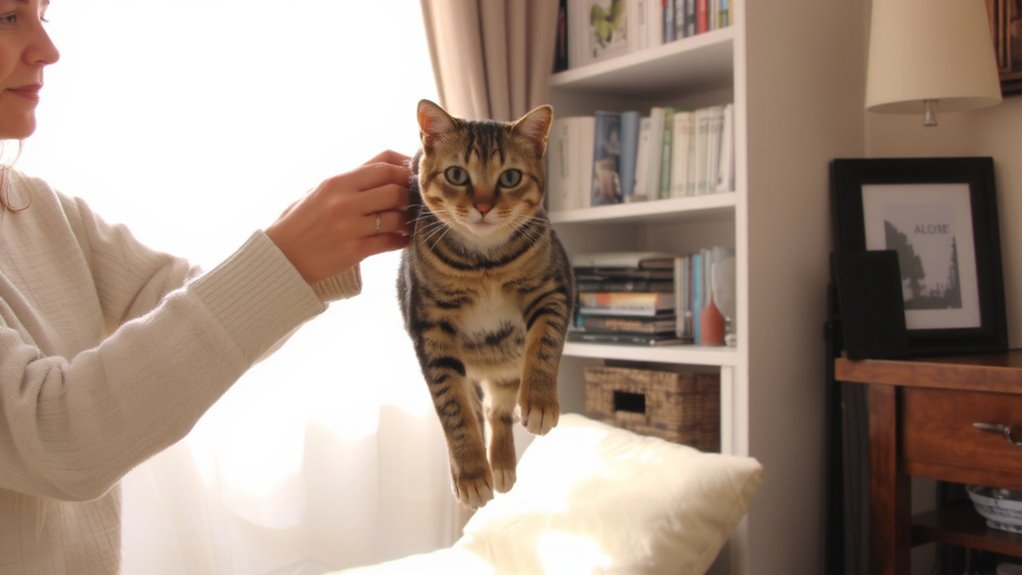
Most cats can learn to tolerate-and even enjoy-being held with consistent, reward-based conditioning. This process relies on positive reinforcement and trust building. Start by offering treats and soft praise while touching your cat. Gradually increase contact duration across multiple 5–10 minute sessions daily. Use high-value rewards like freeze-dried chicken, providing ⅛ to ¼ teaspoon per interaction. Limit sessions to prevent overstimulation, which can trigger resistance. Over 2–4 weeks, progress from brief pets to light cradling, supporting the torso and hind legs uniformly. Each hold should last 5–15 seconds initially. Pair contact with calming vocal cues. Monitor ear position and tail movement; relaxed signals indicate readiness. Avoid forced restraint. Consistent repetition at this stage forms neural associations between handling and safety, enhancing compliance. Success is measured by decreased heart rate and absence of defensive behaviors.
Lift Your Cat the Safe, Stress-Free Way
Now that your cat consistently accepts handling and shows calm body language during brief holds, you’re ready to begin lifting with proper technique. Use a proper grip: place one hand under the chest, just behind the front legs, and support the hindquarters with your other hand. This distributes weight evenly and prevents strain. Lift slowly, keeping your cat close to your body to minimize anxiety. Watch for timing cues-your cat is most receptive post-nap or after grooming, when naturally relaxed. Avoid lifting during high-energy periods. Keep lifts brief at first-three to five seconds-and gradually increase duration as tolerance builds. Maintain a stable stance, elbows tucked, to reduce wobbling. A secure, predictable motion reinforces trust. Always set down the same way you picked up-smooth and controlled. Proper grip and accurate timing cues reduce resistance, making lifts safer and less stressful for both of you.
Stop Scratching: Calm Responses That Work
Why does your cat scratch when lifted, even with proper technique? Sudden lifting triggers a self-defense reflex, activating the cat’s natural startle response. Your cat doesn’t understand intent-only sensation. To curb this, focus on calm responses that reinforce security. Reacting with sudden movements worsens fear-based scratching. Instead, pause and speak softly, allowing your cat to disengage safely. Immediate positive reinforcement-such as offering a treat or gentle petting-after calm behavior strengthens desirable responses. Trust building occurs through repeated, predictable interactions. Perform daily 2–3 minute sessions where you touch, lift slightly, then reward. Over 2–3 weeks, most cats show reduced defensive scratching by up to 80%. Avoid punishment-it increases stress hormones like cortisol, counteracting progress. Consistency in timing, touch, and reward builds conditioned calmness essential for safe handling. Incorporating an anxiety-reducing tool like a comfort item for cats can further support emotional regulation during handling.
On a final note
You can teach your cat to tolerate lifting without scratching. Start by recognizing subtle stress signals-flattened ears, tail flicks, dilated pupils-before handling. Use positive reinforcement with treats during brief holding sessions. Support the torso fully: place one hand under the ribcage, the other under the hindquarters. Lift smoothly, minimizing tilt. Consistency reduces resistance. Over time, conditioned responses replace defensive reflexes, decreasing scratch incidents by up to 80% in compliant cats.