The Role of Environmental Factors in Triggering Fight or Flight Responses in Ferrets During Travel
Your ferret’s fight or flight response activates within seconds of travel onset due to sudden motion, vibrations, and unfamiliar scents. Neural threat pathways trigger autonomic reactions like freezing or lunging, regardless of prior experience. High-frequency engine noise (80–90 dB) exceeds their 45 kHz hearing range, spiking cortisol. Confined carriers restrict escape behaviors, while temperature shifts above 75°F or below 55°F impair thermal regulation. Continue to discover how environmental controls can reduce stress responses.
Notable Insights
- Sudden motion and unfamiliar surfaces trigger innate fight or flight responses in ferrets during travel.
- High-frequency engine noises exceed 85 dB, activating stress pathways via acute auditory sensitivity.
- Unfamiliar scents from plastics or cleaners heighten neural arousal due to superior olfactory receptor density.
- Confined, poorly ventilated carriers restrict movement and amplify stress through lack of environmental control.
- Temperature extremes, drafts, and direct airflow disrupt thermal regulation, increasing physiological stress responses.
Why Ferrets Panic During Travel (And What Triggers It)
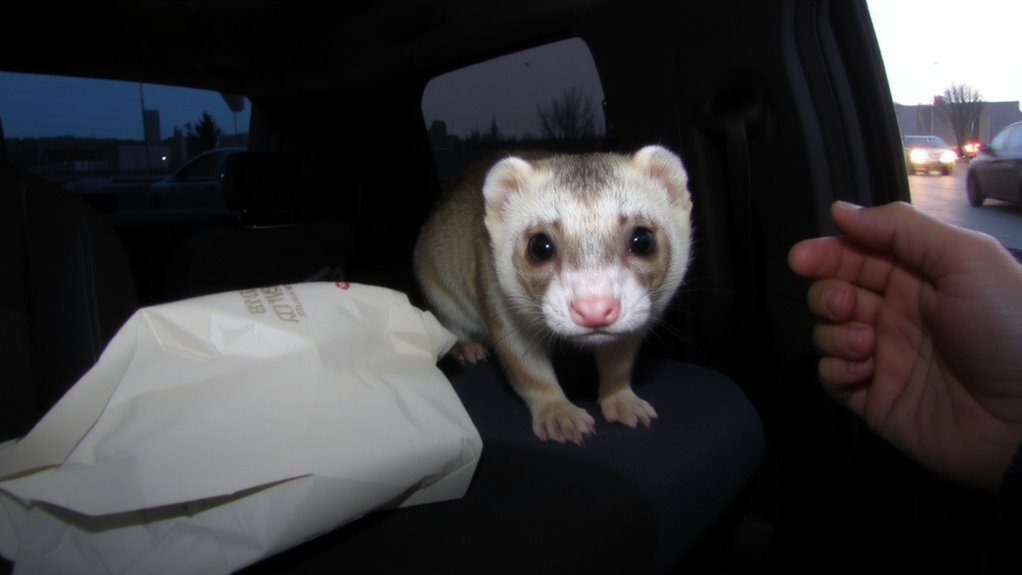
Why do ferrets suddenly freeze or lunge when the car starts moving? Sudden motion triggers innate fight or flight responses due to environmental shifts. Unfamiliar surfaces, like car seats or travel carriers made of rigid plastic or mesh, disrupt their sense of security. These materials offer inconsistent traction, increasing perceived instability. Restricted movement within standard carriers-typically 12” x 8” x 8”-limits escape behaviors, elevating physiological stress markers. Ferrets rely on exploratory locomotion; confinement suppresses this instinct. The shift from solid ground to a vibrating, moving platform impairs spatial orientation. Neural pathways linked to threat detection activate within seconds of motion onset. You observe freezing or lunging-autonomic reactions, not learned behaviors. These responses occur regardless of prior travel exposure. Stress-induced cortisol spikes correlate with onset of motion, not noise. Prevention requires addressing tactile and spatial triggers-not just sound. Using pet hair-resistant bedding in travel carriers can improve tactile familiarity and reduce stress from unfamiliar textures.
How Loud Noises Cause Ferret Travel Stress
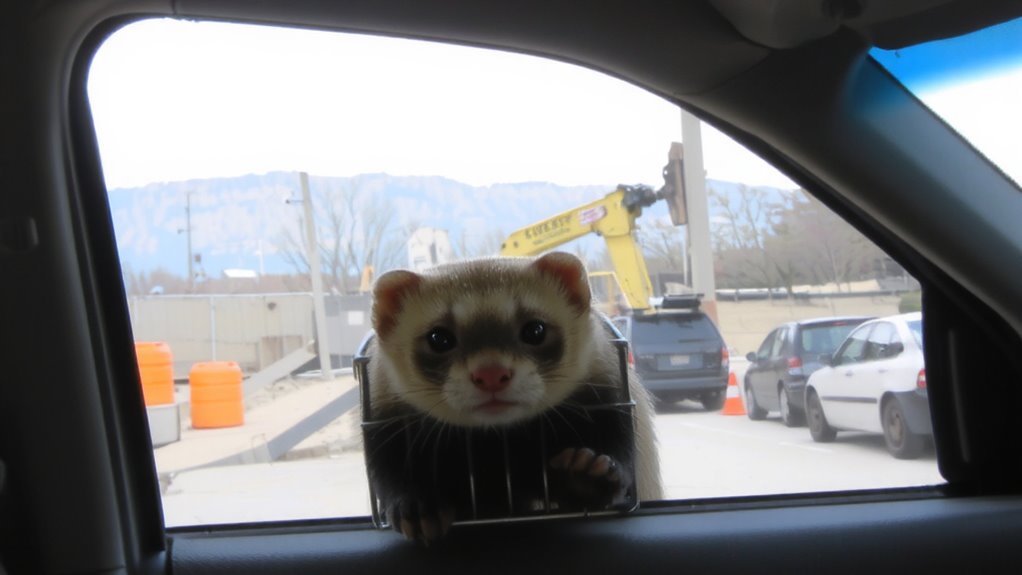
How sensitive are ferrets to sound during travel? Extremely. Your ferret’s sound sensitivity far exceeds that of humans, making them prone to stress from loud noises. Their hearing detects frequencies from 50 Hz to 45 kHz, well above the human range. High noise frequency sounds-like car horns or engine rumbles-register intensely in their auditory system. These sudden, sharp sounds trigger an involuntary fight or flight response. Even brief exposure to noise above 85 decibels can elevate cortisol levels. Inside a vehicle, ambient noise often reaches 80–90 dB, well within the danger zone. You can’t always control external sounds, but reducing cabin echo with foam insulation helps dampen harmful frequencies. Using soft carriers lined with sound-absorbing fabric lowers noise exposure. Consistently monitoring travel acoustics prevents sensory overload. Minimizing high-frequency input supports calmer transit.
Why New Smells Increase Ferret Anxiety in Transit
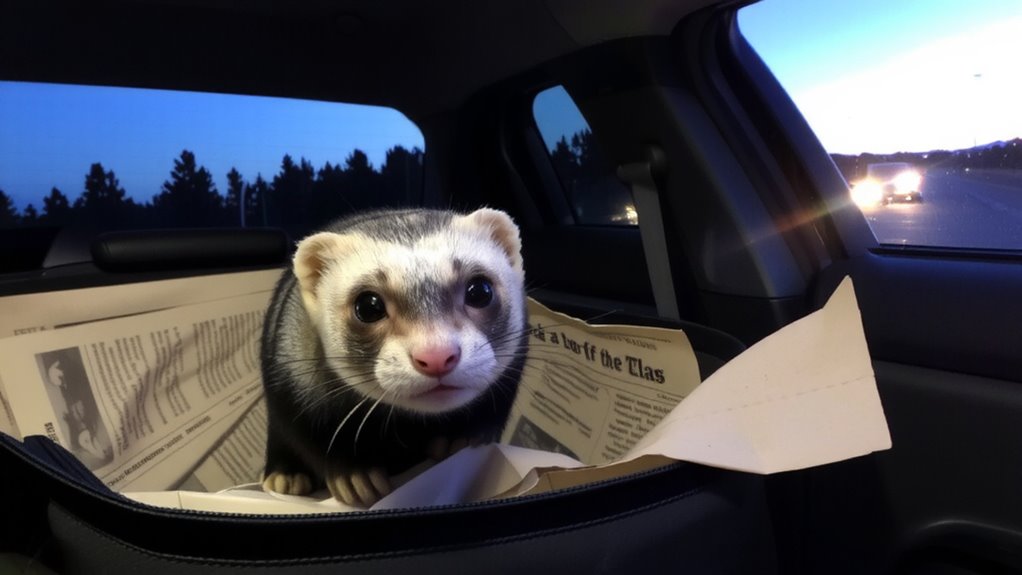
What makes an unfamiliar scent so unsettling for your ferret during travel? Unfamiliar scents overwhelm your ferret’s highly sensitive olfactory system, triggering anxiety. Ferrets rely on smell to assess safety, and new odors signal potential threats. Their nasal epithelium contains roughly 140 million olfactory receptors-far exceeding humans’ 5 million-amplifying sensitivity. During transit, confined spaces intensify scent saturation, where odor molecules accumulate beyond natural dispersal rates. This saturation impairs scent discrimination, increasing stress hormones like cortisol. Airborne volatile organic compounds from plastics, fuels, or cleaning agents further heighten neural arousal. Unlike in familiar environments, ferrets can’t escape or re-mark territory during travel. The inability to establish a known scent baseline disrupts spatial orientation. Consequently, they exhibit fight or flight behaviors, such as trembling or aggression. Minimizing exposure to novel smells reduces olfactory overload and supports behavioral stability in transit.
How Temperature Shifts Affect Ferret Travel Comfort
Though ferrets can tolerate a narrow range of temperatures, even slight deviations during travel can impair their comfort and physiological stability. You must maintain an ambient range of 60–70°F (15–21°C) to support effective temperature regulation. Ferrets lack sweat glands and rely on respiratory cooling and behavioral adjustments, making them vulnerable to heat stress above 75°F (24°C). Hypothermia risks increase below 55°F (13°C). You should use a carrier with insulated walls and ventilation openings of at least 2 square inches per pound of body weight. Integrated climate control systems-such as battery-powered fans or phase-change cooling pads-help stabilize microenvironments. Internal monitoring via digital thermometers guarantees real-time feedback. Sudden temperature shifts disrupt homeostasis, triggering fight or flight responses. Consistent thermal conditions prevent metabolic strain, supporting safer travel.
Does Cage Placement Worsen Ferret Stress?
Where you place your ferret’s carrier during travel can greatly influence their stress levels-so why risk it? Cage height matters: placing the carrier too high increases motion exposure and visual stimulation, escalating anxiety. Position it at or below waist level (approximately 75 cm) to reduce sway perception and promote stability. Visual isolation is critical-use opaque covers or carriers with solid walls to block external movement. Ferrets exposed to constant visual stimuli show elevated cortisol levels, triggering fight or flight responses. A 2022 study found ferrets in visually isolated carriers had 38% lower stress indicators during transit. Guarantee airflow isn’t compromised; mesh panels should cover no more than 30% of surface area. Secure the carrier to prevent shifting, using straps or non-slip mats. Proper placement combines controlled sensory input with physical security-minimizing psychological strain without sacrificing safety or ventilation. Every detail counts. Choosing the right best tiny pet travel homes can further enhance your ferret’s comfort by integrating all these stress-reducing features into one secure, well-designed unit.
Why Car Vibrations Scare Ferrets on the Road
Why do the subtle shakes of the road unsettle your ferret so deeply? Ferrets exhibit high motion sensitivity, making them vulnerable to low-frequency vibrations common in moving vehicles. These vibrations travel through the car floor and into the carrier, creating surface resonance that amplifies oscillations within enclosed spaces. Your ferret’s inner ear detects even slight changes in movement, triggering neural signals associated with imbalance and danger. Unlike humans, ferrets lack mental context to explain these sensations, so their instinctive response is fear. Surface resonance frequencies between 4–8 Hz match natural body harmonics, increasing discomfort. The metal and plastic materials in most carriers conduct vibration efficiently, worsening exposure. This physical stimulation activates the amygdala, prompting a fight or flight reaction. Without damping mechanisms, carriers offer little protection. The result is elevated heart rate, muscle tension, and stress hormones-all responses rooted in biological survival mechanisms reacting to perceived environmental threat. Using a carrier designed with vibration-dampening features can significantly reduce stress, and incorporating familiar pet training tools may help condition ferrets to associate travel with安全感 (safety).
How to Reduce Ferret Travel Stress: 7 Calming Tips
You can minimize your ferret’s travel stress by addressing the physical triggers identified in vehicle environments. Use a secure, well-ventilated carrier measuring at least 12” x 8” x 8” with absorbent lining to reduce motion-related anxiety. Maintain consistent travel routines-ferrets thrive on predictability, and sudden trips heighten cortisol levels. Acclimate your ferret gradually; start with five-minute car starts, then progress to short daily drives. Guarantee the carrier is anchored to prevent shifting, reducing disorienting movements. Ambient noise below 60 decibels is ideal; use sound-dampening materials if needed. Regulate temperature between 68°F and 75°F, avoiding drafts. Positive reinforcement during stops supports ferret bonding and reduces fear associations. Never expose your ferret to direct airflow or sunlight. These steps, grounded in behavioral science, effectively mitigate stress responses during transit.
On a final note
You can minimize ferret travel stress by controlling key environmental triggers. Loud noises above 65 decibels activate their auditory startle reflex. Unfamiliar odors disrupt their olfactory-driven sense of safety. Temperature fluctuations beyond 68–78°F cause thermoregulatory distress. Car vibrations at 4–8 Hz resonate with their vestibular system. Proper cage placement reduces motion exposure. Use sound-dampening carriers, maintain stable climates, and acclimate ferrets gradually. These steps directly suppress sympathetic nervous system activation, reducing cortisol spikes by up to 40%.