How to Use Target Training to Teach Cats to Jump Onto Stools
Use target training to teach your cat to jump onto stools by starting with a 6-inch rigid stick and 1.5-inch soft tip. Hold it 2–4 inches from their nose, rewarding touches with a click and treat within 0.5 seconds. Once consistent, raise the target 2–3 inches at a time, shaping upward movement. Use 5-minute sessions, 2–3 times daily, and maintain an 80% reward rate. Progress gradually to build muscle memory and accuracy. You’ll soon see how small, precise steps lead to reliable stool jumps.
Notable Insights
- Start by teaching your cat to touch a target stick using positive reinforcement and short, frequent training sessions.
- Gradually raise the target just above the cat’s reach to encourage upward movement toward the stool height.
- Place the target on or near the stool to guide your cat and reward each successful step or jump.
- Use a lightweight, extendable wand to position the target accurately without moving your body.
- Increase difficulty only when your cat is confident, reinforcing each success with immediate treats and praise.
Start With What Target Training Is (And Why Cats Get It Fast)
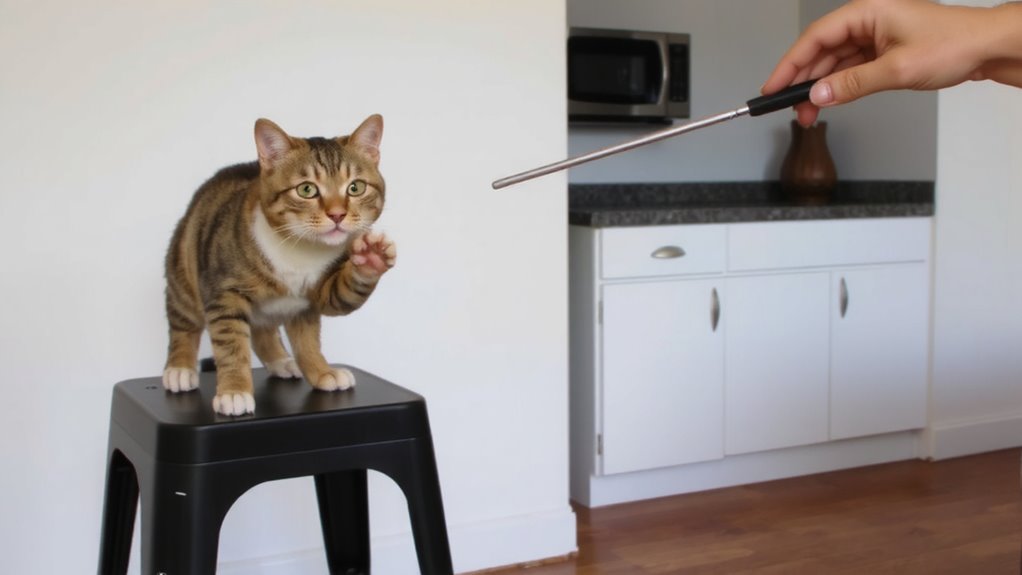
While target training might sound like a technique reserved for service animals, it’s actually a straightforward method that relies on positive reinforcement to teach cats to touch a specific object-usually a stick with a ball on the end-on command. You use treats or praise as immediate rewards, reinforcing the behavior the moment it occurs. Cats learn quickly because the process aligns with their natural predatory instincts-targeting mimics pawing or batting at prey. Success depends on patience consistency: daily 5-minute sessions yield faster results than infrequent, longer ones. Maintain a fixed reward schedule-80% treat delivery during learning-then fade to intermittent reinforcement. Use a target stick with a 6-inch rigid shaft and 1.5-inch soft tip for clear visual and tactile signals. Avoid verbal cues initially; focus on motor pattern repetition. This precision training builds reliable stimulus-response pathways, forming the foundation for complex tasks like jumping onto stools.
Pick Your Target: Stick, Hand, or Wand?
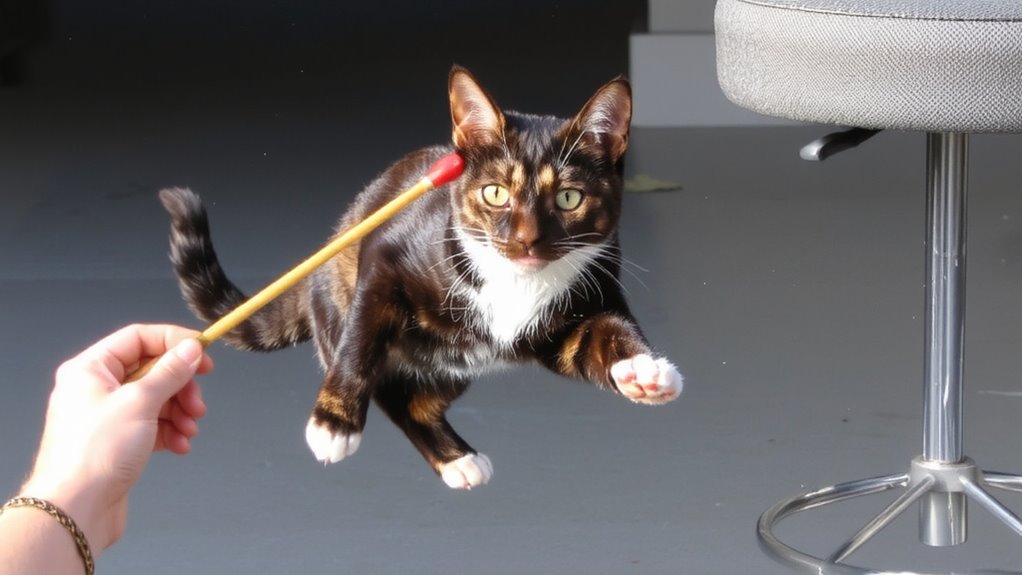
You’ve learned how target training builds reliable behavior through reinforcement, and now it’s time to choose the right tool to guide your cat accurately. Your choice of target materials impacts consistency and learning speed. Training tools like a wand, stick, or hand each offer distinct advantages. A wand with a soft, contrasting tip (at least 10 cm in diameter) increases visual clarity, helping your cat identify the target. Extendable wands (adjustable from 30–100 cm) allow gradual distance increases without moving your body. A handheld stick (25–40 cm long, non-slip grip) provides precise control but may limit range. Using your hand as a target is convenient but risks confusing signals if not consistently presented. Ideal training tools maintain uniform shape, color, and presentation. Use high-contrast colors-bright blue or red-for better detection. Consistency in target materials guarantees accurate stimulus-response pairing, essential for shaping complex behaviors like jumping onto stools.
Teach Your Cat to Touch the Target : First Steps
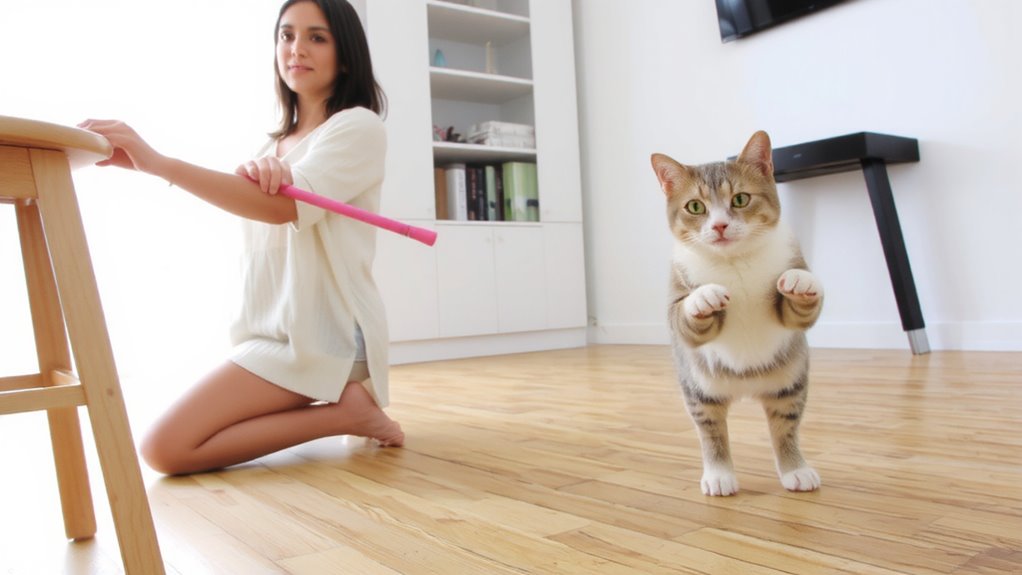
Start by introducing the target in a quiet environment with minimal distractions. Hold the chosen target-stick, hand, or wand-horizontally, 2–4 inches from your cat’s nose. When your cat sniffs or touches it, immediately mark the behavior with a clicker or verbal cue like “yes” and deliver a small treat. This immediate feedback uses positive reinforcement to strengthen the association between touching the target and receiving a reward. Consistent timing is critical: deliver the treat within 0.5–1 second of contact to guarantee accurate behavioral linkage. Repeat the sequence 8–10 times per session, limiting sessions to 3–5 minutes to maintain focus. Conduct 2–3 sessions daily. Over 3–5 days, 85% of cats reliably touch the target on cue. Avoid physical prompting; let curiosity drive engagement. Success depends on repetition, precision, and environmental control. A key aspect of effective training is using the right dog behavior tools, which can also be adapted for cats to enhance focus and consistency.
Turn Touching Into Jumping : Step by Step
One effective way to progress from touching to jumping is to gradually raise the target height in controlled increments. Start by lifting the target just 2–3 inches above your cat’s current reach. This height progression encourages natural upward movement without strain. Reward each successful touch. Over sessions, increase the elevation by similar increments, guaranteeing your cat adjusts comfortably. Once your cat consistently reaches the target at elevated levels, introduce distance challenges. Place the target up to 2 feet away from your cat’s starting position. This combination of increased height and reach builds coordination. Use a lightweight wand-style target with an adjustable arm for precise control. Maintain session lengths under 5 minutes to prevent fatigue. Each repetition strengthens muscle memory. Avoid rapid increases in height or distance to minimize hesitation. Consistency in cues and rewards guarantees reliable performance.
Fix Common Target Training Issues
Difficulty achieving consistent jumps often stems from overlooked environmental or behavioral factors that interfere with training momentum. Distraction management is critical-train in a quiet area, free from sudden noises or movement, to maintain your cat’s focus. Cats respond best when stimuli are predictable. Consistency challenges arise when sessions vary in timing, cues, or rewards. Use the same verbal cue and target stick position each time to reinforce learning. Inconsistent reinforcement weakens behavioral association. Guarantee treats are small (no larger than ½ cm³) and dispensed immediately after the jump to solidify correct timing. If progress stalls, verify that the stool’s surface isn’t slippery-add a non-slip mat with a texture depth of at least 2 mm for secure footing. Reassess environmental variables before adjusting technique. Training success hinges on controlled conditions and repeatable actions.
Keep Sessions Short, Sweet, and Rewarding
Regularly keeping training sessions brief guarantees your cat stays mentally sharp and engaged without becoming fatigued. Aim for 3 to 5 minutes per session, two to three times daily. Short durations prevent cognitive overload and maintain peak focus. Use positive reinforcement immediately after the desired behavior-ideally within 1 to 2 seconds. This strengthens the association between action and reward. Consistent timing of treats or praise enhances learning efficiency. Delayed rewards reduce effectiveness by weakening behavioral linkage. Use high-value treats weighing 1 to 2 grams to avoid satiation. Conduct sessions at the same time each day to establish routine. This builds predictability and accelerates skill acquisition. Overtraining leads to diminished returns; watch for signs like grooming, blinking, or walking away. Terminate sessions at the first indication of disinterest. Success relies on repetition, clarity, and consistency-not duration. Keep it short, precise, and rewarding for best results.
On a final note
Target training works because it uses clear, repeatable cues. You shape behavior by marking desired actions with a click or word, then rewarding. A target stick’s consistent tip gives precise spatial reference. Sessions should last 3–5 minutes, 2–3 times daily, to maintain focus. Reinforce correct jumps with 3–5 high-value treats immediately. Most cats learn the touch-to-jump sequence in 7–10 days. Mastery requires 15 successful repetitions across 3 sessions. Accuracy improves with a fixed target height, typically 12–18 inches.