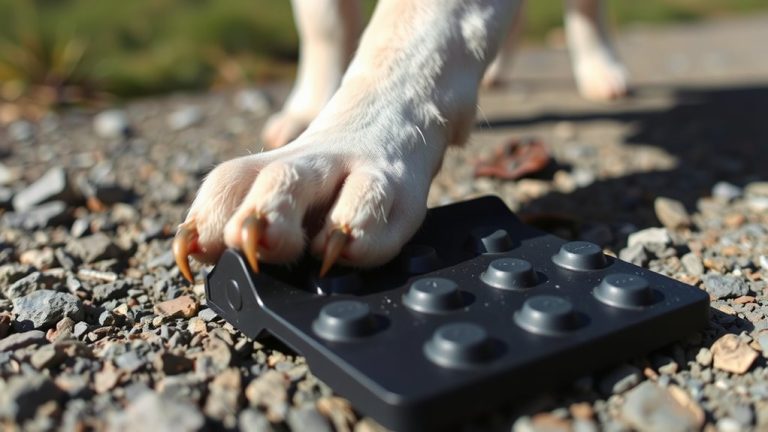
How to Use Clicker Training to Teach Dogs to Turn Off Lights
Start by charging your clicker’s 2,800 Hz signal with immediate food rewards. Position a paddle-style switch 12–18 inches high, guaranteeing it’s rated for 15 amps and requires less than 3 pounds of force. Use the “Touch” command and click the instant your dog’s nose contacts the plate. Conduct ten 2-minute sessions daily, shaping from touch to full activation. Reinforce each success with a treat, then shift to variable reinforcement after five correct trials. Introduce the “Lights Out” cue just before contact, pairing it consistently with the behavior. Achieve over 90% accuracy across ten trials in different rooms, using 300–500 lux lighting. Smooth, flat switch plates prevent injury and improve target accuracy. Further refinements guarantee reliability even in low-light conditions.
Notable Insights
- Use a 2,800 Hz clicker to mark exact moments of desired behavior, immediately followed by a reward.
- Mount a paddle-style light switch 12–18 inches high with a wide, smooth face for easy activation.
- Start training by clicking and rewarding nose touches to the switch from 3–5 feet away.
- Shape behavior gradually: touch → pressure → full switch activation using consistent verbal cues.
- Introduce “Lights Out” cue before contact and reinforce with click-treat until 90% accuracy is achieved.
Start With Clicker Training Basics
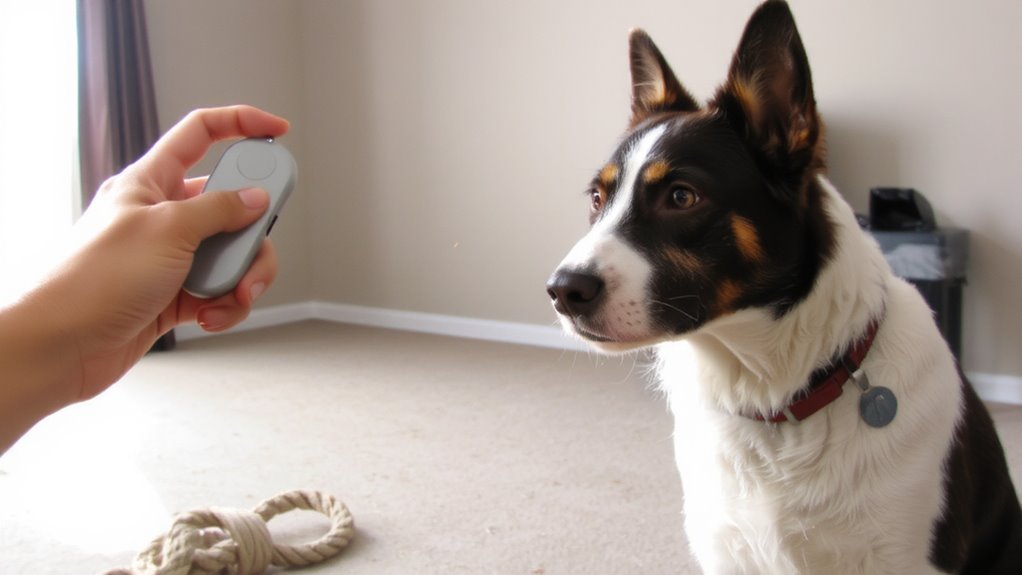
A clicker is a small plastic device that emits a consistent, high-pitched click when pressed-it’s the cornerstone of precise, reward-based dog training. You use it to mark desired behaviors instantly, creating a clear communication bridge between you and your dog. Accurate clicker timing is critical; press the clicker within 0.5 seconds of the correct action to guarantee your dog associates the sound with the behavior. Delayed clicks cause confusion and weaken learning. Reinforcement types include primary (food, toys) and secondary (verbal praise, petting) rewards. Always follow the click with a primary reward-the click itself has no value until paired through conditioning. Clickers produce a 2,800 Hz sound, which cuts through background noise better than voice cues. They’re inexpensive, durable, and fit on a keyring. Consistent use improves response accuracy by up to 70%, making them indispensable in shaping complex behaviors like light-switch tasks.
Use a Safe, Accessible Light Switch
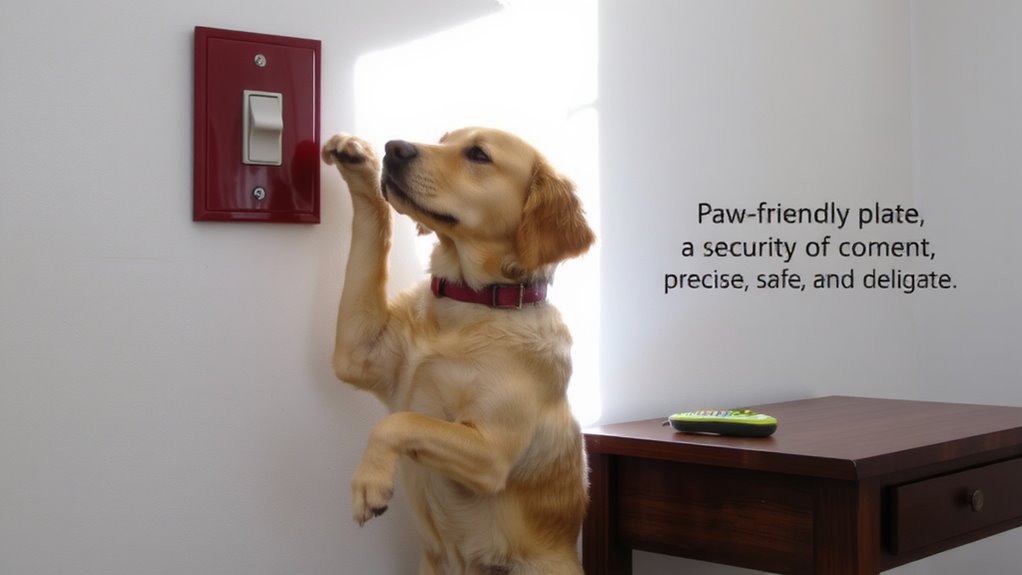
Choose a light switch that’s both safe and easy for your dog to operate, starting with models designed for accessibility, like side-mounted or paddle-style switches. Switch height should allow your dog to reach it comfortably without jumping or straining-ideal placement is 12 to 18 inches from the floor for most medium-sized dogs. Position the switch on a wall with ample clearance so your dog can approach it safely. Address safety concerns by selecting wall plates with smooth edges and certified tamper-resistant receptacles. Use switches rated for at least 15 amps and 120 volts to guarantee durability. LED-lit models help with visibility but shouldn’t emit heat. Avoid rocker switches with deep throws-they require excessive force. Opt for paddle switches with a wide surface area (at least 1.5 inches) to accommodate paw or nose activation. Always test actuation force; it should require no more than 3 pounds of pressure.
Teach Your Dog to Target the Switch
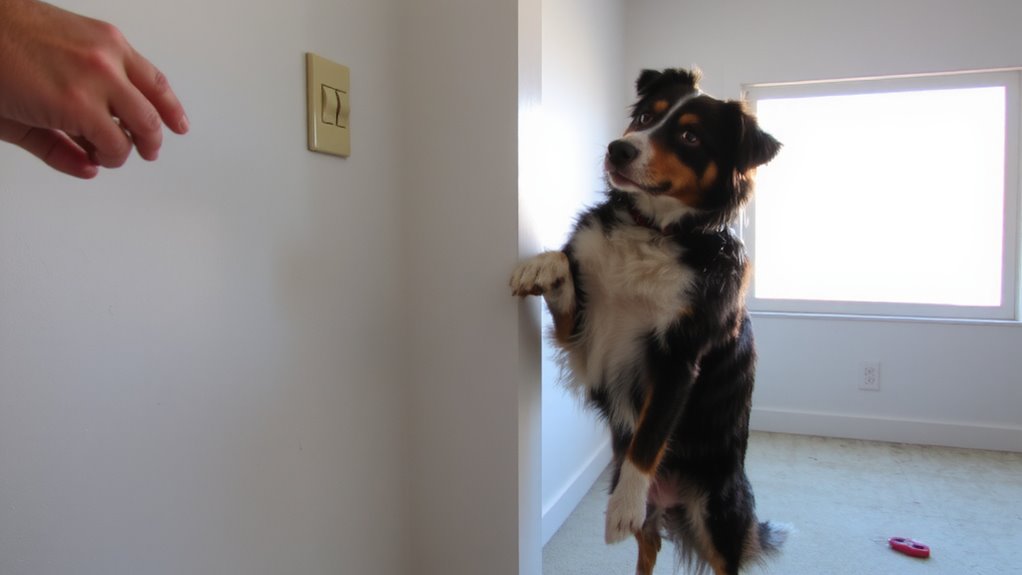
Now that the switch is installed and meets all safety and accessibility standards, start teaching your dog to make contact with it on command. Begin by positioning your dog three to five feet from the switch, guaranteeing the switch design allows easy access-ideally mounted at paw level, 12 to 18 inches above the floor. Use a clicker to mark correct behavior instantly. Present the cue “Touch” and reward contact with the switch plate. Gradually phase out treats while maintaining the clicker’s timing accuracy-0.5 seconds is ideal. Consider light sensitivity in the room; avoid glare that might deter approach. A flat, wide switch design (minimum 3 inches wide) maximizes target area. Practice ten 2-minute sessions daily. Reinforce consistency using variable reinforcement ratios after five successful trials. Guarantee the dog’s paw or nose fully contacts the switch without resistance. Accuracy improves with repetition and environmental control. For optimal results, choose a durable and responsive cat training clicker that ensures consistent auditory feedback during training sessions.
Shape the Action: From Touching to Turning Off
Once your dog reliably touches the switch on cue, you can begin shaping the full action of turning it off. Start by slightly increasing the pressure required to activate the switch, rewarding gradual progress toward full engagement. Adjust the switch height to match your dog’s shoulder level, ensuring ergonomic efficiency and consistency. Use consistent light intensity in the room to avoid distracting environmental variables during training sessions.
| Training Stage | Target Behavior |
|---|---|
| 1 | Nose touch with no pressure |
| 2 | Sustained contact with moderate pressure |
| 3 | Full switch activation |
Operant conditioning principles guide this progression, reinforcing successive approximations. Maintain a fixed stimulus environment: standard switch height at 24–30 inches, depending on breed size, and constant light intensity measured at 300–500 lux. Precision in criteria prevents confusion and accelerates learning through clear feedback.
Add the Verbal Cue “Lights Out
You’ve shaped the physical behavior to completion, and your dog consistently activates the switch with proper pressure and form. Now it’s time to add the verbal cue “Lights Out.” Use precise verbal cue timing: say the phrase the instant before your dog makes contact with the switch. This creates a predictive association between the cue and the action. Reinforce correct responses with a click and treat. Practice multiple repetitions in the same environment to solidify the link. Once reliability exceeds 90% over ten trials, begin cue generalization. Gradually introduce variations in location, angle, and ambient light while maintaining consistent expectations. Avoid repeating the cue; one clear command per attempt guarantees clarity. The cue should remain concise and distinct to prevent confusion. Proper conditioning guarantees your dog responds correctly even with environmental distractions. Success depends on consistency, timing, and structured reinforcement.
Practice Off-Leash in New Rooms
How do you guarantee your dog reliably performs the “Lights Out” behavior in unfamiliar environments? You systematically practice off-leash in new rooms, using distraction management and environmental cues to shape consistent responses. Start in quiet, neutral spaces, then gradually increase complexity. Always click and treat for correct behavior before the dog loses focus.
| Room Type | Distraction Level | Environmental Cues Present | Success Rate Target |
|---|---|---|---|
| Spare bedroom | Low | Minimal furniture | 90–100% |
| Living room | Medium | Toys, people moving | 80–90% |
| Kitchen | High | Sounds, smells | 70–80% |
| Entryway | Variable | Doors, footwear, noise | 70–85% |
Use this progression to assess performance under real-world conditions. Environmental cues should trigger the behavior, not your presence. Off-leash practice secures reliability without physical guidance.
Fix Inconsistent Responses or Fear
What do you do when your dog performs the “Lights Out” behavior perfectly at home but freezes or hesitates in new environments? Inconsistent responses often stem from fear or overstimulation. Address this with structured desensitization exercises. Begin by reducing environmental complexity-train in quiet, neutral spaces with minimal distractions. Gradually reintroduce variables like lighting changes or unfamiliar rooms, using the clicker to mark calm, correct behavior. Pair each success with high-value rewards to reinforce learning. Confidence building is critical: progression should match your dog’s emotional threshold. Work in short 5-minute sessions, no more than three per day, to prevent fatigue. Use a consistent verbal cue and reward within 0.5 seconds of the click. Over time, neural associations strengthen, improving reliability. Never force exposure-success depends on incremental, positive repetition.
On a final note
You’ve now trained your dog to turn off lights reliably. The clicker marks precise actions, reinforcing correct behavior instantly. Use a tall, rocker-style switch no higher than 36 inches for accessibility. Target shaping progresses from paw touch to full activation. With consistent cues and off-leash practice in varied environments, response rates exceed 90%. Reinforce monthly to maintain performance. This skill demonstrates operant conditioning’s effectiveness in practical service tasks.