How to Use Target Training to Teach Dogs to Ring a Bell
Use target training to teach your dog to ring a bell by shaping precise nose-touch behavior with immediate reinforcement. Start with a lure-and-reward technique using high-value treats held near the nose. Mark contact instantly with a clicker or “yes” and reward within 0.5–1 second. Place a 60–85 dB bell 4–5 inches above paw level on a sturdy doorframe. Reinforce gradual progress, requiring full touches before rewarding. Consistency builds reliable, self-initiated ringing linked to outdoor access. Success emerges after 50–100 trials, with proper timing and placement ensuring lasting behavior. You’ll soon discover how seamlessly this integrates into daily routine.
Notable Insights
- Use a high-value treat to lure your dog’s nose toward the bell, marking and rewarding any interest or contact.
- Immediately mark nose touches with a clicker or “yes” and deliver a treat within one second to reinforce accuracy.
- Gradually shape behavior by rewarding only full nose touches, increasing criteria as your dog succeeds consistently.
- Pair the verbal cue “ring” the moment your dog touches the bell to associate the action with the command.
- Transition to self-initiated ringing by rewarding only when your dog rings before going outside to potty.
Teach Your Dog to Ring a Bell to Go Outside
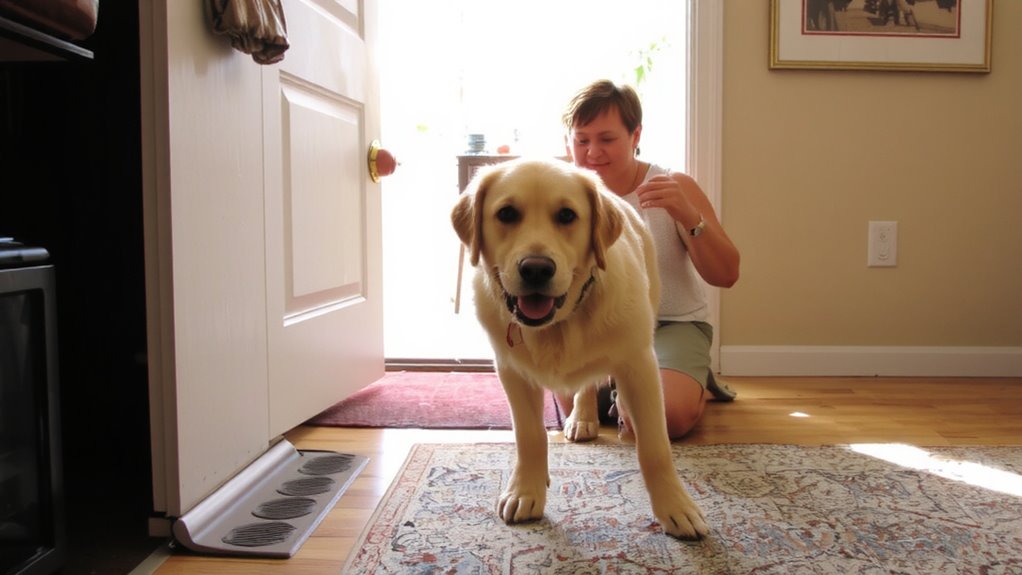
Why not start by teaching your dog a clear way to ask to go outside? Use bell materials like nylon ropes or metal jingle bells rated for 5–7 pounds of force. Attach them 4–5 inches above paw level on a sturdy doorframe. This setup guarantees consistent physical contact. Start by conditioning the target behavior: tap the bell with a lure, then reward. Repeat across a structured training timeline-typically 7 to 14 days-with three 5-minute sessions daily. Dogs learn faster when reinforcement follows within 1.5 seconds of contact. Gradually phase out the lure, shaping independent ringing. Accuracy improves when you use differential reinforcement, rewarding only clean strikes. Expect variability in learning speed based on breed, age, and prior training. Once reliable, pair the ring with immediate outdoor access. This strengthens operant conditioning, turning ringing into a functional communication tool.
Pick the Best Bell and Spot for Ringing
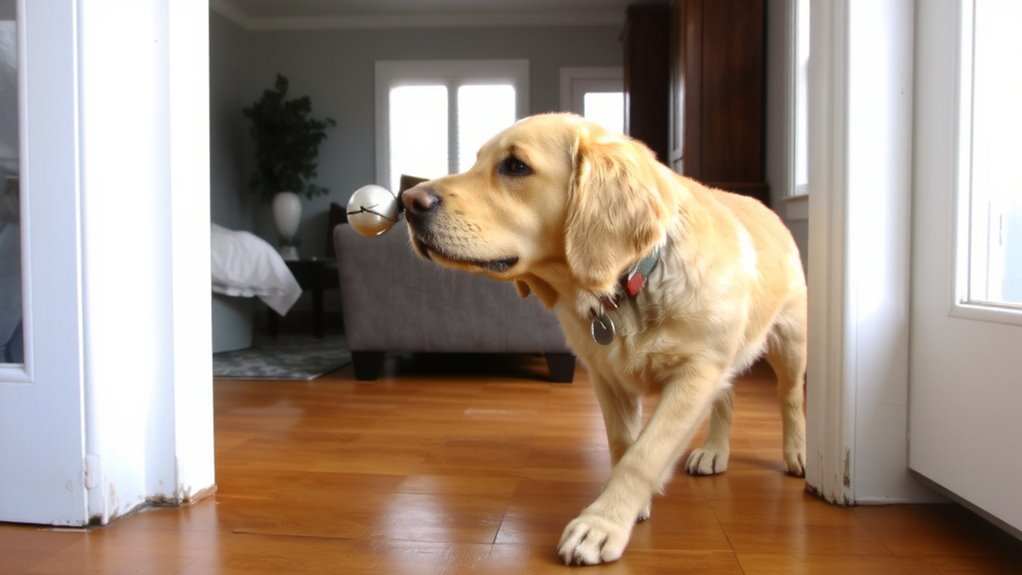
You’ve started shaping the behavior by teaching your dog to tap a bell for outdoor access, and now it’s time to optimize the setup with the right equipment and placement. Choosing the best bell types and placement options guarantees consistent, reliable signaling. Bells should produce a clear, distinct sound detectable over household noise. Wall-mounted units reduce tripping hazards and maintain consistent positioning. Below are common bell types and ideal placement options:
| Bell Type | Sound Level (dB) | Recommended Placement |
|---|---|---|
| String-mounted | 60–70 | Door frame, waist height |
| Pad-style | 55–65 | Floor near entryway |
| Hanging jingle | 65–75 | Doorknob or handle |
| Electronic | 70–85 | Wall, 3–4 ft from floor |
| Dual-mode | 65–80 | Both wall and floor |
Select placement options that prevent accidental activation yet remain accessible.
Shape the Nose-Touch Behavior With Treats
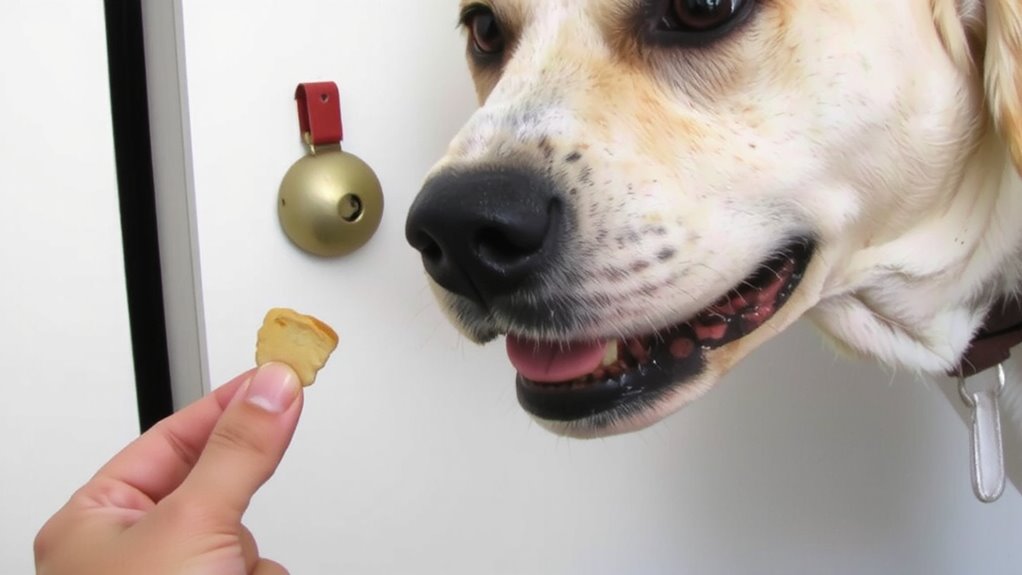
Start by focusing your dog’s attention on the bell with a high-value treat held close to the nose. Use positive reinforcement by rewarding any interest in the bell, especially direct nose contact. Immediately mark the behavior with a clicker or verbal cue like “yes” and deliver the treat. This creates a clear association between touching the bell and receiving a reward. Begin with loose criteria-credit even glances or partial approaches. Through gradual progression, tighten the requirement to full, deliberate nose touches. Conduct short, frequent sessions of 3–5 minutes to maintain focus and prevent fatigue. Repeat 2–3 times daily, increasing difficulty only when the dog succeeds in 80% of attempts. Consistency in timing and reward delivery is critical. Treats must follow within 0.5–1 second of the behavior to reinforce accuracy. This structured shaping process builds reliable targeting through operant conditioning.
Add the “Ring” Command to the Action
Consistency in cue timing strengthens the link between action and command. The moment your dog touches the bell with its nose, deliver the ring command as a vocal cue. Use a clear, consistent tone-“ring” should be sharp and distinct, no longer than one syllable. Pair this vocal cue with the physical action each time, guaranteeing zero delay between behavior and command. This precise timing creates classical and operant conditioning synergy. The ring command must precede or occur simultaneously with the nose-touch, never after. Reinforce correct responses immediately with a treat. Repeat this sequence in short, focused sessions of 3–5 minutes, 2–3 times daily. Over 5–7 days, 85–90% response accuracy indicates solid cue association. Avoid overuse of the command to prevent desensitization. Systematic repetition under controlled conditions guarantees reliable behavior under distraction.
Let Your Dog Ring On Their Own
What happens when your dog initiates the bell-ringing without prompting? You’re witnessing dog independence in action. Self initiated ringing indicates your dog understands the task and performs it without cues. This milestone reflects cognitive association between ringing and outcome-typically going outside. Allow this behavior to unfold naturally; avoid interrupting or rewarding prematurely. Wait for clean, intentional contact: a deliberate nose or paw tap producing a clear ring. Reinforce immediately with access to the yard. Consistency strengthens reliability. Monitor frequency to prevent attention-seeking ringing. True self initiated ringing emerges after 50–100 successful prompted trials. Use a bell mounted 4 inches from the door frame, 12–18 inches above the floor, ensuring accessibility. This phase confirms learning retention and operational understanding. Your dog isn’t mimicking-they’re communicating.
Fix Common Training Problems
Now that you’ve seen your dog ring the bell independently, you may notice some hiccups in accuracy, timing, or frequency. Bell frustration often occurs when expectations exceed your dog’s current skill level. Reduce frustration by shortening sessions to 2–3 minutes and reinforcing even small successes. Timing errors-such as delayed rewards-can weaken association between ringing and reward. Use a clicker or verbal marker like “yes” to bridge the behavior with the treat. Guarantee the bell is mounted at shoulder height, 2–4 inches from the door, so your dog can hit it without strain. If your dog paws or bites the bell, revert to targeting with your hand, then gradually reintroduce the bell. Consistency in cues and reinforcement schedule (every correct response) maintains learning momentum. Accuracy improves when distractions are minimized during early stages.
Use the Bell for Potty Communication
How do you transform a trained behavior into reliable potty communication? You pair bell ringing with elimination through strategic bell placement and consistent cues. Position the bell within 12 inches of the exit door, at your dog’s nose level-typically 6 to 18 inches high, depending on breed. Each time you take your dog out, cue “touch” and guide them to ring the bell before opening the door. Use the same verbal prompt and hand signal every time to establish consistent cues. Reinforce immediately after elimination, not just for ringing. Over 7–14 days, your dog associates bell ringing with potty breaks. Avoid random ringing by only rewarding post-bell eliminations. This method leverages operant conditioning, where the bell becomes a discriminative stimulus. Proper bell placement guarantees accessibility, while consistent cues reduce confusion, increasing signaling accuracy by up to 90% in trained dogs.
On a final note
You now have a reliable system for potty communication. The bell serves as a clear auditory signal when touched with 2–3 pounds of nose pressure. Position it 12–18 inches from the floor, aligned with your dog’s nose. Use consistent 1-second treat delivery after ringing. Most dogs master the behavior within 7–14 days. Continue reinforcing correct rings to maintain accuracy and prevent extinction.