Using Food-Dispensing Toys to Reduce Rapid Eating in Competitive Cats
You can slow your cat’s eating by using food-dispensing toys designed to mimic foraging. These puzzles release 1–3 kibble pieces per interaction through 1.2-inch apertures, extending mealtime to 10–20 minutes. Models made of BPA-free polypropylene with rotating discs or treat mazes reduce consumption speed by up to 70%. Multi-stage, wall-mounted designs minimize food theft in competitive households. Start with Level 1 puzzles, then adjust difficulty as skills improve-there’s more to optimizing this strategy effectively.
Notable Insights
- Food-dispensing toys slow eating by requiring physical and mental effort before each bite.
- Puzzle feeders reduce food competition by allowing separate, controlled feeding in multi-cat homes.
- Using treat mazes with narrow channels extends mealtime from seconds to up to 20 minutes.
- Start with low-difficulty puzzles and gradually increase challenge based on the cat’s skill level.
- Introduce puzzles during mild hunger using preferred treats to encourage consistent engagement.
Why Your Cat Eats Too Fast
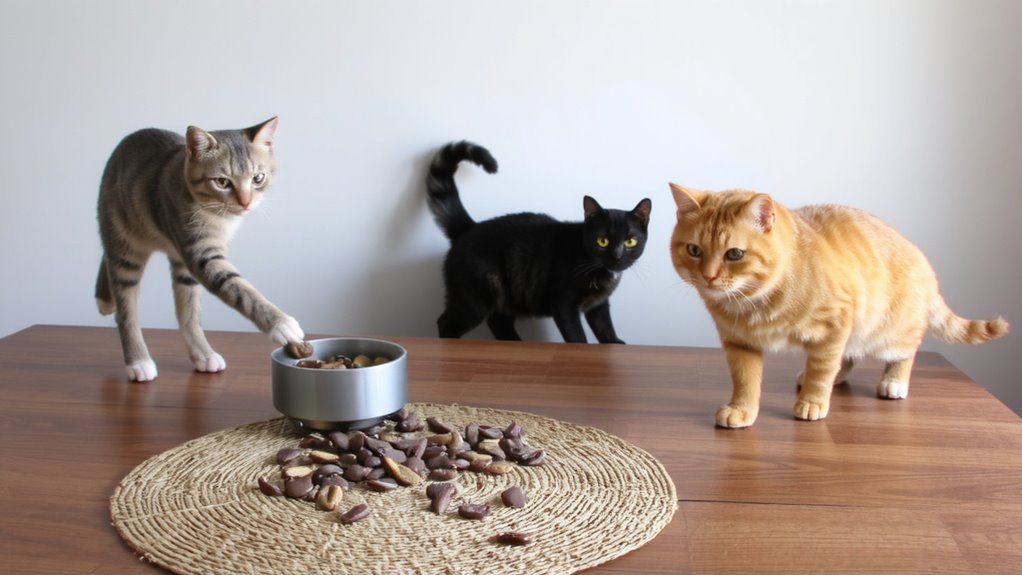
Why does your cat inhale their food like a vacuum cleaner on overdrive? Your cat’s rapid eating stems from a genetic predisposition shaped by evolutionary survival mechanisms. Wild felines faced unpredictable food access, favoring those who consumed meals quickly. This trait persists in domestic cats, especially in multi-cat households. There, social hierarchy plays a critical role-lower-ranking cats eat fast to avoid conflict or food theft. Studies show dominant cats can consume 30% more food in half the time compared to subordinates. Fast eating increases choking risks and digestive discomfort. In competitive environments, feeding speed correlates directly with perceived resource scarcity. Even with ample food, behavioral patterns driven by hierarchy and instinct remain. You can’t change genetics, but you can modify the feeding environment. Recognizing these biological and social factors helps you address overeating at its root-before it leads to health complications or inter-cat aggression.
How Puzzle Feeders Slow Down Eating
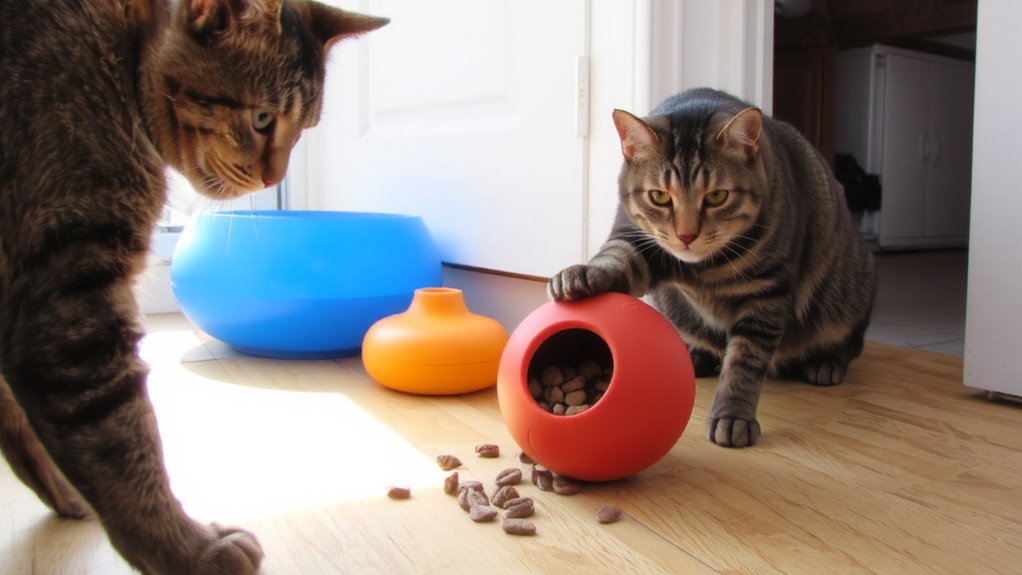
While your cat’s instinct drives them to eat quickly, puzzle feeders disrupt this behavior by requiring physical effort and mental focus before each bite. You can adjust the difficulty by choosing models with smaller openings or rotating compartments, which limit how much food dispenses at once. The food texture influences release rate-kibble flows more predictably than soft or moist food, guaranteeing consistent performance. Each feeder controls portion size, typically holding ½ to 1 cup, releasing only 1–3 pieces per interaction. This forces your cat to work for calories, extending mealtime from seconds to 10–20 minutes. The sustained engagement mimics natural foraging, reducing gulp-and-run behavior. Devices made from BPA-free plastic or stainless steel maintain hygiene and durability. Calibration according to your cat’s weight and dietary needs guarantees safe, effective use. Puzzle feeders alter eating tempo through mechanical resistance, not just distraction, making them a precise tool for managing intake efficiently. For optimal results, choose from the best puzzle pet feeders based on your pet’s skill level and feeding needs.
Best Puzzle Feeder Types for Fast Cats
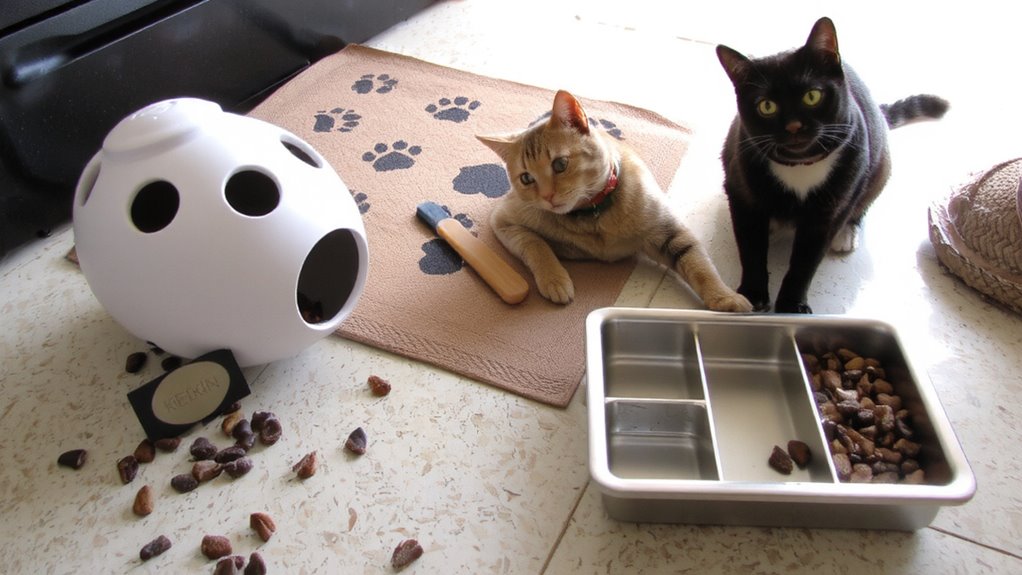
When your cat bolts through meals, choosing the right puzzle feeder becomes critical to effective pace control. Interactive puzzles designed for rapid eaters increase engagement through mechanical resistance and compartmentalized feeding zones. Models with rotating discs or sliding trays require sustained paw manipulation, slowing intake by up to 70% compared to bowl feeding. Treat mazes with narrow channels and dead ends force cats to nudge kibble incrementally, extending meal duration. Select feeders made from BPA-free polypropylene, 6–8 inches in diameter, with adjustable openings to regulate food release. Durable, non-slip bases prevent tipping during aggressive interaction. Multi-stage treat mazes with three or more compartments distribute food unevenly, promoting prolonged problem-solving. These designs outperform single-chamber feeders in time-to-consume metrics. Weighted or wall-mounted options deter displacement in multi-cat homes. Opt for dishwasher-safe components to maintain hygiene. Performance peaks when puzzle complexity matches motor skill ability. Top-rated options often feature modular designs that cater to evolving feline intelligence, making Top Cat Puzzle Toys a valuable reference for long-term engagement.
Choose the Right Difficulty for Your Cat
Matching puzzle feeder complexity to your cat’s skill level guarantees sustained engagement without frustration or disinterest. Too easy, and your cat loses interest; too hard, and they quit. Adjust difficulty to support play integration and food variety, encouraging natural foraging behaviors.
| Difficulty Level | Recommended For |
|---|---|
| 1 (Low) | Novice cats, seniors |
| 2 (Moderate) | Intermediate learners |
| 3 (High) | Experienced puzzle solvers |
| 4 (Variable) | Cats needing progressive challenge |
| 5 (Customizable) | Multi-cat households, high IQ breeds |
Select feeders with adjustable openings (3–10 mm) to regulate kibble release. Models allowing food variety-wet, dry, treats-enhance sensory input. Incorporate play integration by rotating designs weekly. Use durable, BPA-free materials rated for >50,000 activations. Proper difficulty sustains cognitive stimulation and slows ingestion rates up to 70%. A well-chosen product roundup can simplify the selection process for first-time buyers.
Train Your Cat to Use Puzzle Feeders
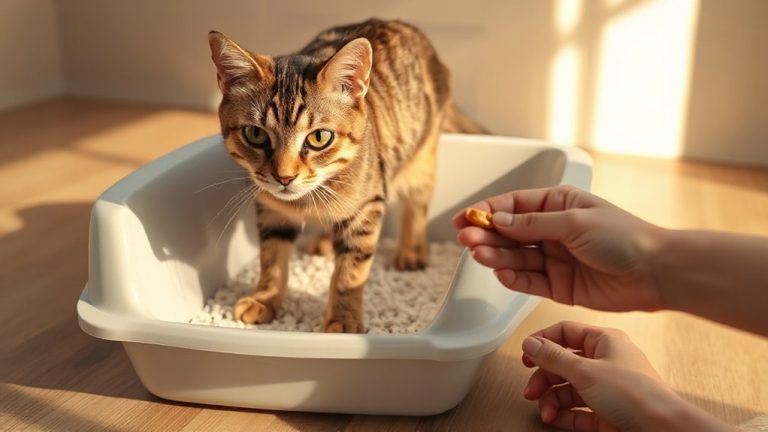
Success with puzzle feeders starts with a simple truth: your cat learns best through gradual exposure and positive reinforcement. Begin by selecting a stationary puzzle with large openings, such as the Outward Hound Nabber (4.5 inches diameter, 1.2-inch openings), to simplify initial interaction. Place a few kibble pieces inside and let your cat discover them through smell and touch, limiting session time to 3–5 minutes to maintain focus. Introduce the toy when your cat is mildly hungry but calm. Use treats your cat prefers-freeze-dried chicken works well-to boost motivation. Gradually increase complexity by switching models with smaller apertures or moving parts, such as the Trixie 5-Treat Maze, over 7–10 days. Introduce new textures slowly, like rubber flaps or plastic sliders, to avoid sensory overload. Encouraging exploration skills builds problem-solving behavior. Monitor interaction duration and success rate-effective training yields 80% treat retrieval within two weeks.
Replace Meals With Puzzle Feeders Safely
A gradual shift guarantees your cat adapts to puzzle feeders without stress or nutritional gaps. Begin by substituting one-quarter of a meal into a feeder, increasing in 25% increments every three days. This method guarantees portion control while monitoring intake accuracy. Use feeders sized to dispense 1–2 kibble per rotation, preventing overeating. Confirm toy safety by selecting BPA-free, non-toxic materials with no detachable small parts. Devices should withstand 5 lbs of pressure to resist crushing. For multi-cat homes, deploy separate stations spaced 6–8 feet apart to reduce competition. Calibrate dispenser difficulty to your cat’s skill-start with stationary base models, then progress to rolling units. Each session should last 10–15 minutes, mimicking natural foraging duration. Monitor weight weekly to verify nutritional consistency. Replace worn feeders annually or when jamming occurs.
On a final note
You can effectively reduce rapid eating in competitive cats using food-dispensing puzzle feeders. These devices slow consumption by 60–80%, promoting digestive health and reducing regurgitation. Models like the Outward Hound Active Tumbler (diameter: 6.5 inches; adjusts for kibble sizes 0.25–0.75 inches) offer adjustable difficulty. Start on level one, then progress over 2–3 weeks. Use non-slip bases to prevent skidding. Replace 1–2 meals weekly until full integration.