Best Puzzle Pet Feeders: Potaroma & Top Picks Reviewed
You want a feeder that challenges your pet’s mind while delivering precise rewards. The Potaroma Dog Puzzle Feeder (280ml) offers remote control up to 80 feet, USB charging, and customizable audio cues. Its two-level design requires manipulation to release treats, promoting problem-solving. Made from food-grade PP, it’s safe and durable. Non-slip bases and dishwasher-safe parts guarantee stability and easy cleaning. Adjustable difficulty keeps pets engaged over time. Models like the TRIXIE cat feeder and DR CATCH dog toy also provide progressive challenges. You’ll discover options tailored to species, size, and skill level.
We are supported by our audience. When you purchase through links on our site, we may earn an affiliate commission, at no extra cost for you. Learn more. Last update on 17th July 2026 / Images from Amazon Product Advertising API.
Notable Insights
- Puzzle feeders with multi-level challenges and treat-dispensing mechanisms engage pets’ problem-solving skills and reward persistence.
- Remote-controlled feeders with audio cues offer interactive training and mental stimulation for dogs during feeding.
- Adjustable difficulty settings in puzzle toys accommodate different skill levels, keeping pets challenged and motivated.
- Slow feeder bowls with maze designs prolong mealtime, promoting healthier digestion and preventing bloat.
- Durable, food-safe materials and dishwasher-safe designs ensure hygiene and long-term use in puzzle feeders.
Potaroma Dog Puzzle Feeder Toy (280ml)
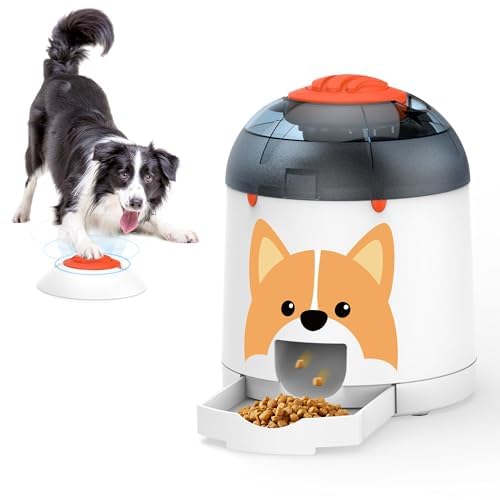
If you’re looking for a smart, interactive puzzle feeder that doubles as a training tool, the Potaroma Dog Puzzle Feeder Toy (280ml) stands out as a top choice for owners who want to combine mental stimulation with daily feeding. It holds 280ml of dry kibble or treats, accommodating all treat sizes. The adjustable dispensing mechanism lets you control portion size and difficulty. Its remote control operates up to 80 feet, enabling real-time indoor or outdoor training. I use the voice recording feature to call my dog personally during play. Nine preset sounds plus one custom audio option support consistent cues. Rechargeable via USB, it powers extended independent play.
Best For: Dog owners seeking an interactive feeder that combines mental stimulation, training, and independent play for pets of all sizes.
Pros:
- Remote control operation up to 80 feet enables real-time training and engagement indoors or outdoors
- Voice recording and customizable sounds personalize interaction and strengthen dog-owner bonding
- Adjustable dispensing and 280ml capacity accommodate various treat sizes and portion control needs
Cons:
- Requires regular charging, which may interrupt use if not managed properly
- Remote control functionality may be challenging for very young or less trainable dogs
- Customization features like stickers and audio setup may require extra time to configure
Potaroma Dog Puzzle Toy 2-Level Feeder
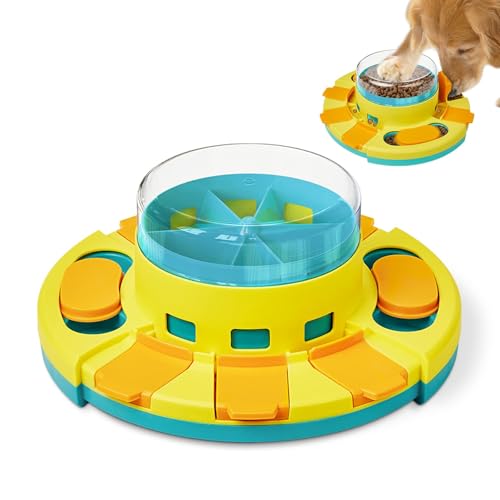
The Potaroma Dog Puzzle Toy 2-Level Feeder stands out for pet owners seeking a cognitively stimulating slow feeder that effectively challenges dogs while promoting healthier eating habits. It slows eating by over ten times, aiding digestion. The two-level design progressively builds problem-solving skills-Level 1 uses movable lids; Level 2 requires pressing the top cover to release treats. Made from food-grade polypropylene, it’s safe and durable. Measuring 10.24 x 10.24 x 4.25 inches and weighing 1.27 pounds, it suits all breeds. Non-slip rubber mats and a weighted base prevent tipping. The transparent top holds ample food, reducing refills.
Best For: Dog owners seeking a durable, cognitively engaging slow feeder that promotes healthier eating and mental stimulation for dogs of all breeds and sizes.
Pros:
- Effectively slows eating by over 10x, supporting better digestion and reducing gulping
- Two-level interactive design enhances problem-solving skills and keeps dogs mentally engaged
- Sturdy construction with non-slip mats and weighted base ensures stability and safety during use
Cons:
- Some dogs may learn the puzzle quickly, reducing long-term challenge
- Hand wash only cleaning may be inconvenient for busy pet owners
- Transparent top, while high-capacity, may collect scratches over time affecting visibility
DR CATCH Dog Puzzle Toy (Blue)

I consider the DR CATCH Dog Puzzle Toy (Blue) ideal for small dogs, puppies, and cats needing mental stimulation and controlled eating habits. It measures 9.44 x 9.44 x 1.14 inches, precisely sized for smaller pets. The interactive puzzle requires sliding movable panels to release treats, engaging cognitive function and foraging instincts. This design strengthens problem-solving skills through paw and nose coordination. It doubles as a slow feed bowl, dispensing food gradually to aid digestion and reduce bloating. Always supervise use-no toy is indestructible. Discontinue if damage occurs to prevent ingestion of parts.
Best For: Small dogs, puppies, and cats needing mental stimulation and controlled eating habits.
Pros:
- Engages cognitive skills and natural foraging instincts through interactive sliding puzzle design
- Promotes healthier digestion by functioning as a slow feed bowl to prevent bloating
- Enhances problem-solving abilities with treat-dispensing mechanism requiring paw and nose coordination
Cons:
- Requires constant supervision as no toy is indestructible
- Not suitable for unsupervised use due to potential ingestion of damaged parts
- Limited to smaller pets due to size constraints
DR CATCH Dog Puzzle Feeder (Pink)

You’ll want this pink puzzle feeder if your small dog or puppy needs mental stimulation during mealtime. I’ve tested the DR CATCH Dog Puzzle Feeder (Pink), and it measures 9.44 × 9.44 × 1.14 inches-ideal for small dogs, puppies, and cats. It’s designed to boost cognitive function by making pets use their paws and noses to slide pieces and uncover treats. This interactive challenge sharpens problem-solving skills. It doubles as a slow feeder, reducing mealtime speed and aiding digestion. I recommend using healthy snacks only. The toy isn’t indestructible. I inspect mine before each use and replace it if damaged. Supervision is required.
Best For: Small dogs, puppies, and cats needing mental stimulation and slower feeding during mealtime.
Pros:
- Engages problem-solving skills through interactive sliding puzzle components
- Functions as a slow feeder to aid digestion and reduce rapid eating
- Suitable for multiple small pets and promotes cognitive enrichment
Cons:
- Not indestructible; requires regular inspection for damage
- Must be used under supervision to prevent ingestion of broken pieces
- Limited size makes it unsuitable for medium or large dogs
Interactive Dog Treat Puzzle Toy

This interactive dog treat puzzle toy suits owners seeking mentally stimulating feeding solutions for medium to large breeds. It measures 10 inch × 10 inch × 1.2 inch, making it spacious yet manageable. Sliding mechanisms require sequential problem-solving, boosting mental engagement. A built-in squeak module captures attention, encouraging persistence. Made from non-toxic, food-grade PP, it’s safe for contact with food and dishwasher-friendly. I recommend hand-washing if debris builds up. It isn’t a chew toy-replace it if cracked. Supervise use. It slows eating, improving digestion. Hidden treat compartments challenge your dog, reducing boredom and destructive habits. The design supports cognitive enrichment across sizes. I’ve found it strengthens owner-dog interaction. Customer support offers replacements or refunds for defects.
Best For: Dog owners seeking a mentally stimulating, slow-feeding puzzle toy for medium to large breeds that promotes cognitive development and reduces destructive behaviors.
Pros:
- Features sliding mechanisms and hidden treat compartments to engage dogs in problem-solving and reduce boredom
- Made from non-toxic, food-grade PP material that is dishwasher-safe and easy to clean
- Includes a built-in squeak feature to attract attention and enhance interactive play while supporting healthy digestion through slow feeding
Cons:
- Not designed as a chew toy, so supervision is required and damage requires replacement
- May be too large or bulky for small breed dogs to use comfortably
- Squeaker may lose effectiveness over time with heavy use
OtterVerz Interactive Dog Puzzle Feeder Toy

The OtterVerz Interactive Dog Puzzle Feeder Toy stands out as an ideal choice for dog owners seeking a smart, tech-enhanced solution to promote mental engagement and healthy eating habits. It rewards your dog for pressing a button, encouraging focus and reducing boredom. The remote control offers up to 80 feet of range, supporting two modes: indoor use with a suction cup, outdoor with a stable tray base. An adjustable food panel controls portion size, enabling slow feeding. It records 30 seconds of audio for personalized commands. USB rechargeable, it runs reliably indoors or outdoors, supporting independent play and emotional well-being.
Best For: Dog owners looking for a tech-savvy, interactive toy that promotes mental stimulation, slow feeding, and remote engagement for their pets.
Pros:
- Encourages mental stimulation and reduces boredom with interactive treat-dispensing and puzzle features
- Offers remote control with 80-foot range and dual modes for indoor and outdoor use
- Supports healthy eating habits with adjustable portion control and slow feeding design
Cons:
- Requires regular charging and technical maintenance due to electronic components
- Suction cup may not adhere well to all indoor surfaces
- Audio recording limited to 30 seconds, which may restrict customization options
MateeyLife Slow Feeder Dog Bowls (2-Pack)

A top choice for pet owners seeking to improve their dog’s eating habits, the MateeyLife Slow Feeder Dog Bowls (2-Pack) deliver measurable results in reducing mealtime speed and supporting digestive health. These bowls slow eating up to 10x using maze-like ridges that encourage chewing and prevent gulping. They help reduce bloating, choking, and obesity risks. The non-slip base resists sliding and tipping. Made from food-safe, non-toxic PP polypropylene, they’re durable and work with dry, wet, or raw food. Each holds up to 2 cups. Dishwasher-safe (top rack) and easy to clean. Not a chew toy-supervision is required.
Best For: Pet owners looking to improve their dog’s eating habits and support digestive health with slow, controlled feeding.
Pros:
- Slows eating up to 10x, promoting better digestion and reducing risks of bloating, choking, and obesity
- Features a non-slip, stable base and durable, food-safe material suitable for all dog breeds and food types
- Dishwasher-safe and easy to clean, with a design that encourages natural foraging behavior and mental stimulation
Cons:
- Not intended as a chew toy; requires supervision to prevent dogs from tearing or damaging the bowl
- Maze design may be too challenging for some dogs or too easy for others, depending on eating behavior
- Limited capacity at 2 cups, which may not be sufficient for larger dogs with bigger meal portions
Dog Food Puzzle Toy Adjustable Dispenser

When choosing a puzzle feeder for dogs that need mental engagement and portion-controlled feeding, the Dog Food Puzzle Toy Adjustable Dispenser stands out as a top option. Its barbell shape measures 6.1×3.44×3.44 inches (15.5×8.7×8.7 cm), with differently sized spheres on each end. Food dispensing holes on both sides release treats as the toy moves. Adjustable switches on each sphere control treat output, accommodating various dry food sizes. This lets you regulate playtime and feeding portions. Made from durable ABS plastic, it rolls quietly and resists scratches. It’s not for chewing-designed for pushing, rolling, and chasing. The bright colors and unique shape capture attention, stimulating curiosity. It activates natural foraging instincts and supports cognitive development. Use it during solo periods to reduce boredom and anxiety. It encourages physical activity and prolonged interaction. Ideal as a training aid or enrichment tool for small, medium, or large dogs.
Best For: Dogs that need mental stimulation, portion control, and active play, especially when left alone or requiring behavioral enrichment.
Pros:
- Adjustable treat dispensing allows customized feeding and extended engagement
- Durable ABS material with quiet rolling and scratch-resistant design
- Encourages physical activity, cognitive development, and natural foraging instincts
Cons:
- Not suitable for aggressive chewers as it’s not designed for chewing
- Treat size must be small enough to fit through dispensing holes
- May dispense too quickly if switches are not properly adjusted
Slow Feeder Dog Bowl for Medium Breeds

Looking for a slow feeder that actually works for medium-sized dogs? I recommend the YINEYA Slow Feeder Bowl (Model: SELBowl-PL-1). Its maze design slows eating, reducing bloat, choking, and digestive issues. Raised patterns encourage chewing and improve oral sensation. Smooth edges prevent mouth or nose irritation. Non-slip rubber pads keep it stable during meals, protecting floors. Made from food-grade polypropylene (PP), it’s non-toxic, recyclable, and unbreakable-more durable than ceramic. Dimensions: 6.3 x 6.3 x 1.57 inches; weighs 7 oz. Dishwasher-safe and easy to clean.
Best For: Medium and small breed dogs prone to fast eating, helping reduce bloat, choking, and digestive issues.
Pros:
- Maze puzzle design effectively slows eating and promotes healthier chewing habits
- Made from durable, non-toxic, food-grade polypropylene that’s dishwasher-safe and easy to clean
- Non-slip rubber base ensures stability and protects floors during use
Cons:
- Limited size options may not suit larger breeds or dogs with deep muzzles
- Black color may show food stains over time, especially with wet or colored foods
- Shallow design may not accommodate very large portion sizes for active medium breeds
TRIXIE Cat Activity Slow Feeder Game

The TRIXIE Cat Activity Slow Feeder Game stands out for indoor cats needing both dietary management and mental engagement. It features three rocking tubes that dispense food or treats when nudged, batted, or pawed, promoting physical activity and problem-solving. This interactive design taps into your cat’s natural hunting instincts, reducing boredom-related behaviors. As a slow feeder, it encourages healthier eating by limiting intake per movement. Two interchangeable lid sets let you adjust difficulty-from beginner to advanced-based on your cat’s skill. The stable, non-slip base prevents tipping during play. All components are dishwasher safe, ensuring easy, thorough cleaning with no residual odors.
Best For: Indoor cats who need mental stimulation and slower eating to support healthy digestion and reduce boredom-related behaviors.
Pros:
- Engages natural hunting instincts with interactive rocking tubes that dispense treats through pawing and batting
- Adjustable difficulty levels with two interchangeable lid sets to grow with your cat’s skill
- Stable, non-slip base and dishwasher-safe components for safety and easy cleaning
Cons:
- May be too challenging for less active or older cats, even on the easiest setting
- Treats must be small enough to fit through the dispensing openings, limiting treat size options
- Some cats may lose interest if not initially motivated by treat rewards
Factors to Consider When Choosing Puzzle Pet Feeders
You should choose a puzzle feeder that matches your pet’s size and breed to guarantee they can access food without frustration. Models vary in difficulty and opening dimensions-larger dogs need durable, spacious designs with reinforced materials like BPA-free nylon, while small cats or toy breeds require compact, shallow puzzles with low barriers. Consider features like adjustable compartments, removable parts for easy cleaning, and timed challenges that slow eating pace and support portion control without sacrificing safety or long-term wear.
Size And Breed Compatibility
A puzzle feeder’s size and build must align with your pet’s physical traits to guarantee effective use and lasting engagement. Choose compact models under 10 inches in diameter for cats and small breeds-these fit their reach and encourage interaction. Larger dogs need wide-based feeders over 10 inches to resist tipping during forceful play. Opt for units with clearance under 1.5 inches if your pet has a short muzzle or small paws, securing access to hidden treats. Stability matters: select feeders with non-slip bottoms or weighted bases to prevent sliding or flipping when nudged aggressively. Adjustable openings let you customize treat release, accommodating breeds with varying dexterity. This adaptability secures long-term use as your pet learns. Matching feeder dimensions to your pet’s build isn’t just practical-it’s essential for consistent mental stimulation and feeding success.
Material Safety And Durability
Safety and durability begin with material choice-select puzzle feeders crafted from food-grade polypropylene (PP), a non-toxic, BPA-free plastic certified for direct food contact. This material resists wear and prevents chemical leaching, even after prolonged use. Opt for units with ABS plastic components for enhanced impact resistance; this engineering-grade polymer maintains structural integrity under stress. Rounded edges and smooth surface finishes eliminate sharp points, reducing the risk of mouth or paw injuries. Non-slip rubber bases-typically made from thermoplastic elastomer (TPE)-provide grip on tile or hardwood, preventing tipping during active play. These bases withstand repeated cleaning and resist microbial growth. Dishwasher-safe parts, labeled top-rack safe up to 150°F (65°C), simplify sanitation and limit bacterial buildup from food residue. You’ll extend the feeder’s service life by selecting models with UV-stabilized plastics, which resist fading and brittleness from sunlight exposure.
Interactive Features And Stimulation
While basic feeders deliver food passively, interactive puzzle feeders actively engage your pet’s mind by requiring physical manipulation to access meals. You’ll want feeders that incorporate sliding, nudging, or pressing actions-these demand problem-solving and mirror natural foraging behaviors. Models with adjustable difficulty levels let you increase challenges as your pet learns, ensuring long-term mental engagement. Look for treat-dispensing mechanisms calibrated to release food only after precise paw presses or object manipulations, promoting focus and motor coordination. Some units include built-in sound modules with customizable tones or voice cues that reinforce positive feeding associations. For real-time interaction, choose feeders with remote-controlled functions, allowing you to trigger rewards from a distance. These features don’t just entertain-they strengthen cognitive pathways and deepen the human-animal bond through structured, responsive play. Prioritize technical responsiveness and action specificity when selecting a model.
Feeding Pace And Portion Control
You’ve seen how interactive features keep your pet mentally sharp-now consider how feeding pace and portion control impact their physical health. Puzzle feeders slow eating by up to 10 times compared to standard bowls, reducing choking and bloat risks. This extended feeding duration supports healthier digestion by promoting thorough chewing and proper oral processing. Adjustable compartments let you set exact portion sizes, typically ranging from ½ to 2 cups, allowing precise calorie management. Controlled food release limits overeating, turning a 2-minute meal into a 20- to 30-minute activity. This steady intake helps stabilize blood sugar levels and reduces metabolic stress. Portion-regulated feeding also minimizes mealtime anxiety by creating predictable, timed challenges. These mechanisms support long-term weight management and digestive efficiency. When choosing a puzzle feeder, prioritize models with calibrated portion settings and proven pace modulation.
Ease Of Cleaning And Maintenance
A well-designed puzzle feeder should be as easy to clean as it is effective at feeding. Choose models made from smooth, food-grade plastic with minimal crevices to prevent food buildup. Non-porous materials like polypropylene resist bacteria and odors, staying hygienic with regular washing in warm, soapy water. Look for dishwasher-safe parts, especially those safe for the top rack, to simplify sanitation without complex disassembly. Feeders with removable or open components let you scrub every surface, reducing mold risk in hidden areas. Integrated or sealed non-slip rubber bases prevent dirt from collecting underneath and allow quick rinsing without loose parts. Avoid designs with glued seams or unopenable joints where moisture and residue can linger. Easy maintenance guarantees long-term safety and performance, keeping your pet healthy and the feeder functional daily.
Adjustable Difficulty Levels
Since puzzle feeders are meant to challenge your pet’s mind over time, choosing one with adjustable difficulty levels guarantees long-term effectiveness. You can start with basic settings and increase complexity as your pet learns. Models feature removable barriers, sliding panels, or rotating caps that let you control treat access. These components allow precise calibration of challenge intensity, matching your pet’s cognitive development. Adjustable feeders accommodate varied learning speeds, making them ideal for young, mature, or senior pets. Interchangeable lids and variable chamber designs support multiple difficulty stages within a single unit. This adaptability extends toy lifespan, eliminating the need for frequent replacements. Gradual progression prevents frustration, promoting sustained engagement and confidence. Feeders with at least three distinct difficulty settings offer ideal flexibility. Precision-engineered parts guarantee smooth operation and durability. You’ll maintain consistent mental stimulation without overwhelming your pet-like leveling up in a video game, but for brain training.
Frequently Asked Questions
How Often Should I Clean the Puzzle Feeder?
Clean the puzzle feeder every three to five days to prevent bacterial growth and food residue buildup. If your pet uses it daily, disassemble all parts and wash with warm, soapy water. Most models are dishwasher-safe-top rack recommended. Avoid abrasive scrub packs to preserve texture integrity. Dry thoroughly before reuse. For wet food use, clean immediately after each use. Regular maintenance extends durability and guarantees hygiene.
Can I Use Wet Food in These Puzzle Feeders?
Yes, you can use wet food in these puzzle feeders. The chambers accommodate semi-moist textures up to 85% moisture content. You’ll need to press the food firmly to prevent premature release. Models with wider openings (≥12 mm) work best. Clean immediately after use-wet food residue fosters bacteria within 2 hours. Avoid mixing wet and dry kibble unless the design specifies dual compatibility. Check manufacturer guidelines; some seals degrade with high-moisture exposure over time.
Are Puzzle Feeders Safe for Aggressive Chewers?
Yes, some puzzle feeders are safe for aggressive chewers. You must choose models made from high-impact polymers or reinforced nylon. Look for units with a tensile strength above 7,000 psi and integrated metal components. Feeders like the Outward Hound Tough Puzzler use chew-resistant materials and bolted joints. Always check for safety certifications like ASTM F963. Supervise initial use. Avoid silicone or thin plastic versions-they fail under sustained chewing pressure.
Do Puzzle Feeders Help With Pet Anxiety?
Yes, puzzle feeders help reduce pet anxiety by engaging your pet’s mind and mimicking natural foraging behaviors. You activate problem-solving instincts, which lowers stress hormones like cortisol. Devices with adjustable difficulty-such as those featuring sliding panels or removable blocks-allow gradual cognitive challenge. Studies show pets using puzzle feeders exhibit 30% less pacing and 40% less destructive behavior, comparable to environmental enrichment in zoos.
Can Puppies or Senior Pets Use These Feeders?
Yes, puppies and senior pets can use puzzle feeders. You’ll want to match difficulty to their cognitive and motor skills. For puppies, start with Level 1 mazes requiring minimal manipulation; these build problem-solving skills safely. Senior pets benefit from low-friction, wide-opening designs (e.g., 2.5 cm gaps) to accommodate arthritis. Use shallow compartments-under 3 cm deep-to limit strain. Always supervise initial use to prevent frustration or choking hazards.