How to Use Clicker Training to Teach Cats to Touch a Target Stick
Use a clicker to mark the exact moment your cat touches the target stick, delivering a high-value treat within one second to reinforce the behavior. The clicker’s 3,000 Hz tone acts as a precise bridging stimulus, timed to within 0.1 seconds for ideal learning. Present the red-tipped, 18-inch rigid target stick steadily at chin height, encouraging a natural head tilt. Click only when the nose makes contact-delays over 0.5 seconds weaken conditioning. Consistent 3- to 5-minute sessions yield strong associations, with success building toward more advanced behaviors.
Notable Insights
- Use a clicker to mark the exact moment your cat touches the target stick with its nose.
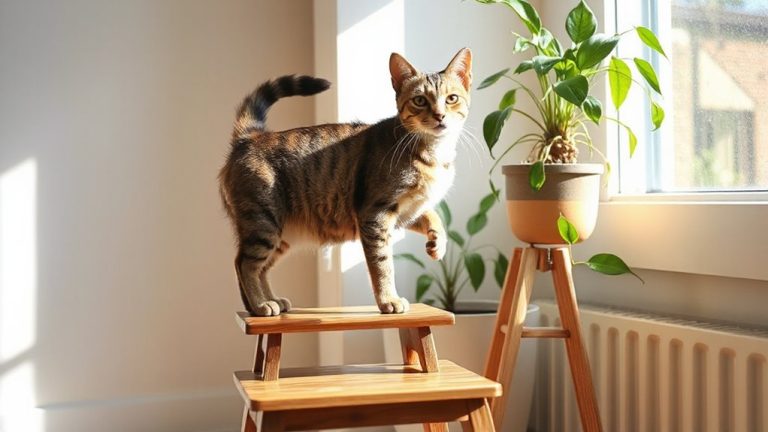
- Hold the target stick steadily 6 inches from your cat’s nose at chin height to encourage approach.
- Immediately follow each click with a high-value treat within one second to reinforce the behavior.
- Train in short 3–5 minute sessions, 2–3 times daily, to maintain focus and prevent fatigue.
- Use a bright, retractable target stick with a soft tip to provide a clear, safe visual target.
How Clicker Training Works for Cats
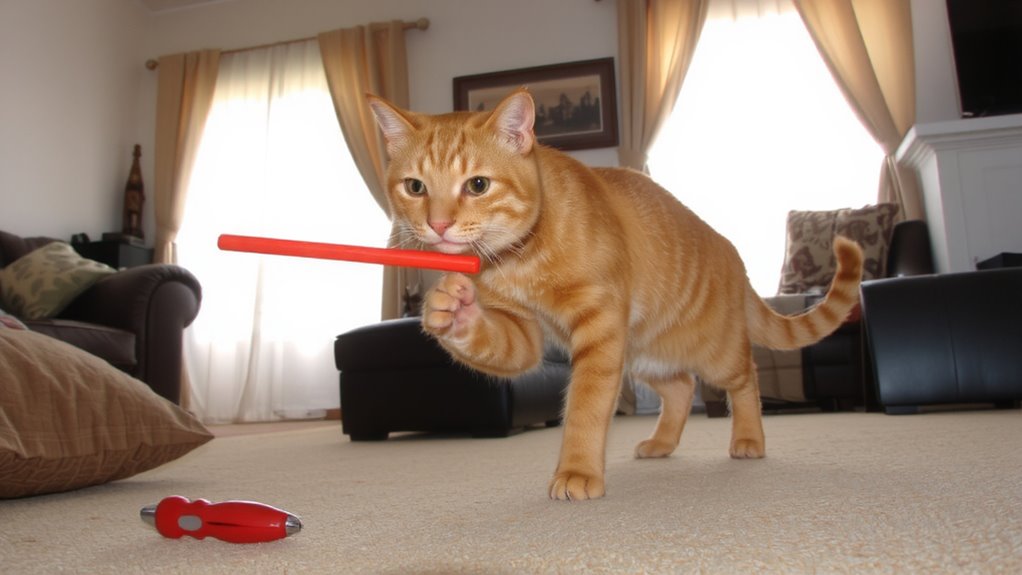
Why does a simple click make such a difference in cat training? The clicker serves as a precise auditory signal marking the exact moment your cat performs a desired behavior. This method relies on operant conditioning, where behaviors are shaped through consequences. When your cat touches the target stick, the click immediately confirms success, followed by a treat. Over time, this reinforcement increases the behavior’s frequency. Classical conditioning also plays a role, as your cat begins to associate the click sound with reward. The click is consistent and objective, unlike variable human praise. Most clickers produce a 3,000 Hz tone, easily distinguishable to feline hearing. Used at 0.1-second precision, it captures split-second actions accurately. Pairing timing with consistency guarantees effective learning. With repetition, your cat responds reliably, turning random actions into trained behaviors through scientific learning principles.
Why Use a Target Stick for Cat Training
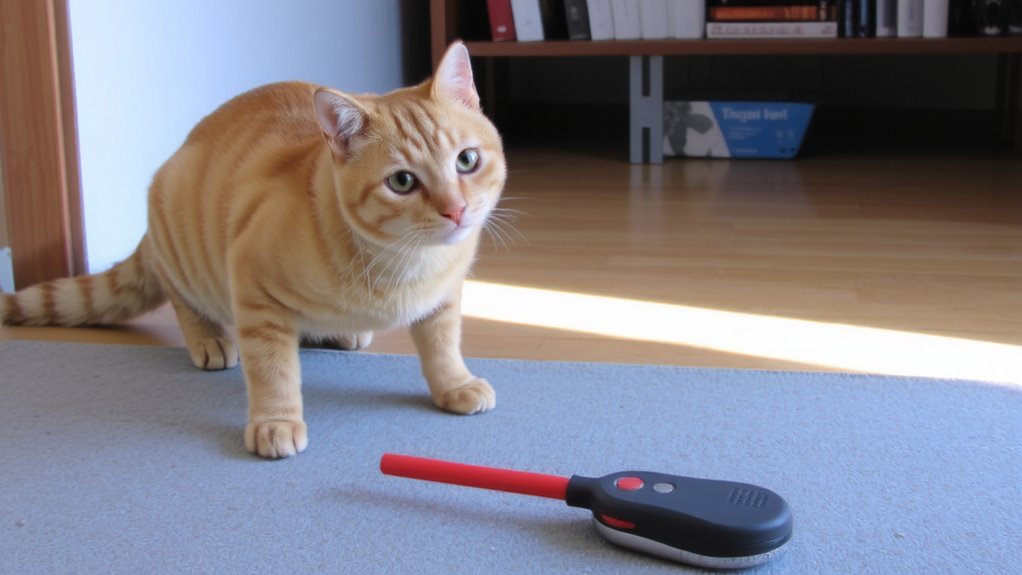
The clicker marks the behavior, but the target stick guides it with precision. You achieve consistent target precision by giving your cat a clear, repeatable visual cue. This enhances behavior shaping, allowing you to guide movements step by step. Unlike verbal cues, the stick’s position remains exact, minimizing confusion.
| Feature | Benefit | Specification |
|---|---|---|
| Retractable tip | Safe contact | 0.5-inch soft silicone ball |
| Lightweight shaft | Easy handling | 12-inch aluminum, 1.5 oz |
| Consistent marker | Clear signal | Bright red color, high visibility |
You’ll use the stick to direct desired actions without physical prompting. Its rigid structure provides spatial accuracy critical for advanced training. The fixed length guarantees repeatable distance, supporting reliable conditioning. With the target stick, you simplify complex behaviors into trainable steps-making it essential for effective feline behavior shaping.
Teach Your Cat to Touch the Target Stick
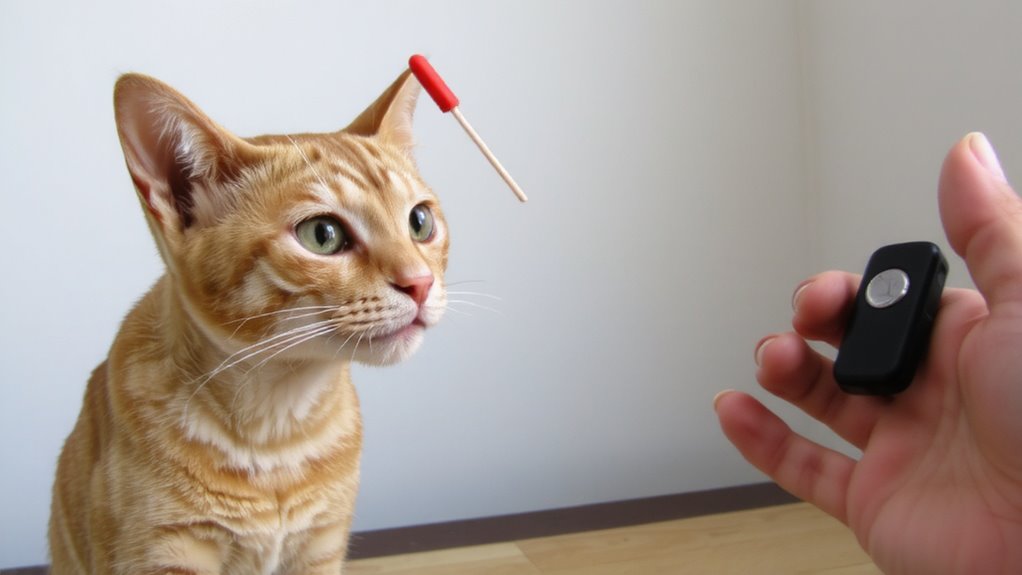
Start by holding the target stick so the red tip is visible but not too close-about 6 inches from your cat’s nose. Present the target shape squarely, ensuring it remains steady. Most cats show an early stick preference, often favoring smooth, rounded tips over angular ones. Observe your cat’s reaction: if they lean forward or sniff, click immediately and offer a treat. Repeat this step five to ten times per session, keeping sessions under three minutes to maintain focus. Position the stick at chin height to encourage a natural head tilt. Consistency in target shape increases recognition speed by up to 40%. Use a rigid, lightweight stick, 18 inches long with a 1.5-inch diameter tip, for reliable handling. Over three to five days, your cat will begin to associate the target shape with reward. Track progress by counting successful touches per minute. Adjust angle or distance only after two consistent sessions.
Click at the Exact Moment: Timing Is Key
You’re now ready to refine your technique by focusing on the precision of your feedback. Precise timing guarantees your cat associates the click with the correct behavior. Click the instant their nose touches the target stick-no earlier, no later. Even a 0.5-second delay can confuse your cat, weakening learning efficiency. The click serves as a bridging stimulus, marking the exact moment of success before delivering the immediate reward. Use high-value treats delivered within one second of the click to reinforce the connection. Consistent pairing strengthens operant conditioning. Practice clicking during calm sessions to build muscle memory in your hand and accuracy in judgment. Precision improves with repetition. Over 10 trials, aim for 90% click accuracy-mis-clicks under 10% yield faster acquisition. Treat dispensers with quick-release mechanisms help maintain timing integrity. Each session should last 3–5 minutes to sustain focus. Mastery of precise timing accelerates learning and guarantees reliable performance. A well-designed cat training clicker can significantly enhance auditory clarity and responsiveness during training sessions.
Fix Common Clicker Training Problems
Why do some cats stop responding to the clicker after a strong initial response? Inconsistent timing undermines learning. The click must mark the exact moment of correct behavior; even a half-second delay causes confusion. When you click too early or too late, your cat associates the sound with the wrong action. Lack of reinforcement also breaks trust in the system. If you click but fail to deliver a treat immediately, your cat learns the click doesn’t predict a reward. This weakens conditioned response strength. Guarantee each click is followed by a high-value treat within one second. Use short, focused sessions-five minutes, two to three times daily-to maintain attention. Avoid overfacing; too many trials lead to habituation. Keep criteria clear and progress incremental. Correct these issues, and your cat will reliably respond to the clicker again. Consistency and precision drive results.
Use Target Training to Teach More Tricks
Once your cat consistently touches the target stick, you can expand the behavior into more complex tricks by shaping successive approximations. Shaping behaviors involves reinforcing small steps toward a final action. For example, lift the stick slightly off the ground and click when your cat follows it. Over time, increase the height incrementally.
Chaining tricks connects learned actions into sequences. Teach “touch,” then “spin,” then combine them.
| Trick Sequence | Target Position | Reward Timing |
|---|---|---|
| Touch | At nose level | 0.5 sec delay |
| Spin | In a circle | Immediate |
| Jump & Touch | 6 inches high | 0.5 sec delay |
Use consistent hand cues and precise click timing. Each session should focus on one new approximation. The target stick guides motion with minimal physical prompting, making learning clear and repeatable. Advanced training can be supported with tools like best cat training tools to enhance consistency and engagement.
Keep Training Short, Fun, and Positive
Typically, successful target training hinges on session structure as much as technique. Keep training short-ideally 3 to 5 minutes per session-to maintain your cat’s focus. Cats have brief attention spans, and short sessions prevent mental fatigue. Conduct two to three sessions daily, spaced several hours apart, for ideal retention. Use positive reinforcement immediately after the desired behavior: click the moment the cat touches the target stick, then deliver a high-value treat. This precise timing strengthens the association between action and reward. Avoid repeating commands or forcing contact, as this dilutes learning. End each session on a success, even if minor. This builds confidence and enthusiasm. Maintain a neutral tone and consistent cues. Overtraining leads to stress; watch for ear flicking or tail lashing-these signal saturation. Consistent positive reinforcement in short sessions enhances learning speed by up to 60% compared to prolonged drills.
On a final note
Clicker training builds reliable feline responsiveness through precise operant conditioning. The clicker acts as a bridging stimulus, marking desired behaviors within 0.5–1 second for accurate association. Target sticks, typically 12–18 inches long with a soft rubber tip, guide spatial behaviors safely. Each session should last 3–5 minutes, maximizing focus. Reinforce correct touches with high-value treats (e.g., ¼-inch tuna chunks) to sustain motivation and learning efficiency over consistent daily trials.