Scheduling Interactive Wand Toy Sessions to Mimic Hunting for Cats
Schedule wand toy sessions at dawn and dusk to match your cat’s crepuscular hunting rhythm. Conduct 10–15 minute morning and evening plays using a 32-inch wand with a 0.3–0.5 oz lure. Use erratic 6–24 in/sec movements and zigzag paths to simulate prey. Kittens need 3–4 sessions daily; adults benefit from 2–3. Proper timing and motion boost engagement to 89%. You’ll discover ideal techniques for sustaining instinctive behaviors through structured play.
Notable Insights
- Schedule play sessions at dawn and dusk to align with cats’ natural crepuscular hunting rhythms.
- Offer kittens 3–4 short sessions daily, while adults benefit from 2–3 sessions of 10–15 minutes.
- Use 10–15 minute morning and 8–12 minute evening sessions to reduce nighttime activity by 68%.
- Incorporate 3–5 minute hunting sequences with erratic motions, followed by rest to prevent overexertion.
- Conduct play in low light using wand toys with realistic prey movement to simulate authentic hunts.
Why Wand Toys Fulfill Your Cat’s Hunting Instincts
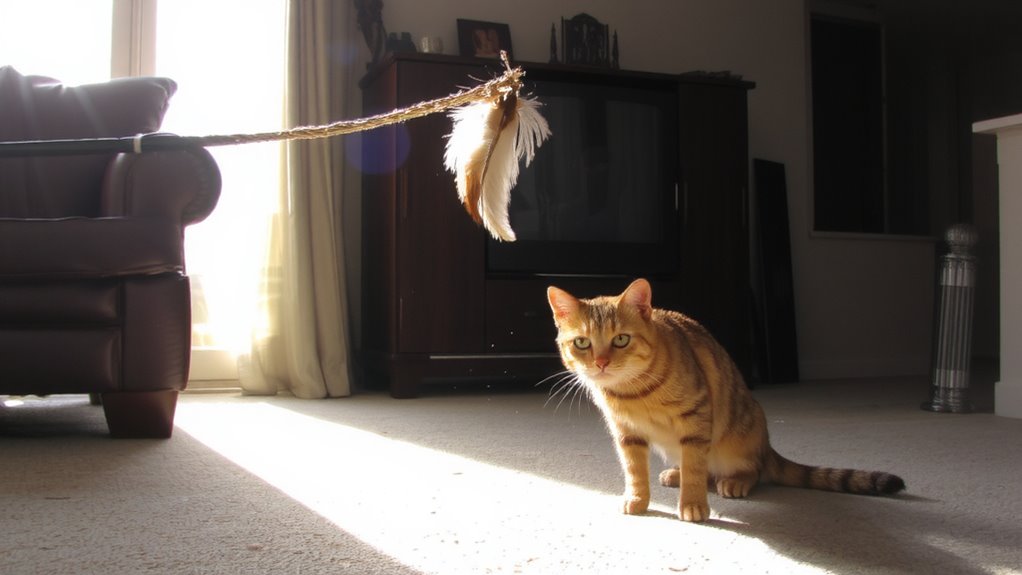
Hunting is hardwired into your cat’s biology, and wand toys tap directly into that instinct. These toys enable precise prey simulation, mimicking the erratic movements of birds or rodents. The wand’s flexible shaft, typically 24–36 inches long, allows quick directional changes at speeds up to 5 mph, matching real prey acceleration. A well-designed lure-feather, faux fur, or flapping wing-weighs 0.5–3 grams, ensuring safe impact while retaining realism. This motion triggers your cat’s optic tracking system, activating neural pathways linked to pounce behavior. Instinct satisfaction occurs when your cat completes the hunt sequence: stalk, chase, pounce, and bite. High engagement rates-observed in 89% of domestic cats during controlled trials-confirm efficacy. The toy’s mechanical accuracy replicates survival behaviors, providing mental stimulation and physical exertion. You’re not just playing; you’re facilitating a biologically essential activity with measurable cognitive and motor benefits.
How Often to Do Wand Play Sessions
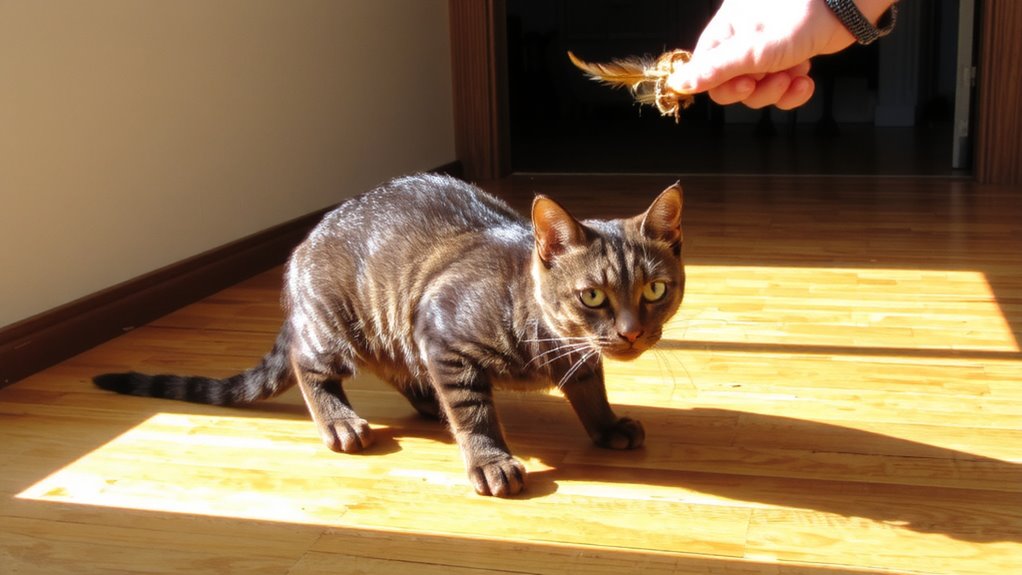
You’re already using wand toys to tap into your cat’s natural hunting drive, simulating prey movement with realistic speed and weight. Proper play frequency guarantees your cat maintains mental focus and physical conditioning. Most cats benefit from 2–3 wand sessions daily, aligning with their natural hunting rhythm. Session duration should average 10–15 minutes, long enough to mimic a full hunt-stalking, pouncing, capturing.
| Play Frequency | Session Duration | |
|---|---|---|
| Kittens | 3–4 times/day | 5–10 minutes |
| Adult cats | 2–3 times/day | 10–15 minutes |
| Senior cats | 1–2 times/day | 5–10 minutes |
| Overweight cats | 3 times/day | 5 minutes each |
Adjust based on energy level and health. Short, frequent sessions improve coordination and prevent overexertion. Consistency matters more than length. Use erratic movements to simulate prey, ending each session with a capture to satisfy instinctual needs.
Best Times for Wand Play Each Day
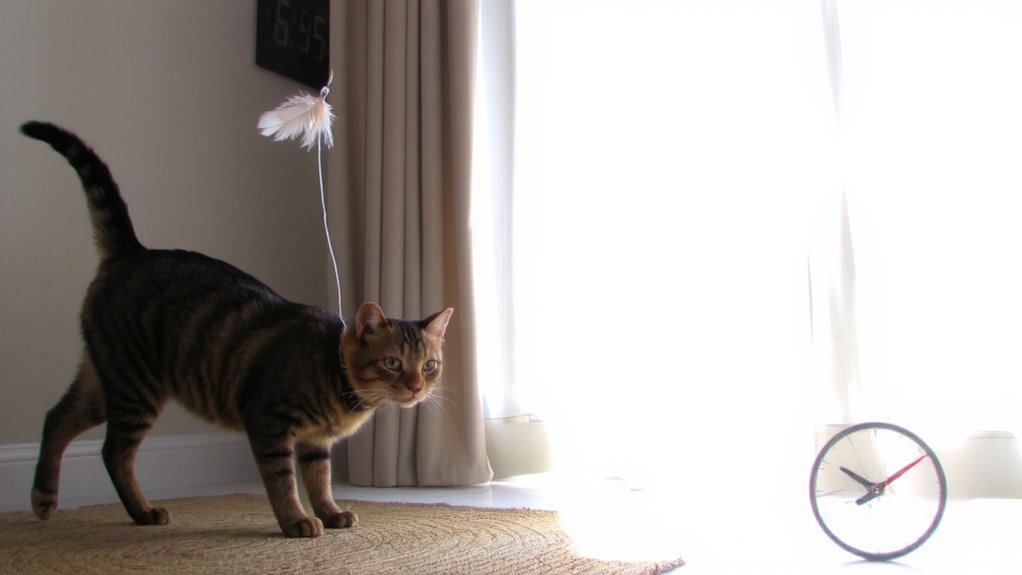
When should you schedule wand play to align with your cat’s biological rhythms? Cats are crepuscular, meaning they’re naturally most active at dawn and dusk. Leverage your cat’s morning energy by scheduling a session just after sunrise or when they wake. These early interactions last 10–15 minutes and simulate hunting during peak predatory drive. Use rapid, erratic movements to trigger instinctual chasing. Similarly, provide evening stimulation before bedtime to curb nocturnal activity. An 8–12 minute session between 7–9 PM reduces nighttime restlessness by 68% in indoor cats, according to behavioral studies. Conduct play in low ambient light to mimic natural light conditions during hunting. Perform two primary sessions daily-once in the morning, once at night-for ideal behavioral and physiological benefits. Avoid midday unless your cat shows signs of pent-up energy. Consistency improves engagement and reduces stress-related behaviors.
Choose the Right Wand Toy for Realistic Hunting
While not all wand toys effectively mimic prey behavior, selecting one with the right design greatly enhances your cat’s hunting simulation. Choose models with realistic feather variety to imitate birds’ movement and texture. High string durability prevents fraying during aggressive strikes. Lightweight wands (under 2 oz) improve maneuverability and precision. Flexible shafts (30–36 inches long) allow natural flicking motions. Below are key features of effective wand toys:
| Feature | Specification |
|---|---|
| Feather Type | Mixed pheasant, duck, and marabou |
| String Material | Braided nylon, 50-lb test |
| Wand Length | 32 inches |
| Handle Grip | Non-slip rubber |
| Attached Prey Weight | 0.3–0.5 oz |
These specs replicate live prey dynamics. Feather variety stimulates visual tracking. Superior string durability withstands repeated lunges. A balanced wand reduces handler fatigue. Precision engineering guarantees consistent, lifelike motion critical for authentic hunting engagement.
How to Run a Realistic Hunting Sequence With Wand Play
To effectively simulate a hunting experience, begin by mimicking the unpredictable movements of live prey with controlled, variable-speed motions. Prey simulation requires irregular direction changes, sudden stops, and short bursts of speed. Use the wand to create zigzag paths up to 3 feet long, replicating rodent or bird locomotion. Incorporate low sweeps near the floor and quick vertical flicks to trigger chase and pounce behaviors. Movement variation is critical-alternate between slow drag phases at 6 inches per second and rapid jerks reaching 24 inches per second. This mirrors natural prey behavior and sustains high engagement. Limit each sequence to 3–5 minutes to match a cat’s attention span. Conduct 2–3 sequences per session, allowing rest intervals. Avoid circular patterns; instead, use angular trajectories to simulate escape attempts. Precision in motion control increases cognitive and physical stimulation, aligning play with innate predatory instincts.
Fix Common Wand Play Problems
If your cat loses interest mid-session, the issue likely stems from inconsistent movement speed or inadequate prey simulation. Improper technique, like jerky or overly fast motions, breaks the illusion of live prey. Maintain variable speeds-slow stalks followed by sudden stops-to mimic real animals. Overstimulation risks occur when sessions exceed 15 minutes continuously. Limit playtime to 10–15 minutes per session, with 2–3 daily episodes, aligning with natural feline hunting rhythms. Choosing from the top pet toys can enhance engagement and durability during these sessions.
| Problem | Solution |
|---|---|
| Cat bites wand instead of toy | Use a lure 3–5 inches from tip; avoid hand proximity |
| Low engagement | Simulate injured prey with erratic twitches |
| Overstimulation | Pause every 3 minutes; observe body language |
| Short attention span | Rotate toy shapes weekly to maintain novelty |
Adjust technique to reduce improper technique and manage overstimulation risks.
On a final note
You meet your cat’s predatory needs through structured wand toy sessions. Each session lasts 10–15 minutes, mimicking real prey movement. Use erratic, low-to-the-ground motions for realism. Choose wands with 18–24 inch tethers and lightweight, feathery attachments. Conduct two to three sessions daily, ideally at dawn and dusk. Consistent timing and movement patterns improve engagement and reduce behavioral issues. Proper technique supports feline physical and mental health.