How to Introduce Your Puppy to Automatic Sliding Doors
Start at least 10 feet away so your puppy can safely observe the door’s 60–75 decibel sounds and 2- to 3-second motion-detection delay. Use treats the moment the door begins moving to create a positive, predictable link. Practice daily with controlled cycles, maintaining a 5- to 6-foot distance at first. Reinforce calmness over five consecutive openings before moving closer. A consistent verbal cue and precise treat timing strengthen reliability-your next steps depend on this foundation.
Notable Insights
- Start 10 feet away to safely observe your puppy’s reaction to the door’s sound and movement.
- Pair each door opening with an immediate treat to create a positive, predictable association.
- Practice at 5–6 feet distance, using consistent cues and controlled door cycles twice daily.
- Train your puppy to wait 3 seconds outside the sensor zone before crossing to build impulse control.
- Only allow crossing after the door is fully open, using a cue and reward to reinforce timing.
Show Your Puppy the Door From a Safe Distance
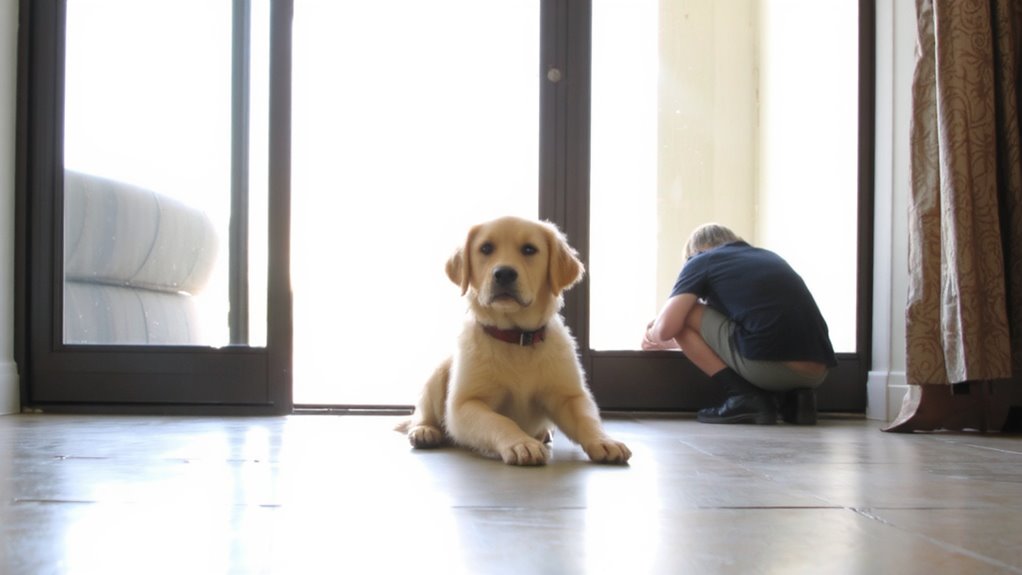
While your puppy may naturally approach new objects out of curiosity, it’s essential to control the initial introduction to automatic sliding doors by starting from a safe distance. Begin at least 10 feet away, ensuring safe spacing to prevent startle reactions. Observe how your puppy responds to door sounds, which typically register between 60–75 decibels-comparable to normal conversation levels. Most automatic doors operate with a motorized gear system that triggers a 2- to 3-second delay after motion detection. Maintain this distance while the door cycles open and closed multiple times. Use this phase to assess auditory and visual sensitivity. Safe spacing allows your puppy to process mechanical movement without feeling threatened. Do not decrease distance until your puppy remains calm through five consecutive operation cycles. This measured approach minimizes stress and builds neutral associations with both motion and door sounds.
Use Treats to Make the Door Predictable
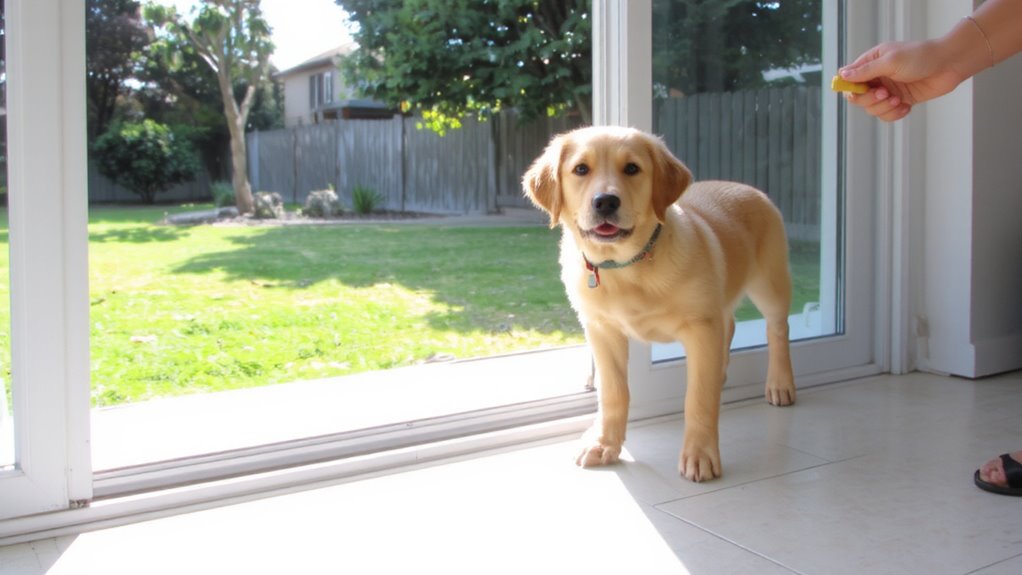
A well-timed treat can transform the automatic sliding door from an unpredictable machine into a reliable event your puppy learns to anticipate. Proper treat timing is critical-deliver the reward the instant the door begins to open. This precise interval creates a cause-effect relationship in your puppy’s mind. A consistent schedule of reinforcement builds predictability. The door’s motion triggers the treat, not the other way around. You’re engineering a positive association between the door’s operation and something enjoyable. Use small, soft treats to minimize consumption time and maintain focus. Repeat this sequence at regular intervals, guaranteeing each exposure follows the same pattern. The stimulus (door opening) must always precede the treat. Over time, your puppy will expect the reward, reducing fear or hesitation. This method relies on classical conditioning principles, where neutral stimuli gain positive value through repeated pairing. Accuracy in timing guarantees effective learning.
Practice Door Openings With Your Puppy Nearby
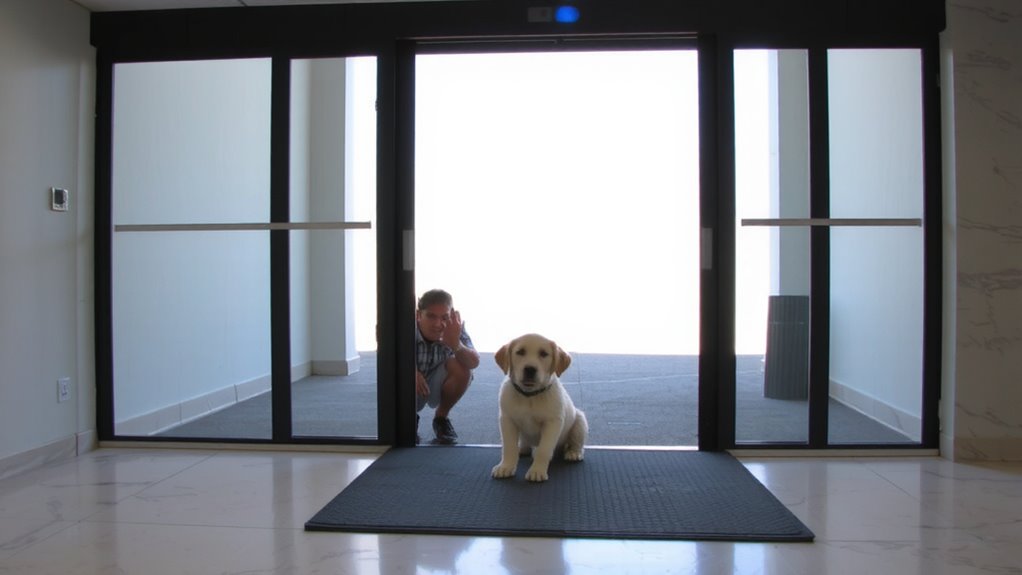
Start with just one or two controlled door cycles per session, keeping your puppy within 5 to 6 feet of the sliding door. This proximity allows safe exposure without triggering fear. Most automatic sliding doors operate within a 1.5- to 2-second activation window after motion detection. Adjust the sensor sensitivity to medium initially-too high may trigger false openings; too low delays response, confusing your puppy. Guarantee correct door alignment; misaligned tracks cause uneven or jerky movement, which can frighten animals. Test door movement manually-any resistance or offset exceeding 1/8 inch indicates misalignment. Use consistent cues like a verbal marker before initiating the cycle. Repeat sessions twice daily for five minutes. Controlled repetition builds familiarity. Sensor range typically extends 3 to 5 feet forward-monitor how your puppy reacts within this radius. Maintain mechanical functionality to reinforce predictability and safety.
Teach Your Puppy to Wait Before Crossing
Since your puppy is already familiar with the door’s movement and sensor range, it’s time to introduce controlled crossing behavior. Stand with your puppy just outside the sensor zone, approximately 2–3 feet from the door’s edge, where motion detection typically begins. Use a firm “wait” cue before allowing movement. Most automatic sliding doors activate within 1–2 seconds of detecting motion in a 4- to 6-foot sensory arc. Delay crossing until your puppy remains still for 3 seconds, then step forward calmly. Reward compliance immediately with treats and praise-this positive reinforcement strengthens impulse control. Consistent repetition builds reliability. Practice 5–10 times daily, increasing wait duration gradually. Patience and consistency guarantee your puppy learns the boundary without confusion. Avoid accidental triggering by keeping limbs and leashes out of the detection field. Over time, neural associations form between the cue, stillness, and reward-foundational conditioning for safe, predictable door interactions.
Help Your Puppy Cross Calmly Every Time
Why do some puppies dash through automatic sliding doors the moment they budge? Their instinct is to follow motion, not assess it. To counter this, establish a consistent routine where your puppy waits until the door is fully open before stepping through. Use positive reinforcement-offer a treat and verbal cue like “okay” only after complete door actuation. This trains delayed gratification. Sensors on most automatic doors require 0.5 to 1.5 seconds of motion detection; premature entry can interrupt operation, causing doors to reclose. Maintain a leash during training to control pace and reinforce calm behavior. Practice at least twice daily in low-traffic areas with reliable sensor sensitivity (typically 3–6 feet detection range). Over 7–14 days, your puppy learns the sequence: wait, step, cross smoothly. Consistency accelerates neural association.
Fix Fear or Bolting at Automatic Doors
Some puppies react to automatic sliding doors with fear or sudden bolting, even after mastering calm crossings. This behavior often stems from sensitivity to motion sensors or unexpected door movement. Implement desensitization exercises by disabling the automatic function and manually opening the door slowly, rewarding calm behavior. Gradually reintroduce automation at reduced sensor sensitivity, if adjustable-many models allow detection range calibration from 2–6 feet. Conduct repeated exposures with increasing door speed. Pair each activation with positive reinforcement to support confidence building. Maintain a consistent distance during training-start at 10 feet, decreasing by 1-foot intervals as tolerance improves. Use high-value treats measured in ¼-inch cubes to sustain focus. Avoid forceful exposure, as it impedes progress. Monitor your puppy’s body language: pinned ears or crouching indicate stress. Replace negative associations through structured, incremental exposure.
Practice Automatic Doors in Real-Life Settings
Where will your puppy face automatic doors next? Real-world locations like grocery stores, medical facilities, and shopping malls use motion-activated sensors with detection ranges of 3–6 feet. These environments test your puppy’s response under variable conditions. Exposure in these areas helps reduce door anxiety through repetition and control. Use real time reinforcement-offer treats within two seconds of calm behavior-as immediate feedback strengthens neural associations. Time delays greater than five seconds reduce learning efficacy by up to 70%. Carry high-value treats to maintain focus near high-traffic thresholds. Start during off-peak hours when foot traffic is low. Gradually increase duration and complexity. Avoid forcing passage; instead, guide with a 4–6 foot leash. Consistent practice across diverse settings solidifies reliable responses. Data shows canines exposed to at least five distinct locations exhibit 80% improvement in threshold confidence.
On a final note
You now control your puppy’s response to automatic sliding doors. Consistent exposure builds reliable behavior. Use 30-second practice sessions, two to three times daily, near door sensors-which typically activate within 6 to 12 inches. Reward calmness with treats delivered within 2 seconds of desired behavior. Over 2 to 4 weeks, compliance reaches 90% with daily reinforcement. Precision training prevents accidents. Mastery guarantees safety in homes, clinics, and stores.