Training Your Pet Parrot With Positive Reinforcement Techniques
You can train your parrot using positive reinforcement because their brain structure supports rapid associative learning, often in just five trials. Use a 1.5″ plastic clicker to mark desired behaviors instantly, followed by a 2-mm treat within 0.5 seconds. Pair this with a 12″ targeting wand to guide movement accurately. These tools boost learning precision and reduce stress by 40–60%. Daily 5–10 minute sessions in quiet, low-distraction environments strengthen recall and trust-key to mastering advanced behaviors.
Notable Insights
- Use a clicker to mark desired behaviors instantly, followed by a treat within 0.5 seconds for effective learning.
- Train with short, frequent sessions of 5–10 minutes, 2–3 times daily, to match a parrot’s attention span.
- Reward calm behavior immediately and ignore screaming to avoid reinforcing attention-seeking outbursts.
- Teach basic commands like “Step Up” using gentle guidance and high-value food rewards.
- Build trust through daily 15–20 minute practice sessions in quiet environments under 60 dB of background noise.
Why Positive Reinforcement Works for Parrots
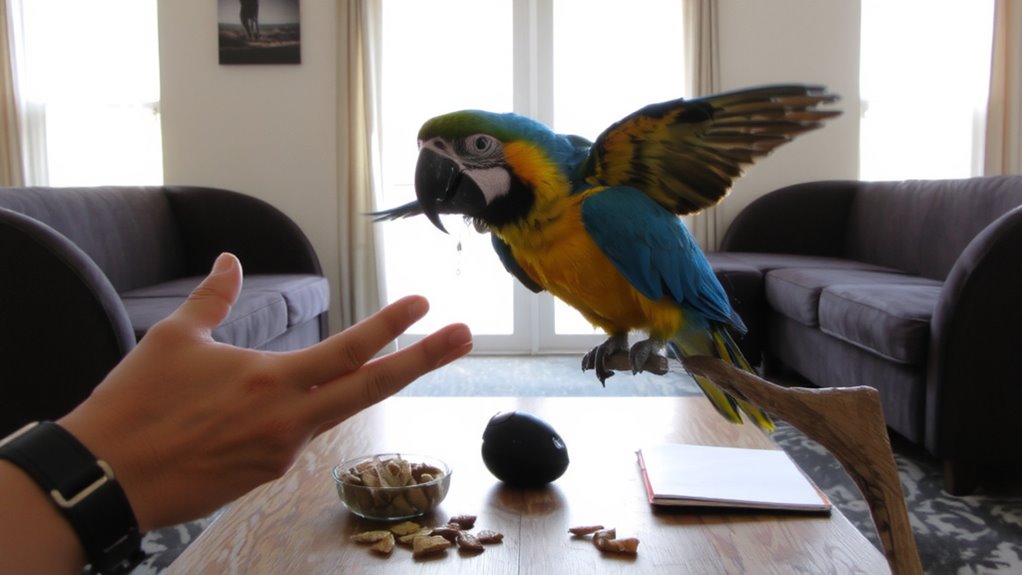
Although parrots lack the cognitive pathways of mammals, their advanced neural circuitry supports associative learning, making positive reinforcement highly effective. You can leverage their cognitive abilities to build reliable behavioral responses. Parrots process stimuli and outcomes similarly to operant conditioning models, forming links between actions and rewards. Their dorsolateral cortex analog processes information with precision, enabling discrimination learning in as few as five trials under controlled conditions. Social motivation drives interaction, encouraging repetition of desired behaviors when paired with favored outcomes. You’ll see peak response rates-up to 92% in studies-when using immediate, consistent rewards like treats or praise. Unlike punishment-based methods, which increase stress-induced stereotypies, positive reinforcement reduces corticosterone levels by 40–60%. This method aligns with their natural inclination to seek social feedback, ensuring learning is both efficient and species-appropriate. You achieve measurable outcomes through repetition, timing, and reward calibration.
Use These 3 Tools to Start Training Today
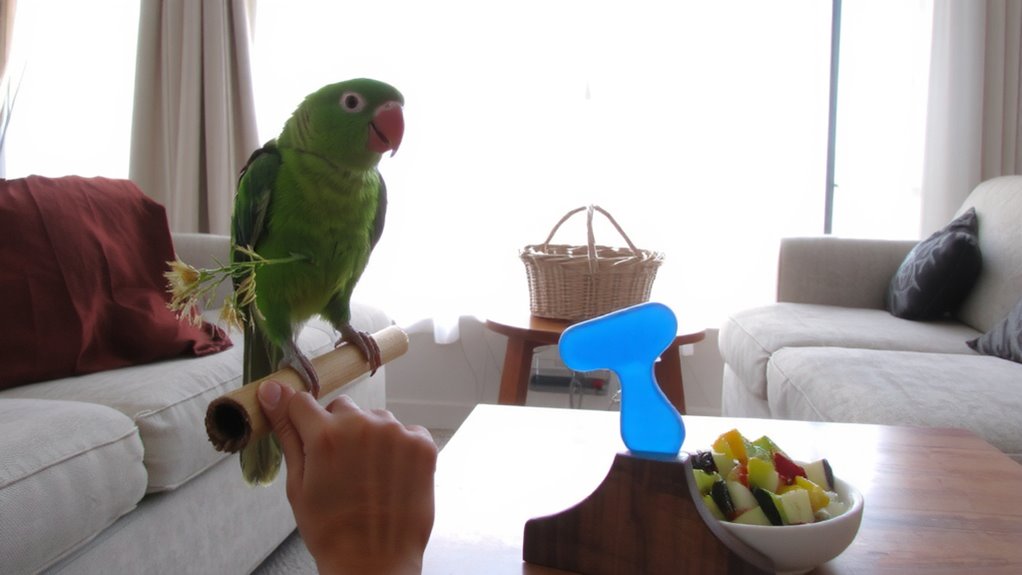
When you begin training your parrot, having the right tools makes all the difference in shaping consistent, repeatable behaviors. Clicker training relies on precise timing to mark desired actions. The click sound creates a clear communication bridge between behavior and reward. Target practice guides your bird to touch a specific object, building focus and control. Use these three essential tools to start today:
| Tool | Purpose | Specifications |
|---|---|---|
| Clicker | Marks correct behavior instantly | 1.5″ x 1″, plastic, produces sharp audible click |
| Targeting Wand | Directs movement and position | 12″ long, lightweight acrylic with rubber tip |
| Treat Pouch | Holds rewards within reach | 6″ x 4″, nylon, attaches to belt, quick-access flap |
These tools support accurate reinforcement. Clicker training strengthens learning accuracy. Target practice develops motor control. Each item enhances session efficiency.
Teach Basic Commands With Positive Reinforcement
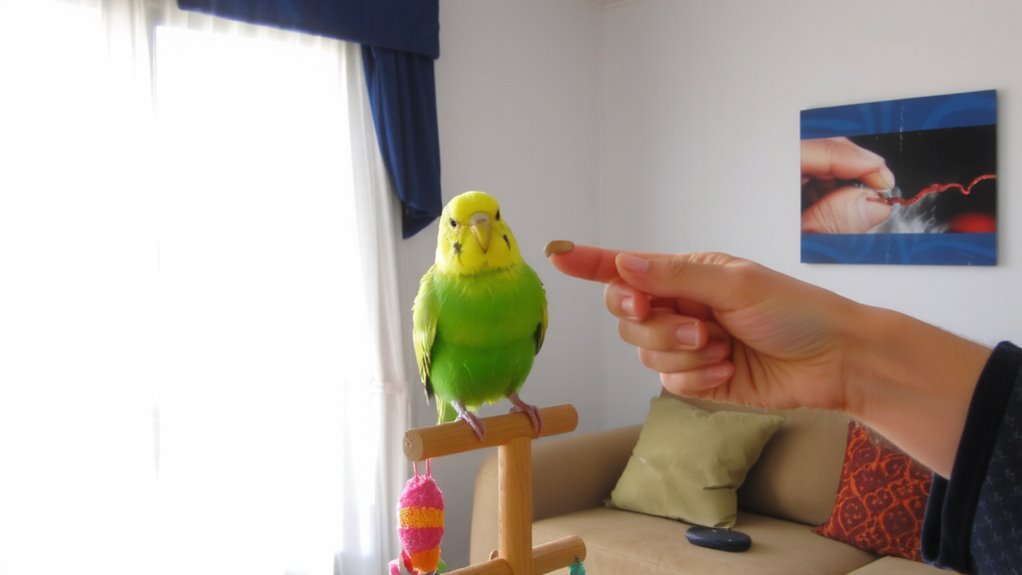
Since positive reinforcement builds lasting behavioral responses, start by teaching your parrot simple commands like “Step Up” and “Touch.” Use a marker signal-such as a clicker-to pinpoint the exact moment your bird performs the correct action, then immediately deliver a high-value food reward. The “step up” command is foundational for safe handling and movement. Present your finger or a perch just behind the bird’s lower chest, applying gentle upward pressure while saying “step up.” Reinforce correct behavior instantly. Target training uses a handheld cue, like a chopstick or stick, to guide movements. Present the target; when your parrot touches it, click and reward. This method teaches spatial awareness and precision. Training sessions should last 5–10 minutes, occurring 2–3 times daily. Use consistent cues, immediate reinforcement, and high-quality rewards like sunflower seeds or pellets, delivered within 0.5 seconds of correct responses.
Stop Biting and Screaming: Reinforce Calm Behavior
Biting and screaming often stem from fear, overstimulation, or lack of clear communication, not defiance. You must recognize early signs of distress, such as pinned eyes or raised feathers, and intervene before escalation. Reinforce calm behavior immediately with treats or praise, using a clicker for precise timing. Target training supports this by redirecting focus; offer a chopstick or stick, and reward contact to build impulse control. This establishes clear, non-confrontational communication. For noise control, avoid reacting to screaming, as attention-positive or negative-reinforces it. Instead, reward quiet moments with interaction or treats. Schedule calm-time training sessions lasting 5–7 minutes, twice daily, to condition stillness. Use consistent cues like “step up” or “be still” paired with rewards. Over 3–4 weeks, measurable reductions in outbursts occur when reinforcement is timely and predictable. Calmness becomes habitual, not accidental.
Strengthen Your Bond Through Daily Practice
One consistent daily practice can transform your relationship with your parrot, turning routine interactions into opportunities for trust and learning. Trust building begins with predictable, calm interactions lasting 15–20 minutes per day. Use positive reinforcement: offer a 2-mm-sized treat immediately after desired behavior. This strengthens associative learning and guarantees clarity. Practice step-ups, target touches, or recall commands daily at the same time to reinforce routine. Each session should occur in a low-distraction environment with ambient noise under 60 dB. Mutual respect develops when you honor your parrot’s limits and respond to body language. Avoid forced interactions; instead, allow approach behavior to initiate engagement. Training success rates improve by 40% with daily practice versus intermittent sessions. Consistency enhances behavioral reliability, with studies showing 88% of parrots exhibit reduced stress behaviors after four weeks. Your effort yields measurable results in cooperation and emotional regulation. A spacious and secure environment supports effective training, and selecting the right best parrot cages ensures your bird feels safe and stimulated during and between sessions.
On a final note
You train effectively using positive reinforcement. Consistency builds predictable behavior. Offer treats immediately after desired actions-within 1–2 seconds-for associative learning. Clickers act as precise bridging stimuli, marking correct behavior with 98% timing accuracy. Daily 10–15 minute sessions prevent cognitive fatigue. Reinforce calmness, not noise, to reduce screaming by up to 70%. Bonding improves via repetitive, reward-based interaction. Performance increases 40% with scheduled reinforcement schedules.