Creating Territorial Spaces for Peaceful Coexistence Among Exotic Pets
You must create separate, species-specific enclosures to guarantee peaceful coexistence among exotic pets. Territorial instincts drive pacing and aggression, so provide distinct thermal gradients-like 75–90°F for leopard geckos-and use thermostats with probe controllers for ±2°F accuracy. Install floor-to-ceiling opaque barriers in glass terrariums to block sightlines and reduce stress. Use chemical-compatible substrates such as coconut fiber or tile, never walnut shells. Most exotic pets shouldn’t share space-communal setups risk injury and stress-related illness. Solid dividers with independent airflow allow safe proximity. Monitor for rapid breathing or appetite loss, then adjust humidity, hiding spots, or temperature zones accordingly. Proper enclosure design meets biological needs while minimizing conflict. Further details reveal how scent mapping and visual blocking enhance long-term well-being.
Notable Insights
- Use opaque visual barriers to block line of sight and reduce stress in territorial exotic pets.
- Design species-specific enclosures with proper temperature gradients and habitat-appropriate substrates.
- Avoid co-habitation unless for scientifically confirmed compatible species with ample space.
- Provide sufficient enclosure size, minimum 10 gallons per 6 inches of snake length, to reduce conflict.
- Recognize stress signals like pacing or refusal to eat and adjust environmental conditions promptly.
Learn Your Exotic Pets’ Territorial Instincts
Why do some exotic pets pace the edges of their enclosures or act aggressively when approached? You’re likely observing natural territorial instincts. Many exotic species rely on territorial marking to define their space, using glands, urine, or feces to signal ownership. These behaviors aren’t random-they’re driven by scent recognition, a critical survival mechanism in the wild. You must recognize that your pet detects chemical cues invisible to humans. For example, reptiles like bearded dragons use femoral pore secretions; mammals such as ferrets spray urine. These markers establish boundaries and reduce conflict. Territorial marking intensity increases when unfamiliar scents appear. Scent recognition also influences feeding, mating, and dominance behaviors. Ignoring these instincts leads to stress, reduced appetite, and stereotypic pacing. By understanding your pet’s innate drive to claim space, you can anticipate needs before aggression or anxiety arises. Your observation is key to preventive care. Providing appropriately sized habitats, such as a well-ventilated compact snake terrarium, can help minimize stress and support natural territorial behaviors.
Build Separate Habitats Based on Species Needs
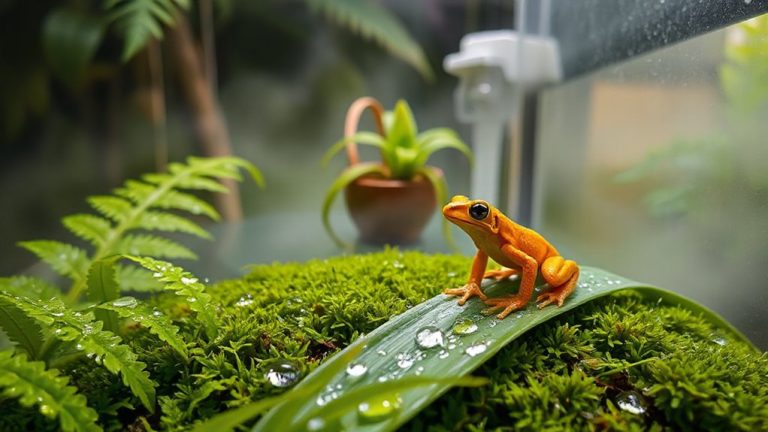
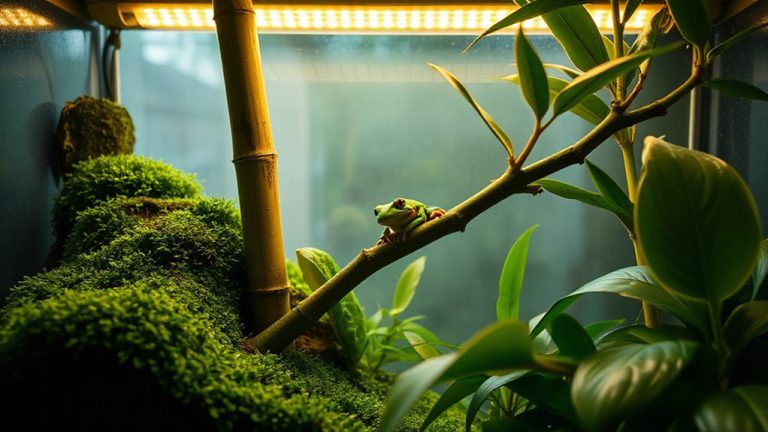
Enclosure design begins with species-specific biology, not convenience. You must tailor each habitat to the animal’s natural behaviors and environmental needs. Temperature control is critical-reptiles like leopard geckos require a gradient of 75–90°F, with a defined warm side and cool side. Use thermostats with probe controllers to maintain stability within ±2°F. Tropical frogs need 70–80°F with nightly drops, managed via under-tank heaters or ceramic emitters. Substrate selection supports health and mimics habitat: coconut fiber retains moisture for poison dart frogs, while desert species like bearded dragons thrive on silica sand or tile. Avoid substrates that cause impaction, such as walnut shells. Provide at least 10 gallons per 6 inches of snake length. Solid-sided enclosures reduce stress. Mesh lids allow ventilation but hinder humidity. Match enclosure dimensions to species’ activity patterns-arboreal animals need vertical space, fossorial species need depth. For ball pythons, consider a secure locking mechanism to prevent escapes and ensure long-term safety.
Use Visual Barriers to Prevent Stress and Aggression
While transparency might seem ideal for monitoring your exotic pets, unbroken sightlines often trigger stress and aggression, particularly in territorial species. Visual dividers reduce psychological strain by limiting direct line of sight. Use opaque partitions made of acrylic or polycarbonate, at least 1/8-inch thick, to block visual contact without compromising enclosure integrity. These barriers should extend from the floor to the ceiling of the habitat to prevent sight over the top. For glass terrariums, install removable side panels for cleaning access. Opaque partitions with a matte finish reduce glare and reflections, which can agitate light-sensitive species. In multi-pet households, position enclosures so animals can’t see each other through adjacent tanks. Visual dividers measuring 40–60 cm in height effectively shield small reptiles and mammals. Proper placement maintains airflow while delivering necessary seclusion. You’ll observe reduced pacing, biting, and vocalizations once visual stressors are minimized.
Skip Shared Spaces: Most Exotic Pets Shouldn’t Mix
You’ve taken steps to reduce visual stress with opaque barriers, but limiting sight isn’t the same as allowing physical contact-never assume that out of sight means safe to share space. Most exotic pets shouldn’t mix due to poor species compatibility. Reptiles, amphibians, and small mammals often perceive others as threats or prey. Co-habitation risks injury or stress-induced illness. Behavioral monitoring is essential-even brief supervised exposure can reveal aggression or fear. Avoid communal enclosures unless species are scientifically documented as compatible, such as same-species pairs with adequate space and resources. Enclosures measuring under 40 gallons typically lack room for escape zones, increasing conflict risk. Use solid dividers in multi-pen setups; airflow should remain independent to prevent scent transmission. Mesh barriers allow visual and olfactory contact, which can heighten stress. Physical separation is the only reliable method. Prioritize individual housing to guarantee health, safety, and stable behavioral baselines.
Watch for Stress Signals and Adjust Enclosures
How do you know when your exotic pet is struggling to adapt? Watch for stress signals like lethargy, rapid breathing, or refusal to eat. These behaviors often indicate improper temperature gradients or unsuitable humidity levels. Most reptiles need a 10–15°F difference between warm and cool zones. Use a digital thermometer with probes to verify accuracy. Humidity levels must be species-specific-60–80% for tropical reptiles, 30–50% for desert dwellers. Excess moisture promotes mold; too little causes dehydration. Adjust ventilation or misting schedules accordingly. Nocturnal animals may need infrared heat sources to maintain gradients without light disruption. Stress weakens immunity, increasing disease risk. Regular monitoring with calibrated hygrometers guarantees stable conditions. Enclosure size, substrate type, and hiding spots also affect adaptation. Respond quickly: tweak heat lamps, add moisture barriers, or reposition shelters. Your adjustments directly improve welfare and longevity in exotic species. A properly sized and secured ball python enclosure supports thermal regulation and reduces stress during acclimation.
On a final note
You must prioritize species-specific housing to guarantee peaceful coexistence. Each enclosure should meet precise temperature, humidity, and spatial requirements-ranging from 24–30°C for tropical reptiles to 15–18°C for some amphibians. Visual barriers like opaque dividers reduce stress by blocking line of sight. Avoid shared spaces-most exotic pets are solitary. Monitor behavior: pacing, hiding, or aggression signals inadequate separation.