Best Snake Enclosures for Ball Pythons That Keep Them Thriving
You need a secure, climate-stable enclosure to keep your ball python thriving. The Unipaws 110 Gal Reptile Tank offers 48″L × 24″W × 24″H interior space, ideal for maintaining a proper thermal gradient of 88–96°F on the warm side and 78–80°F on the cool side. Its dual front-opening tempered glass doors have a keyless lock, preventing escapes while allowing easy access. Silicone-sealed construction ensures 60–80% humidity retention, critical for shedding and health. A built-in cable port supports thermostats, heat lamps, and humidifiers without compromising environmental stability. Its 110-gallon capacity accommodates bioactive setups and supports natural behaviors. This enclosure integrates seamlessly with heating and monitoring equipment for peak performance. You’ll find additional models and detailed comparisons revealing further refinement strategies.
We are supported by our audience. When you purchase through links on our site, we may earn an affiliate commission, at no extra cost for you. Learn more. Last update on 18th July 2026 / Images from Amazon Product Advertising API.
Notable Insights
- Choose a 40–120 gallon enclosure with front access to support natural behaviors and reduce stress.
- Prioritize PVC or acrylic materials for superior insulation, humidity retention, and resistance to warping.
- Ensure proper ventilation with mesh panels or adjustable vents to prevent mold and respiratory issues.
- Provide a secure, escape-proof design with tight seals, locks, and minimal door gaps.
- Size enclosures to allow a thermal gradient of 78–96°F and accommodate hiding spots and substrate depth.
unipaws 110 Gal Reptile Tank for Lizards

If you’re housing an adult ball python and prioritize space, security, and environmental control, the unipaws 110 Gal Reptile Tank is one of the best enclosures for ball pythons-especially if you plan to scale your setup. Its 110-gallon capacity offers ample room for natural movement and thermoregulation. Dual sliding glass doors glide smoothly and lock securely, preventing escapes. A silicone seal between doors eliminates gaps, keeping out dust and in small climbers like crickets. The built-in cable port allows four cords to enter without breaking the enclosure’s climate seal. You can stack units vertically with an optional connector frame, saving floor space.
Best For: Reptile owners seeking a spacious, secure, and expandable enclosure for adult ball pythons or similar-sized reptiles.
Pros:
- Spacious 110-gallon capacity supports natural movement and thermoregulation for adult snakes
- Secure sliding glass doors with locking mechanism and silicone gap seal prevent escapes and maintain climate
- Integrated cable port and stackable design offer practicality for environmental control and space-saving expansion
Cons:
- No connector frame included for stacking, sold separately
- Large footprint may not fit in smaller rooms or apartments
- Glass construction makes it heavy and difficult to move once set up
REPTI ZOO 50 Gal PVC Reptile Enclosure

Choosing the REPTI ZOO 50 Gal PVC Reptile Enclosure means prioritizing thermal stability and long-term durability for ball pythons and other humidity-sensitive reptiles. Its high-grade PVC construction resists moisture far better than glass or wood. The non-porous material won’t warp, rot, or degrade over time. It maintains consistent internal temperatures and humidity-ideal for tropical and arid species alike. A removable tempered glass sliding door offers secure access and clear visibility. The safety lock helps prevent escapes. A detachable mesh screen top allows full-spectrum, UVB, and infrared light penetration. It also guarantees proper airflow. This design supports respiratory health and simplifies cleaning.
Best For: Reptile owners seeking a durable, moisture-resistant enclosure with excellent insulation for humidity-sensitive species like ball pythons, geckos, and tropical lizards.
Pros:
- High-grade PVC construction provides superior thermal insulation and humidity control for stable environmental conditions
- Non-porous, moisture-resistant material ensures long-term durability without warping, rotting, or degrading
- Removable tempered glass door with safety lock and mesh screen top offer secure access, clear visibility, and optimal airflow with full lighting penetration
Cons:
- Heavier than standard glass or wooden enclosures, making relocation difficult
- Limited customization options compared to modular or DIY builds
- Higher initial cost compared to traditional glass terrariums
60 Gal Reptile Tank with Stand (PX02RTB)

The Gal Reptile Tank with Stand (PX02RTB) is an ideal choice for ball python owners who prioritize space, functionality, and integrated design. Its 60-gallon capacity offers ample room for adult ball pythons to thrive, supporting natural behaviors and long-term growth. The front sliding acrylic doors provide full access and unobstructed viewing. A ventilated mesh top guarantees airflow while preventing escapes. It includes a 4-socket AC power strip for heat lamps, UVB fixtures, and thermostats. High-quality MDF construction ensures durability. The built-in cabinet stores substrate, tools, and supplies neatly. This enclosure combines form, function, and practicality in one sleek unit.
Best For: Ball python owners seeking a spacious, stylish, and functional enclosure with integrated storage and power management.
Pros:
- Spacious 60-gallon habitat ideal for adult ball pythons and other mid-sized reptiles
- Built-in cabinet provides organized storage for supplies and equipment
- Equipped with a 4-socket power strip and mesh ventilation for optimal habitat control
Cons:
- Not suitable for aquatic or semi-aquatic reptiles
- MDF construction may be susceptible to moisture damage if not maintained properly
- Acrylic front doors may scratch over time with improper cleaning
New Age Pet ECOFLEX Reptile Habitat

I’ve found the New Age Pet ECOFLEX Reptile Habitat works best for keepers who prioritize eco-conscious design without sacrificing functionality in a ball python setup. It’s made from ECOFLEX, a moisture-resistant composite that controls odors and simplifies cleaning. While not fully waterproof, it handles low-to-moderate humidity well. The natural maple, black, and grey finish gives a clean aesthetic and unobstructed viewing. Interior dimensions are 46.46L x 22.32W x 21.26H. Sliding glass doors lock securely. Vented sides and a mesh top guarantee airflow. I can assemble it in 20–30 minutes. It’s U.S. designed, backed by a 10-year warranty, and 100% pet approved.
Best For: Eco-conscious reptile keepers seeking a stylish, durable, and well-ventilated habitat for ball pythons or similar-sized reptiles in low-to-moderate humidity environments.
Pros:
- Made from eco-friendly ECOFLEX composite that resists moisture, controls odors, and simplifies cleaning
- Features sliding glass doors with a lock, vented sides, and a large mesh top for security, accessibility, and superior airflow
- Easy 20–30 minute assembly with included hardware and clear instructions; backed by a 10-year warranty
Cons:
- Not fully waterproof, limiting suitability for high-humidity reptile setups
- Stand and stacking accessories sold separately, increasing overall cost
- Composite material, while durable, may degrade over time if exposed to prolonged moisture
120 Gal Reptile Tank Stand with Outlets
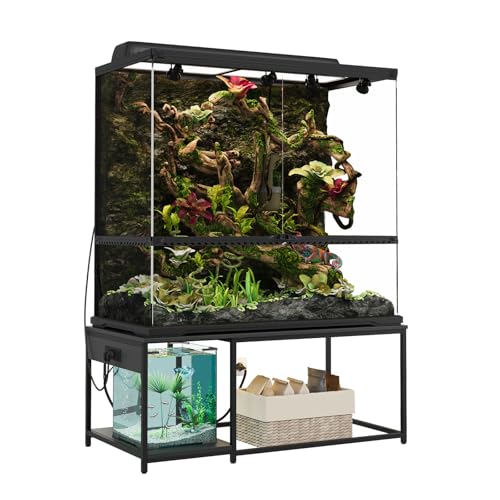
If you’re setting up a large, permanent habitat for your ball python, the Gal Reptile Tank Stand with Outlets delivers both structural reliability and smart integrated features. Its six-leg design and P2-grade engineered wood guarantee stability under heavy enclosures up to 230 gallons. The metal frame supports 48″x24″ terrariums, including 48x24x46 and stackable 48x24x24 PVC tanks. It accommodates chameleon, bearded dragon, and large snake enclosures. Built-in electricals include 3 AC outlets and 2 USB ports for lights, heaters, and foggers. A multi-mode LED strip adds ambient lighting. Assembly is straightforward-parts are numbered, and tools plus instructions are included.
Best For: Reptile owners setting up large, permanent habitats who need a stable, feature-rich stand with built-in power and lighting options.
Pros:
- Sturdy six-leg design and P2-grade engineered wood support heavy enclosures up to 230 gallons with excellent stability
- Integrated 3 AC outlets and 2 USB ports simplify powering lights, heaters, and other terrarium equipment
- Multi-mode LED light strip enhances visual appeal and allows customizable ambient lighting
Cons:
- Limited to 48″x24″ terrariums, reducing compatibility with non-standard or larger enclosure sizes
- Built-in electrical components may pose risks if exposed to accidental water splashes or humidity
- Assembly, while tool-assisted, may be time-consuming due to the number of parts and hardware involved
120 Gal Bearded Dragon Tank with Sliding Door

A 120-gallon reptile tank with sliding doors isn’t just for bearded dragons-this enclosure works exceptionally well for larger ball pythons that need spacious, climate-stable habitats. It measures 48″ L x 24″ W x 24″ H, built with rigid tempered glass and a silicone-sealed bottom for durability. Front-opening doors feature handles and minimal gaps, ensuring secure containment. The rust-proof top screen allows steady airflow and full lighting penetration. I use standard Zoo Med 5.5″ heat lamps and misters without issues. Its closed design holds stable humidity and temperature. Front access simplifies cleaning and feeding, and the built-in substrate barrier prevents spills. It assembles in six steps, is stackable with Phailozoo V2 stackers only, and isn’t leakproof-so I seal it for bioactive builds.
Best For: Reptile owners seeking a spacious, durable, and well-ventilated 120-gallon enclosure for large species like adult bearded dragons, ball pythons, and other lizards requiring stable temperature and humidity.
Pros:
- Spacious 48″ L x 24″ W x 24″ H design accommodates adult reptiles and supports bioactive setups
- Front-opening sliding doors with minimal gaps and built-in handles allow easy access and secure containment
- Rust-proof top screen ensures proper ventilation and compatibility with standard reptile lighting and misting systems
Cons:
- Not leakproof out of the box, requiring additional silicone sealing for bioactive or high-humidity builds
- Only compatible with Phailozoo V2 stackers, limiting stacking options with older models
- Front-opening doors may limit overhead access compared to top-opening enclosures
REPTI ZOO 50 Gal Glass Terrarium
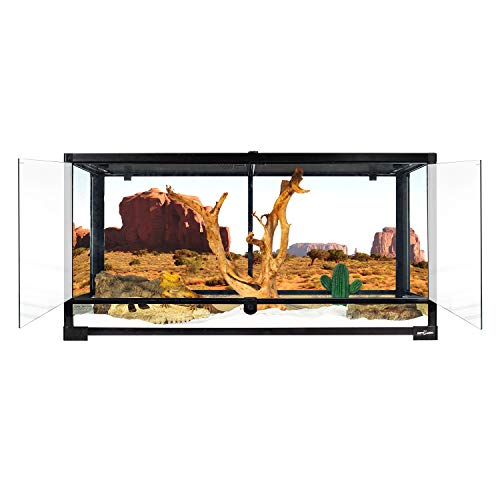
The REPTI ZOO 50 Gal Glass Terrarium stands out for ball python owners who prioritize both thermal control and habitat flexibility. It measures 36″ x 18″ x 18″, offering ample floor space for proper temperature gradients. Its raised bottom frame accommodates substrate heaters safely. The waterproof base supports setups for arid or humid environments. Double front hinge doors open independently, simplifying feeding while minimizing escape risks. A removable screen top allows UVB and infrared penetration and secures tightly. Ventilation comes from side, top, and rear inlets, some with closable ports for wiring. I found assembly fast-under five minutes-thanks to its knock-down design. It arrives in heavy-duty packaging with reinforced foam. Built with durable materials, it’s adaptable for various reptiles.
Best For: Ball python owners who need a spacious, thermally versatile, and escape-resistant terrarium with easy access and reliable ventilation.
Pros:
- Spacious 36″ x 18″ x 18″ design provides ample floor area for proper temperature gradients and enrichment
- Raised bottom frame and waterproof base allow safe use with substrate heaters and adaptability for desert or rainforest setups
- Double front hinge doors and removable screen top enhance accessibility, security, and UVB/infrared penetration
Cons:
- Glass construction makes it heavy and less portable once set up
- Screen top may require additional security measures to prevent determined climbers from escaping
- Limited ventilation control despite closable inlets, which may challenge precise humidity management in very humid setups
85 Gallon Reptile Tank with Front Opening

When choosing a secure, spacious habitat that accommodates both current needs and future upgrades, the 85-gallon reptile tank with front opening stands out as the best choice for ball python owners who prioritize accessibility and structural integrity. It measures 48”L × 24”W × 18”H-ideal for adult ball pythons and bioactive setups. Rigid tempered glass doors have a 2mm gap, preventing escapes. Silicone-sealed bottom boosts strength but needs extra sealing for moisture retention. Front access simplifies feeding and cleaning. Top screen allows 28% airflow blockage and supports heat lamps, humidifiers, and UV lighting. It assembles in six steps and is stackable for expansion.
Best For: Ball python owners seeking a secure, spacious, and accessible habitat that supports bioactive setups and future expansion.
Pros:
- Front-opening design with tempered glass doors allows easy access for feeding and cleaning while preventing escapes
- Top screen provides 28% airflow blockage and is compatible with heat lamps, humidifiers, and UV lighting
- Lightweight, stackable construction enables easy assembly and scalable multi-unit setups
Cons:
- Silicone-sealed bottom is not leakproof and requires additional sealing for optimal moisture retention in bioactive enclosures
- Limited height of 18 inches may restrict vertical enrichment for some reptile species
- Front door gap of 2mm, while small, may still require monitoring for very small or juvenile reptiles
25 Gallon Reptile Tank PVC Enclosure

If you’re housing a ball python and demand a durable, efficient enclosure that simplifies daily care, the 25-gallon PVC reptile tank stands out as a top-tier choice. It measures 24″x16″x16″, offering ideal horizontal space for ground-dwelling snakes. The PVC and acrylic build is lightweight, shatter-resistant, and easier to move than glass. This material retains heat better, supporting stable thermal gradients critical for digestion and health. A front-opening panel allows stress-free access for feeding and cleaning, with a lockable latch to prevent escapes. Integrated side and rear vents guarantee steady airflow, reducing humidity spikes and odors. Assembly requires no tools-just follow the included instructions or video guide for quick setup.
Best For: Reptile owners seeking a durable, low-maintenance enclosure ideal for ground-dwelling species like ball pythons, leopard geckos, and snakes.
Pros:
- Lightweight, shatter-resistant PVC and acrylic construction offers superior durability and easier handling than glass tanks
- Front-opening panel with a lockable latch allows secure, stress-free access for feeding and cleaning
- Integrated ventilation system ensures proper airflow, reducing moisture buildup and odors
Cons:
- Limited vertical space makes it unsuitable for arboreal reptiles that require climbing room
- Plastic materials may scratch over time with regular cleaning or handling
- Ventilation, while sufficient, may require supplemental solutions in very humid climates
Reptile Tank 230 Gallon with Glass Door

A 230-gallon reptile tank with a glass door isn’t just a habitat-it’s a long-term investment for serious keepers committed to creating a premium environment for ball pythons and other sizable reptiles. Measuring 48″x24″x46″, its extra-tall design offers ample floor space and vertical climbing room. Black PVC side panels retain heat and humidity, reduce stress, and eliminate the need for a background. The front features sliding tempered glass doors with a keyless lock for security and easy access. A ventilated mesh top allows airflow and supports overhead heating or UVB fixtures, while adjustable crossbars let me position lights precisely. The raised bottom accommodates substrate heaters. I can recreate natural desert or rainforest bioactive setups using coconut fiber, hides, and climbing branches-delivering functionality, durability, and seamless setup for sustained reptile health.
Best For: Dedicated reptile enthusiasts seeking a spacious, durable habitat to create naturalistic bioactive environments for large or climbing species like ball pythons, bearded dragons, and leopard geckos.
Pros:
- Extra-tall 230-gallon design provides ample floor space and vertical climbing room for larger reptiles
- Black PVC side panels retain heat and humidity while reducing stress and eliminating the need for a background
- Front-opening tempered glass doors with a keyless lock ensure security, easy access, and clear viewing
Cons:
- Heavy and large footprint requires significant room space and strong floor support
- Mesh top may not retain humidity as effectively in very dry environments without additional measures
- No built-in lighting or heating included, requiring additional setup costs
Factors to Consider When Choosing a Snake Enclosure for Ball Python
You need the right enclosure size to keep your ball python healthy-aim for a minimum of 36 inches long by 18 inches wide by 12 inches high for an adult. The material should be sturdy and insulating, like PVC or solid wood, to maintain temperature and humidity without warping. Good ventilation, secure access doors, and precise thermal control are just as critical to prevent stress and support proper shedding.
Size And Dimensions
At a minimum, your ball python’s enclosure must offer 36 inches of length and 18 inches of width-this floor space is essential for establishing a proper thermal gradient. You need a temperature differential between the warm and cool ends, allowing your snake to regulate its body temperature effectively. The enclosure should be at least 18 inches tall to support vertical humidity gradients while preventing escape. An ideal setup provides 75 to 120 gallons of total volume, giving room for deep substrate, multiple hides, and environmental zones. Avoid cramped designs; restricted space limits natural behaviors and stress resistance. Front-opening access is critical-you’ll reduce stress during maintenance and feeding compared to top-opening models. Look for fully enclosed structures with tight seals; even small gaps can cause humidity to drop below the necessary 50% threshold. Size matters for health, not just comfort.
Material Quality
PVC stands out as the top choice for ball python enclosures due to its excellent insulation and moisture resistance. It maintains stable internal temperatures and humidity levels, typically retaining 60–80% RH with minimal fluctuations. Its non-porous surface resists microbial growth and won’t warp or degrade, even under constant moisture exposure. Unlike glass tanks, which conduct heat and struggle to hold humidity, PVC minimizes thermal bridging and condensation. Glass offers clarity and durability but often requires additional sealing or humidity boxes. Acrylic is lightweight and shatter-resistant but scratches easily, reducing visibility over time. High-quality sealed composite wood resists odors and simplifies cleaning, enhancing long-term hygiene. These materials provide structural integrity and reduce pathogen retention. Choose PVC for ideal environmental stability, especially in variable room conditions. It’s ideal for consistent, low-maintenance habitats that support your ball python’s health through reliable performance.
Ventilation Needs
While maintaining proper humidity is essential, insufficient airflow can compromise your ball python’s health just as quickly. Proper ventilation prevents stagnant air and excessive moisture, reducing the risk of respiratory infections. You need balanced airflow-typically achieved with mesh panels or vents on the top and sides-to allow consistent air exchange without creating drafts. Aim for 20–30% of the enclosure’s surface area dedicated to ventilation. This range supports ideal humidity levels between 50% and 60% while minimizing mold and bacterial growth. Enclosures made of PVC or glass often lack natural airflow, so built-in or add-on vents are critical. Choose models with adjustable or partially closable vents. These let you temporarily reduce airflow during shedding, when you need short-term humidity boosts. Effective ventilation isn’t about maximum airflow-it’s about controlled, steady circulation that mirrors the snake’s natural environment.
Access And Security
Good ventilation supports a healthy environment, but without secure access points, even the best airflow design can’t keep your ball python safe. Front-opening doors with secure locking mechanisms reduce escape risks and let you feed or clean safely. Look for gaps smaller than 2mm around doors-this blocks escapes and helps maintain stable temperature and humidity. Tempered glass or solid PVC enclosures with sealed seams offer durability and prevent leaks or tampering. Slide or lift-off doors with handles give easy access while limiting substrate spillage during maintenance. Use lockable access points-like keyless combos or strong latches-to guarantee long-term security, especially if you have kids or pets. These features work together to create a sealed, reliable habitat. A well-built enclosure doesn’t just hold your snake-it protects it. Prioritize structure, fit, and locking function every time.
Thermal Regulation
Creating a stable thermal environment is essential for your ball python’s health, and the right enclosure makes all the difference. You need a thermal gradient with the warm side at 88–96°F (31–36°C) and the cool side at 78–80°F (25–27°C) to support digestion and thermoregulation. Use under-tank heating pads or ceramic heat emitters to provide reliable belly heat, which drives metabolic function. Always pair heat sources with a thermostat to maintain consistency and prevent overheating, especially at night when temps must stay above 75°F (24°C). Opt for enclosures made from insulated materials like PVC or wood-they hold heat better than glass, reducing thermal fluctuations. Avoid heat sources that create hot spots or uneven gradients. Inconsistent temperatures cause stress, hinder digestion, and increase the risk of respiratory infections. Choose designs that support precise, stable thermal control for long-term health.
Frequently Asked Questions
How Often Should I Clean My Ball Python’s Enclosure?
You should clean your ball python’s enclosure weekly. Spot clean daily to remove feces, urates, and shed skin. Perform full cleanings monthly using a 5% bleach solution, rinsing thoroughly and drying before reuse. Maintain hygiene to prevent bacterial or fungal growth. Replace substrate completely each month. Guarantee humidity stays 50–60%, temperature 78–80°F cool side, 88–96°F basking side. Clean water bowls every 2–3 days.
Can Ball Pythons Live Together in the Same Tank?
No, you shouldn’t house ball pythons together. They’re solitary by nature and stress easily in shared spaces. Co-habitation increases aggression, feeding competition, and disease transmission risk. Enclosures meant for one adult-typically 36–48 inches long-become overcrowded. Temperature gradients and hiding spots can’t be properly utilized when snakes compete. Even juveniles fare better alone. A single-stress-free habitat guarantees stable behavior, proper feeding, and peak health. You’ll prevent injury and promote consistent shedding and growth.
Do Ball Pythons Need UVB Lighting to Stay Healthy?
No, ball pythons don’t need UVB lighting to survive, but you’ll improve their long-term health by providing it. You can replicate natural daylight cycles with a low-output 2–5% UVB bulb. Install it over the basking zone, 10–12 inches above the substrate, on a 12-hour timer. This exposure supports vitamin D3 synthesis, calcium metabolism, and natural behavior-like feeding and shedding-more effectively than ambient light alone.
What Temperature Should a Ball Python Enclosure Be?
You should keep your ball python’s enclosure between 75°F and 80°F on the cool side, with a warm side of 88°F to 92°F. Maintain this gradient using an under-tank heater or radiant heat panel. Use a reliable thermostat to prevent overheating. The basking surface must stay at 88–92°F while ambient air temps stay stable. Consistent thermal gradients support proper digestion and overall health.
How Long Can a Ball Python Go Without Eating?
You can expect a ball python to go without eating for up to six months safely, especially during brumation or due to stress. Adults often skip meals for 4–6 weeks routinely. Prolonged fasting beyond six months risks muscle atrophy and fatty liver disease. Juveniles shouldn’t fast longer than 1 month. Monitor weight monthly; a drop over 10% demands intervention. Offer pre-killed prey on a consistent schedule to maintain metabolic health.