Growth Patterns and Development Milestones in Rabbits, Guinea Pigs, and Other Small Mammals
You’ll see rabbit kits double their birth weight by day 7, reaching 80–120 g, while guinea pig pups are born weighing 70–110 g, fully furred and mobile. Kits open eyes at 10–12 days; pups are sighted at birth. Wean rabbits at 28 days, aligning with gut closure and immune development. Guinea pigs begin solids at 10 days, weaning fully by 21. Both species show early motor development, with neural maturation driving coordination. Sexual maturity occurs as early as 10–12 weeks in rabbits, 6 weeks in guinea pigs. Growth rates vary-rabbits gain up to 0.5 lbs/week, guinea pigs peak in the first six weeks. Track weekly weights to monitor development. Patterns reflect evolutionary adaptations to predation and environment. Key milestones follow species-specific timelines shaped by metabolic and neurological demands. Further details reveal how environment and nutrition fine-tune these trajectories.
Notable Insights
- Rabbit kits double birth weight within 5–7 days, while guinea pig pups grow rapidly in the first six weeks.
- Kits are born altricial, opening eyes at 10–12 days, whereas guinea pig pups are precocial with eyes open at birth.
- Rabbit weaning occurs at 28 days; guinea pigs begin solids at 10 days and wean by 21 days.
- Play behavior peaks at 4–8 weeks, supporting motor skills and social bonding in both species.
- Female rabbits mature at 12 weeks; guinea pig females can conceive as early as 6 weeks.
Newborn Care for Rabbits and Guinea Pigs
Newborn care begins the moment kits enter the world, and timing is critical. You must guarantee the environment supports nesting instincts, which drive the mother to create a warm, insulated nest using fur and hay. For rabbits, this nest maintains a microclimate of 32–35°C, essential for thermoregulation in hairless kits. Guinea pigs are precocial, born furred and sighted, yet still rely on maternal bonding for survival. Nursing occurs briefly-rabbits feed kits once daily for 3–5 minutes, transferring antibody-rich milk with 15–20% fat content. Maternal bonding is evident within hours, marked by grooming and vocalizations. Disruption delays bonding and increases mortality. Kits must gain weight steadily: rabbit kits should double birth weight (40–60 g) in 5–7 days. Any deviation signals intervention necessity. Observe closely but minimize handling to preserve natural behaviors and thermal stability.
When Eyes Open and Movement Begins
Once their eyes open, both rabbit kits and guinea pig pups move into a new phase of sensory awareness and physical activity. Eye development in rabbits typically completes around 10–12 days post-birth, revealing fully functional vision. Guinea pigs, however, are born precocial; their eyes open immediately, demonstrating advanced eye development at birth. This early visual capability supports immediate environmental interaction. Motor skills emerge rapidly. Rabbit kits begin uncoordinated movements days after birth but gain limb control by day seven, enabling hopping by eye-opening. Guinea pig pups walk within minutes of birth, supported by developed musculoskeletal systems. Their motor skills include running and evasive maneuvers within hours. Neural maturation drives coordination in both species. While rabbits rely on rapid postnatal development, guinea pigs exhibit mature motor patterns early. These differences reflect distinct evolutionary adaptations. You can expect noticeable improvements in balance and agility daily during this stage.
Weaning: Switching to Solid Foods
Most small mammals begin weaning between 21 and 28 days of age, though the exact timing depends on species-specific developmental milestones. You’ll notice nutritional shifts starting when young animals sample solid food while still nursing. In rabbits, weaning typically occurs at 28 days, aligning with full gut closure and immune protection from maternal antibodies. Guinea pigs begin chewing solids as early as 10 days, but complete weaning finishes around 21 days. Their cecum must undergo digestive adaptation to process fibrous plant material efficiently. Gradual introduction of pellets and hay supports this shift, reducing gastrointestinal upsets. Abrupt weaning stresses developing systems and may impair growth. You should provide high-fiber, low-calorie diets during this phase to match natural foraging patterns. Monitor intake and stool quality closely-changes indicate poor adaptation. Proper weaning sets metabolic and digestive function on track for long-term health.
Socialization and Early Play Behaviors
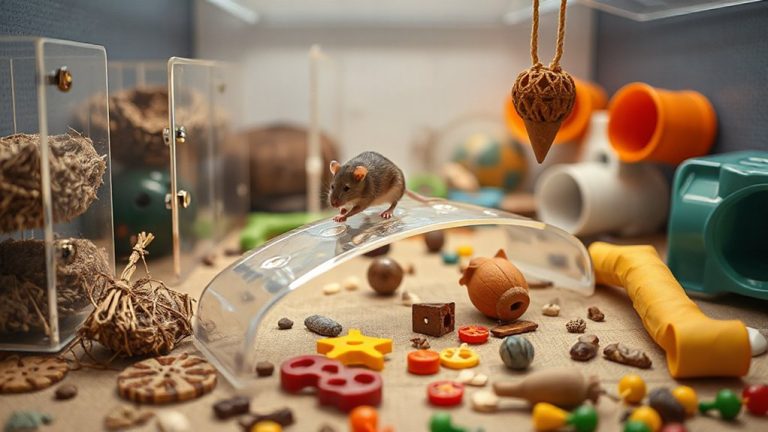
While physical development progresses rapidly in early life, socialization and play behaviors are equally critical for normal behavioral maturation in small mammals. You’ll observe play fighting within days of weaning, especially in guinea pigs and rabbits. This behavior involves gentle nipping, chasing, and mock lunging, which hones motor coordination and social awareness. Play fighting typically occurs in short bursts-20 to 30 seconds-and peaks between 4 to 8 weeks of age. It supports social bonding by establishing dominance hierarchies and reducing future aggression. In communal species like guinea pigs, juveniles spend up to 15% of daily activity in social interactions. These interactions include nose rubbing and mutual grooming, reinforcing group cohesion. Isolation during this period leads to impaired communication and increased stress responses. Proper socialization between 3 to 9 weeks guarantees stable adult behavior. Environmental enrichment, such as tunnels and hiding spaces, promotes natural play patterns. You must provide consistent peer contact to support healthy neurobehavioral development. A diet rich in high-quality best guinea pig hay is essential to support overall health during this critical developmental stage.
Sexual Maturity by Species
Several small mammal species reach sexual maturity rapidly, often within weeks of birth, making timing essential for breeding or separation decisions. You’ll notice breeding readiness in female rabbits as early as 12 weeks, especially in smaller breeds, due to accelerated hormonal changes. Males typically follow shortly after, with sperm production beginning around 10–12 weeks. Guinea pigs mature even earlier; females can ovulate by 3–4 weeks and conceive by 6 weeks, necessitating early male-female separation. Hormonal changes drive visible behaviors like mounting or restlessness, signaling physiological readiness. For rabbits, puberty correlates with reaching approximately 75% of adult body weight. Delaying separation risks unintended litters. Smaller mammals’ brief juvenile phase means you must monitor development closely. Accurate age tracking and sex identification at 3 weeks are critical. These timelines reflect biological imperatives, not anomalies. Misjudging them compromises animal health and breeding integrity.
Rabbit vs. Guinea Pig Growth Rates
Though both rabbits and guinea pigs are small mammals with rapid development, their growth rates differ markedly in pace and pattern. You’ll notice rabbits experience intense growth spurts early, gaining up to 0.5 pounds weekly during their first three months. They reach adult size by 6–8 months, depending on breed. In contrast, guinea pigs grow steadily but slower, with peak growth in the first six weeks. Weight tracking is essential: newborn guinea pigs weigh 60–100 grams, doubling in mass within a week. Rabbits, born altricial, start at 40–60 grams but grow faster due to accelerated metabolism. By weaning at 4 weeks, rabbits can weigh 1–2 pounds. Guinea pigs, precocial, are fully furred and mobile at birth. Their consistent growth requires monthly weight checks to detect health issues early. Accurate weight tracking guarantees proper development in both species, but the timing and magnitude of growth spurts clearly set them apart.
On a final note
You now understand key developmental milestones in small mammals. Rabbits open their eyes at 10–12 days; guinea pigs are born precocial, with eyes open and mobile. Weaning occurs at 3–4 weeks in rabbits, 2–3 weeks in guinea pigs. Sexual maturity arrives at 8–12 weeks (rabbits) and 3–5 weeks (guinea pigs). Growth rates differ markedly-rabbits gain 0.5–1.0 lb/month, guinea pigs 0.2–0.4 lb/month. Monitor weight and behavior closely.