Using Food Puzzle Toys to Encourage Foraging in Indoor Cats
Food puzzle toys tap into your cat’s natural hunting drive by simulating prey movement and requiring effort to access food. Models like motion-based or rotary feeders dispense kibble when batted or rolled, with adjustable openings (1/4 to 1/2 inch) to match skill level. They engage cats for 7–12 minutes per session, matching wild foraging duration. Use BPA-free, dishwasher-safe designs holding up to 1.5 cups. Start simple, then progress difficulty to maintain challenge and mental stimulation. Key benefits emerge with consistent use across varied surfaces and routines.
Notable Insights
- Food puzzle toys mimic prey movement and concealment, activating cats’ natural hunting instincts during play.
- Motion-based and rotary puzzles dispense kibble when manipulated, simulating foraging and extending mealtime engagement.
- Start with simple, low-difficulty puzzles and gradually increase challenge to build confidence in reluctant cats.
- Use adjustable openings to match kibble size and control food release, maintaining appropriate challenge and preventing frustration.
- Rotate puzzle types every few days and place them in varied locations to sustain interest and mental stimulation.
How Food Puzzle Toys Satisfy Your Cat’s Hunting Instinct
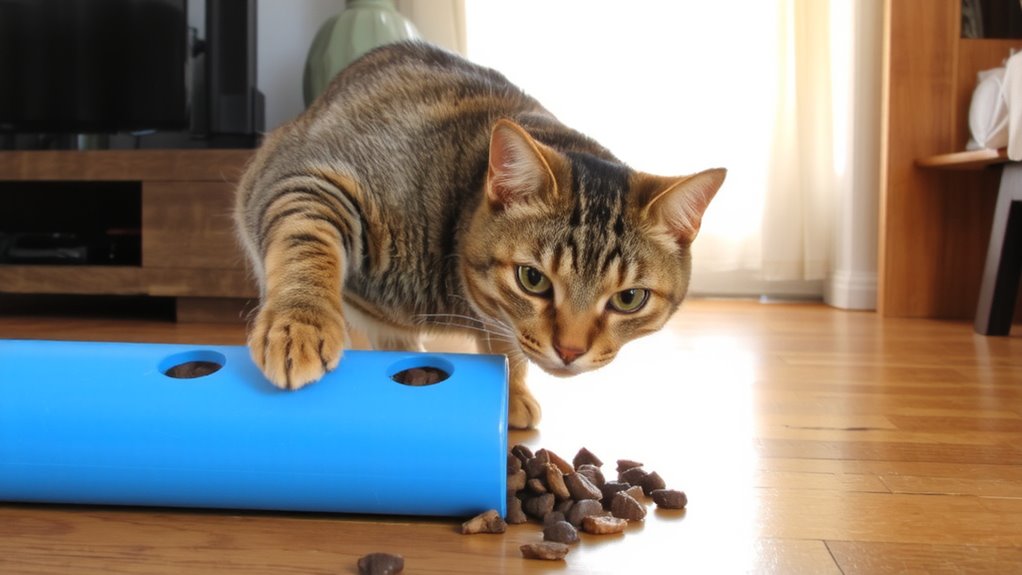
While your cat may never need to hunt for survival, their natural instinct to stalk, capture, and consume prey remains deeply embedded in their behavior. Food puzzle toys enable prey simulation by mimicking the movement and concealment of live quarry. These devices require manipulation-rolling, flipping, or pawing-to release kibble, triggering instinct activation. Studies show cats spend 7–12 minutes per session engaged with puzzle feeders, closely aligning with average wild foraging duration. Toys with adjustable openings regulate food release rate, allowing control over difficulty level. Polypropylene construction guarantees durability, with most units supporting up to 1 cup of dry food. Spherical designs (2.8–3.5 inches diameter) promote rolling, while stationary mazes offer progressive challenge. Engagement with these puzzles increases mental stimulation by 40% compared to free feeding. Consistent use reduces stress-related behaviors by up to 30%. Prey simulation through structured feeding supports natural behavioral patterns, fulfilling a critical aspect of feline psychological health.
Best Puzzle Feeder Types for Indoor Cats
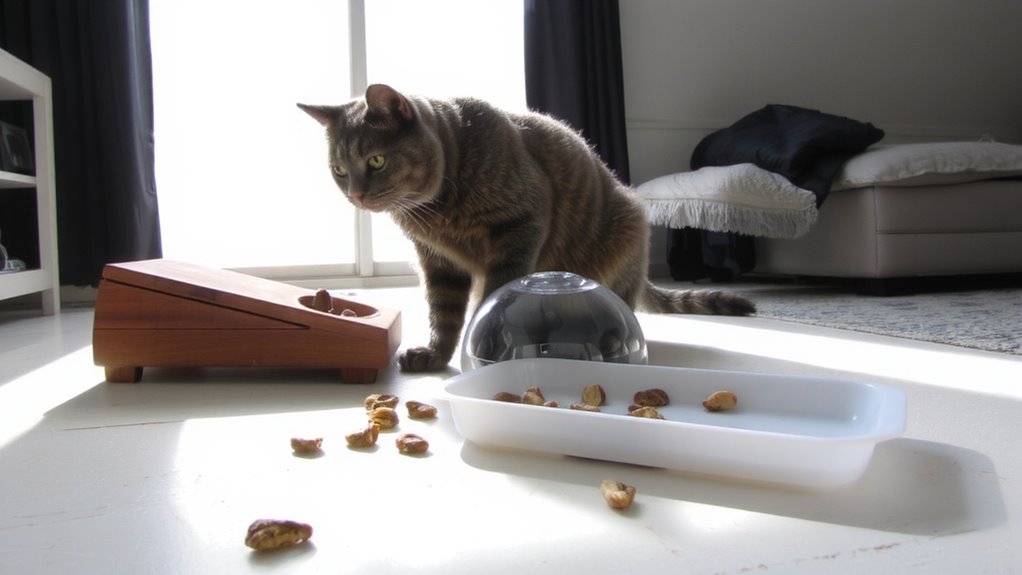
Motion-based feeders rank among the most effective puzzle types for stimulating indoor cats. These units dispense kibble when rolled or batted, mimicking prey movement. Most models measure 6–8 inches in diameter and are constructed from BPA-free plastic, guaranteeing material durability under repeated paw swipes. Weighted bases prevent tipping, while adjustable openings control food release-typically 1/4 to 1/2 inch in diameter. Rotary feeders feature internal baffles that scatter kibble gradually, prolonging engagement. Collapsible treat balls work well for light play but offer limited challenge. For sustained mental stimulation, choose designs that support puzzle variety-interchangeable inserts or modular chambers that alter difficulty. Ceramic or stainless-steel components enhance longevity but increase weight. Dual-chamber feeders allow portion separation, supporting up to 1.5 cups of dry food. Guarantee all seams are ultrasonically welded to prevent breakage. Consistent use of durable, variable puzzles sustains cognitive activation.
Pick the Right Puzzle Toy for Your Cat’s Skill Level
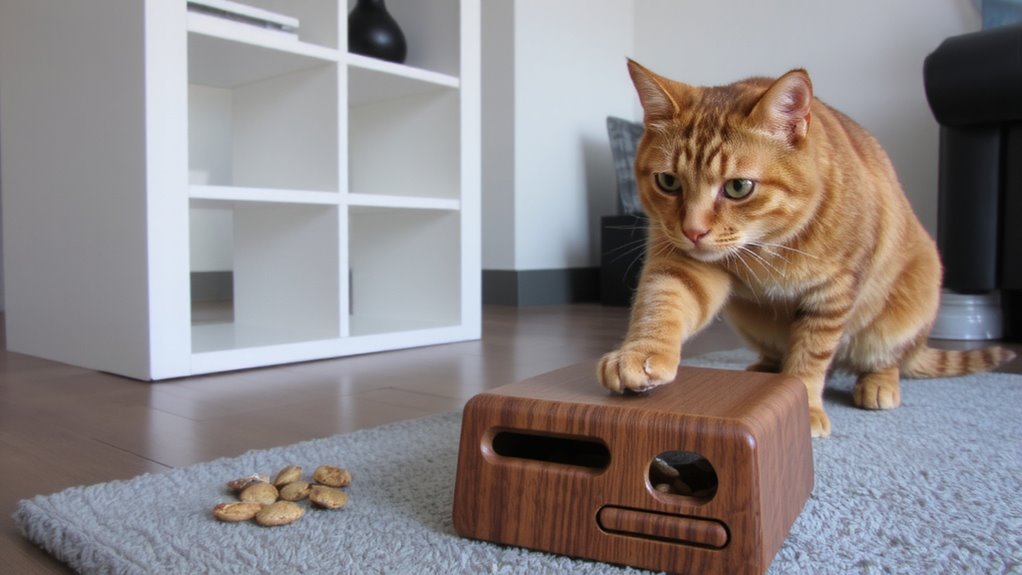
Since every cat develops problem-solving skills at a different pace, matching the puzzle toy to your cat’s experience level guarantees effective engagement and prevents frustration. Start with simple designs, like roll-or-slide feeders, for beginners. These offer larger openings and minimal barriers, allowing novices to succeed quickly. Intermediate cats benefit from multi-step puzzles requiring paws or nose manipulation. Advanced models feature adjustable difficulty, such as rotating lids or hidden compartments. Toy durability is critical-choose BPA-free, chew-resistant plastics or reinforced nylon that withstand repeated use. Measure openings to guarantee reward size matches your cat’s kibble; too small causes frustration, too large reduces challenge. Opt for toys with replaceable parts and dishwasher-safe components. Always test mechanical function before use. Proper selection maintains cognitive stimulation and feeding efficiency. One effective option is choosing from the best puppy puzzle toys, which often include adaptable challenges suitable for varying skill levels.
How to Introduce Food Puzzles to Reluctant Cats
Start by placing the puzzle toy near your cat’s regular feeding area with the kibble visible but easily accessible. Initial resistance is common, especially in sedentary or older cats unaccustomed to problem-solving for food. Use gradual exposure to build familiarity-leave the toy out for 10–15 minutes daily without requiring manipulation. Over time, slowly increase complexity by blocking direct access to food.
| Week | Toy Position | Food Accessibility |
|---|---|---|
| 1 | Adjacent to bowl | Fully visible, loose |
| 2 | Slightly offset | Partial cover |
| 3 | Alone (no bowl) | 25% effort needed |
| 4 | Rotated location | 50% effort needed |
| 5 | New surface | Requires interaction |
Reward any interest immediately. Gradual exposure reduces stress and encourages engagement through low-pressure learning. Choosing the right pet food dispensing toys can significantly impact your cat’s motivation and long-term engagement.
Make Mealtime Active With Daily Foraging Games
Ever wonder how to turn your cat’s routine meals into mentally stimulating challenges? Incorporate daily foraging games using food puzzle toys to create mealtime fun and guarantee consistent daily engagement. Start with simple puzzles-like the Kong Kickeroo or Trixie 5-Sensory Activity Center-that dispense kibble as your cat nudges or swats them. These models measure 4–6 inches in diameter and hold ¼ to ½ cup of dry food, suiting most portion-controlled diets. Rotate puzzles every two days to maintain novelty, preventing habituation. Use timed release models such as the OurPets Play-N-Treat, which releases food after 10–15 targeted interactions, mimicking natural prey capture intervals. Conduct sessions for 10–15 minutes per meal, aligning with feline attention spans. Position puzzles in varied locations-on carpets, tiles, or elevated surfaces-to simulate environmental complexity. This structured approach enhances cognitive function and aligns with natural feline foraging behavior.
Why Puzzle Toys Improve Cat Health and Behavior
Mental stimulation is a cornerstone of feline wellness, and food puzzle toys deliver it through structured problem-solving. You provide cognitive enrichment when your cat engages with these devices, activating neural pathways tied to hunting and survival. This mental engagement leads to reduced anxiety, as predictable challenges replace boredom and stress-related behaviors. Studies show cats using puzzle feeders exhibit 30% less pacing and over-grooming. Physically, these toys encourage movement, burning calories and supporting joint health. They also promote slower eating, which supports improved digestion by preventing bolus formation and reducing regurgitation. Chew-and-release models extend feeding time from 30 seconds to over 15 minutes. Food puzzles vary in difficulty: level 1 (roll-to-dispense) suits beginners; level 3 (manipulation required) challenges advanced users. Durable, BPA-free plastics guarantee safety during repeated use.
On a final note
You improve your cat’s physical and mental health by integrating food puzzle toys into daily routines. These devices mimic natural foraging, increasing activity by up to 30%. Choose models with adjustable difficulty, such as the Trixie 5-Part Maze (8.7″ diameter, food compartment volume: 4 oz), to match skill levels. Consistent use reduces obesity risk and decreases stress-related behaviors. Start with basic puzzles, then progress to timed or multi-step feeders for sustained engagement.