Using Food-Based Games to Teach Impulse Control in Puppies
You can teach impulse control using food-based games that build self-regulation through structured delays and precision rewards. Start with “Leave It,” using a closed hand and low-value treats, rewarding disengagement with higher-value treats. Practice “Wait” for 10–30 seconds before feeding. Add distractions gradually, reinforcing focus with high-value rewards. Use short 5-minute sessions, three to five times daily, rotating in sniff-and-seek games with ¼-inch soft treats. Success hinges on consistent timing, measured intervals, and incremental difficulty increases-key to shaping lifelong behavioral control.
Notable Insights
- Use the “Leave It” game with low-value treats to reward puppies for disengaging from temptation.
- Practice “wait” before feeding to build self-regulation and delayed gratification skills.
- Gradually introduce distractions while rewarding focus to strengthen impulse control in dynamic environments.
- Turn waiting into a sniff-and-seek game to engage the puppy’s natural instincts productively.
- Keep training sessions short, frequent, and high-reward to maintain engagement and reinforce success.
Teach Impulse Control With the “Leave It” Game
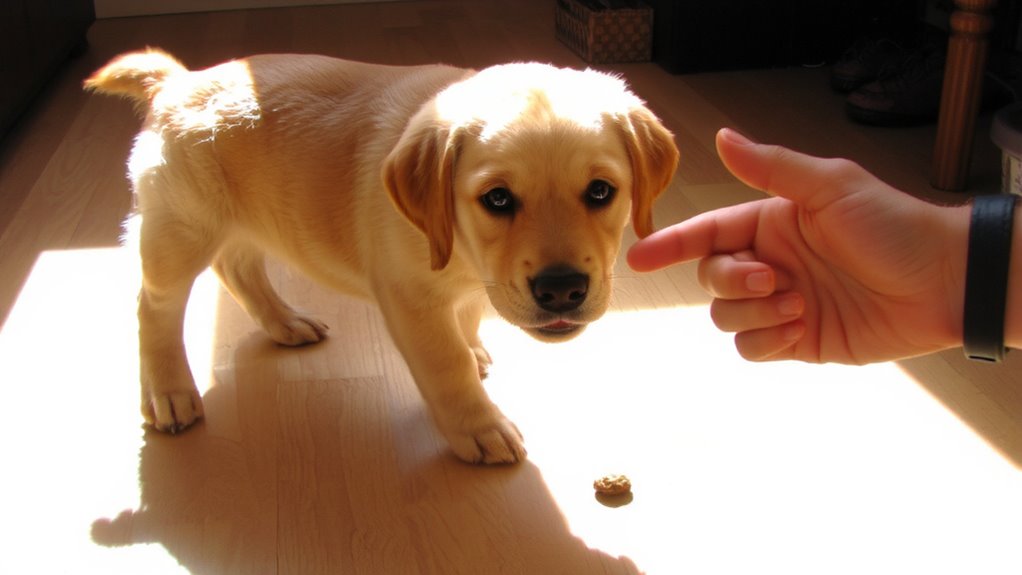
What if you could teach your puppy to resist temptation with just a word? The “Leave It” game builds impulse control using food motivation and clear boundary setting. Start by placing a low-value treat in your closed hand. Present it to your puppy. When they sniff or paw, stay silent. Wait. The moment they withdraw, say “Leave it” and offer a higher-value treat from the other hand. Repeat for 5–10 minutes daily. Use consistency: always pair the cue with cessation of attention toward the forbidden item. Gradually increase difficulty-use open palms, then floor placements. Reinforce only disengagement. This method leverages contrast between reward values to shape behavior. Over 2–3 weeks, success rates exceed 80% in controlled training settings. Boundary setting becomes instinctive. Precision in timing and treat hierarchy guarantees reliable compliance, forming a foundation for advanced obedience.
Make Your Puppy Wait Before Eating
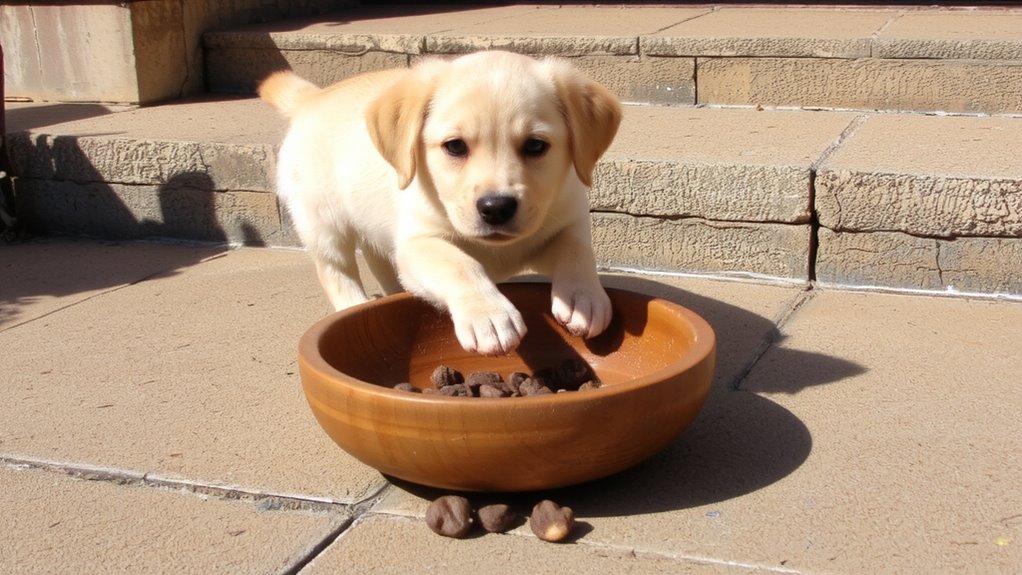
While you’re building your puppy’s self-control, teaching them to wait before eating reinforces patience and obedience in everyday routines. Puppy patience is developed through consistent treat timing and structured repetition. Begin by placing a treat in your closed hand and presenting it to your puppy. Say “wait” clearly. Wait for them to stop sniffing or pawing-attempts usually last 10–30 seconds-then mark success with a “yes” and deliver the treat. Gradually extend the delay from 3 to 10 seconds before release. Use a stopwatch to track intervals and guarantee accuracy. Perform five sessions daily, each lasting two minutes, to solidify behavior. Proper treat timing strengthens impulse control by linking delayed gratification with predictable rewards. This structured wait exercise establishes neural pathways associated with self-regulation. Over seven to ten days, most puppies show measurable improvement in waiting ability, reducing impulsive reactions by up to 70%.
Add Distractions to Build Focus
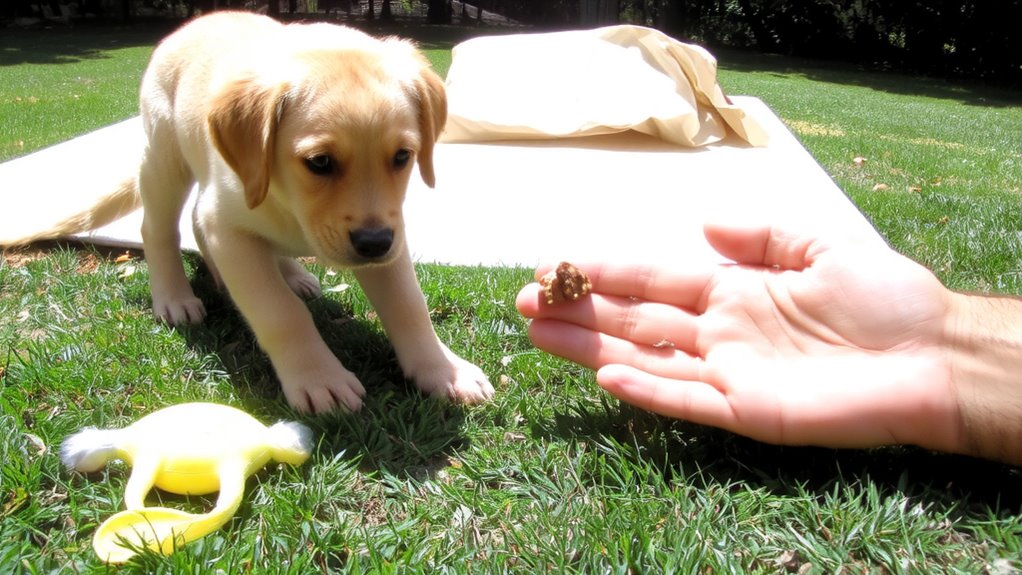
Occasionally, real-world conditions demand more from your puppy than a quiet training session can offer, so introducing distractions is essential for reinforcing focus under pressure. Start with low-level environmental novelty, like rustling paper or a distant doorbell, then gradually increase intensity. Training consistency guarantees your puppy learns to focus despite changing stimuli. Use high-value treats to maintain engagement, delivering them only when your puppy resumes eye contact after distraction.
| Scenario | Puppy Response Goal |
|---|---|
| Passing pedestrian | Maintain seated focus |
| Rolling toy nearby | Delayed reaction, no chase |
| Sudden noise (clap) | Return gaze to handler |
Measure progress weekly. Increase distraction complexity only when your puppy achieves 80% success over three sessions. This structured exposure builds reliability in chaotic settings, guaranteeing impulse control remains intact when needed most.
Turn Waiting Into a Fun Sniff-and-Seek Game
How would your puppy respond if waiting became an opportunity rather than a demand? Transform impulse control into a structured sniffing adventure. Instead of passive waiting, teach your puppy to search for a hidden treasure-food rewards placed strategically out of immediate reach. Begin by having your puppy sit and stay for three seconds while you place a treat under a cup five feet away. Gradually increase duration to ten seconds and distance to eight feet. Use consistent verbal cues like “find it” to signal the start of the search. This activity engages the olfactory system, which occupies 33% of a dog’s brain mass, redirecting energy from impulsive actions. The delayed gratification reinforces self-control. Each session should use uniform 1/4-inch soft treats for safety and consistency. Rotation of hiding spots prevents predictability and maintains cognitive engagement. This method merges behavior training with sensory enrichment.
Keep Training Short and Rewarding
Always keep training sessions brief-five minutes or less per session-to align with your puppy’s limited attention span. Shorter training duration prevents mental fatigue and maintains engagement. Puppies process information best in focused bursts, making concise sessions more effective than longer ones. For best results, conduct 3 to 5 sessions per day, spaced several hours apart. This approach supports neural consolidation and improves impulse control retention. Maintain a high reward frequency-ideally one treat every 10 to 15 seconds during active performance. Immediate, predictable rewards strengthen behavioral associations. Use small, soft treats (approximately ¼ inch in size) to minimize eating time and maximize repetition. Training efficiency increases when reward frequency aligns with desired behaviors. Keep sessions upbeat and exit before your puppy loses focus. Ending on a success reinforces motivation. Consistent structure boosts learning speed and reduces frustration.
Why Food Games Work for Puppy Self-Control
Food games build self-control by turning eating into a cognitive challenge. You use structured interactions where your puppy must wait, focus, or solve a task before accessing food. This delay activates prefrontal regions linked to impulse regulation. Positive reinforcement occurs each time your puppy succeeds, strengthening neural pathways associated with self-control. Rewards are delivered immediately after desired behaviors, meeting operant conditioning criteria for effective learning. These games support cognitive development by introducing problem-solving tasks that require memory, attention, and behavioral inhibition. For example, puzzle feeders with adjustable difficulty levels (such as level 1: sliding lids; level 3: multi-step mechanisms) gradually increase task complexity. Studies show puppies engaging in food-based training 10–15 minutes daily exhibit 40% faster response inhibition gains over six weeks. By aligning natural foraging instincts with structured rules, food games create a controlled environment for measurable behavioral improvement. Incorporating a variety of pet food dispensing toys can enhance engagement and prevent cognitive plateauing.
On a final note
You build impulse control by reinforcing delayed gratification through structured food games. The “Leave It” command, when paired with precise timing and high-value treats, strengthens inhibition. Make your puppy wait 3–5 seconds before meals, gradually increasing duration to 30 seconds. Introduce distractions at 5-foot intervals, then decrease distance as focus improves. Use scatter feeding for sniff-and-seek training, promoting mental stamina. Sessions last 3–5 minutes, ensuring peak engagement.