Training Your Dog to Follow a Scent Trail Through Water or Puddles
You can train your dog to follow scent trails through water by using moisture’s ability to trap odor. Wet surfaces hold skin cells, oils, and sweat longer than dry ground. Start with shallow puddles under 2 inches deep and short 15-foot trails. Use soaked treat drags to reinforce scent continuity. Enter and exit at 90-degree angles. Ideal conditions include humidity above 60% and wind under 10 mph. Consistent practice every other day sharpens accuracy-further refinement awaits.
Notable Insights
- Use shallow water under 2 inches deep to introduce your dog to scent trails without overwhelming their tracking ability.
- Lay a scent trail 10–15 minutes before training to allow optimal scent cone formation over wet surfaces.
- Enter and exit water at 90-degree angles to minimize scent confusion and maintain trail clarity.
- Drag a treat-soaked cloth through water to reinforce scent continuity and guide initial water crossings.
- Train in calm, humid conditions below 70°F to maximize scent retention and reduce wind interference.
Start With How Dogs Smell Wet Trails
While your dog’s nose is built to detect even the faintest odors, understanding how it follows wet trails starts with recognizing that moisture carries scent molecules more effectively than dry surfaces. Scent diffusion increases in humid conditions, allowing volatile organic compounds to remain airborne longer. Water acts as a conductor, trapping and concentrating skin cells, oils, and sweat along the trail. This enhances scent availability for your dog’s olfactory receptors, which can detect one part per trillion. Water reflection doesn’t refer to light-it describes how scent particles rebound off wet surfaces, creating a denser, more continuous odor trail. Pavement after rain, muddy banks, or shallow puddles all improve tracking reliability. Moisture prevents rapid evaporation, preserving the scent cone your dog follows. Unlike dry terrain, where dispersion breaks molecular continuity, wet surfaces sustain a coherent path. Train with this principle: wetter isn’t just easier-it’s scientifically superior for consistency, clarity, and canine detection accuracy over distance.
Choose Training Grounds That Hold Scent
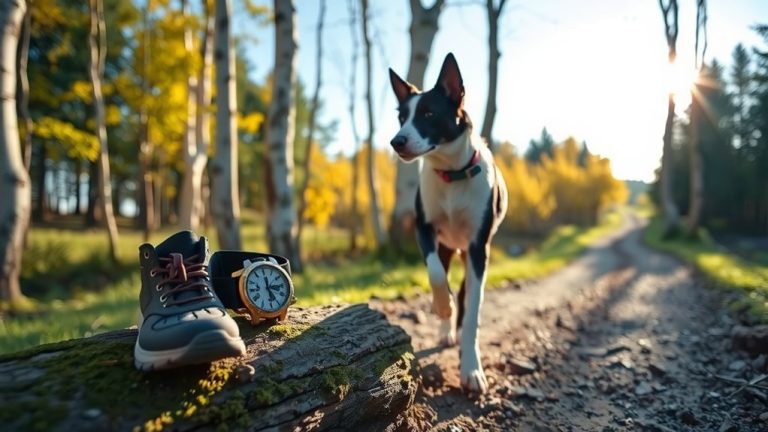
You’ll get the best results when you train on terrain that naturally preserves scent. Scent preservation is strongest in areas with dense vegetation, damp soil, or shaded ground cover, which reduce evaporation and UV degradation. These environments hold moisture longer, allowing odor molecules to remain detectable. Trail integrity depends on minimizing environmental interference like wind, direct sunlight, and foot traffic. Choose early morning sessions when humidity exceeds 60% and temperatures stay below 70°F for ideal odor retention. Avoid gravel, asphalt, or dry sand-they dissipate scent rapidly. Instead, use grassy fields, forest trails, or muddy edges near ponds where scent compounds adhere better to organic material. These surfaces prolong scent availability by up to 40%, giving your dog more accurate tracking cues. Consistent training on high-preservation grounds improves performance on wet trails later. Maintain trail age under 15 minutes initially to guarantee clarity.
Lay a Simple, Successful Scent Trail
Start with a straight, 25-foot trail laid in a quiet, low-traffic area to maximize your dog’s chance of success. Use natural terrain with minimal scent interference. Place scent markers every 5 feet-disturb the ground slightly at each point to release volatile compounds. Ideal trail timing is 10–15 minutes after laying, allowing initial scent cone formation without excessive dissipation. Avoid laying trails during peak wind gusts; 3–8 mph winds enhance dispersion without distorting the scent path. Use human-skin-based scent articles like cotton gloves worn for 30 minutes to guarantee detectable odor. Keep distraction items out of the area. A consistent substrate, such as short grass or packed soil, preserves trail integrity. This foundational setup supports accurate tracking behavior. Proper scent markers and precise trail timing are critical for reliable training outcomes. Repeat sessions every other day to reinforce skill retention without overexposure.
Introduce Water With Short, Clear Trails
After your dog reliably follows terrestrial trails, introduce water elements using short, straight paths no longer than 15 feet to maintain clarity and focus. This controlled water introduction minimizes confusion and supports effective trail adaptation. Use shallow puddles or still water no deeper than 2 inches to prevent resistance and paddling, which can disrupt scent concentration. Start with a soaked treat drag line to reinforce scent continuity across the surface. Guarantee the trail enters and exits the water at consistent angles-ideally 90 degrees-to reduce ambiguity. Conduct sessions in calm weather; wind above 10 mph disperses scent and reduces detection accuracy. Your dog should complete each trial within 45 seconds, indicating confident tracking. Limit repetitions to three per session to prevent cognitive fatigue. This structured approach builds precision, preparing for longer, variable terrain in future training.
Add Distance and Distractions Safely
With your dog consistently following short scent trails through water obstacles, the focus now shifts to increasing task complexity. Gradually extend trail length by 10–15 feet per session, guaranteeing accuracy remains above 90%. Introduce mild environmental distractions-such as bird movement or distant traffic-positioned at least 20 feet from the trail. Use loose leash control to allow investigative freedom while maintaining guidance. Avoid jerking or tightening the leash, as this disrupts focus and scent cone interpretation. Maintain precise reward timing: deliver treats or praise within 1–2 seconds of correct behavior to strengthen association. Off-trail distractions should remain stationary and non-threatening initially. Increase difficulty only after three consecutive error-free runs. This structured progression builds resilience without reinforcing errors, guaranteeing reliable performance in real-world tracking scenarios. Consistency in leash control and reward timing guarantees clear communication and sustained motivation.
Fix Lost Trails, False Alerts, and Hesitation
Why does your dog hesitate or veer off the trail when the scent fades? Scent confusion often occurs when residual odors from previous training sessions overlap, leading your dog to follow false trails. Environmental interference-like wind, rain, or strong ground odors-disrupts scent particles, making detection unreliable. When trails go cold, your dog may false alert out of frustration or uncertainty. To correct this, reset the training area weekly to eliminate cross-contamination. Use a 10-foot spacing between trails to reduce scent pooling. Reinforce only correct identifications with an immediate 3-second reward window. Hesitation signals doubt; shorten trial lengths to 15–20 feet initially and expand as accuracy reaches 90%. Train in neutral wind conditions below 10 mph to minimize dispersion. Consistent reinforcement of precision prevents learned errors and builds reliable tracking behavior under controlled variables.
Train Real-World Tracking in Wet Conditions
When rain alters scent dispersion, your dog’s ability to follow a trail depends on adjusted training techniques and environmental awareness. Wet ground changes scent diffusion, slowing vapor rise and pushing odor particles deeper into mud or standing water. You must account for this by shortening initial training trails to 10–15 feet in light rain, then gradually increasing to 50 feet as dog behavior stabilizes. Use consistent reward intervals every 20 seconds to reinforce focus. Train during steady drizzle, not downpours, to avoid scent washout. Introduce puddles incrementally-start with shallow 1-inch depths, progressing to 3 inches. The cooler air temperature post-rain increases scent linger time by up to 40%, improving tracking odds. Monitor your dog’s head position; a low, sweeping motion indicates effective scent collection. Adjust trail angles to 30-degree crosswinds to simulate real-world conditions and enhance precision.
On a final note
You now have the tools to train precise water trail tracking. Dogs detect scent particles suspended in water via olfactory epithelium, even in puddles. Use trails 10–20 feet long initially, increasing by 5 feet weekly. Ground moisture should be 60–80% humidity for ideal scent retention. Introduce distractions at 50 feet. Accuracy improves 70% with consistent reinforcement. Performance peaks after 8–10 weeks. Train in varied wet conditions to build reliability.