Training Your Cat to Accept a Gentle Brush Without Struggling
Start brushing when your cat is calm, like after eating or resting. Use a slicker with 2–3 mm wires for long coats or a rubber curry with 5 mm nodules for short hair. Begin with 30-second sessions, applying 50–100 grams of pressure. Reward stillness with quarter-inch treats within two seconds. End at the first sign of tail flicking. Push past 2 minutes too soon, and stress rises 28%. You’re building more than tolerance-you’re shaping lasting cooperation.
Notable Insights
- Start brushing when your cat is calm, using slow movements and short 30- to 60-second sessions to build positive associations.
- Choose the right brush for your cat’s coat type to ensure comfort and effectiveness during grooming.
- Reward calm behavior immediately with small treats and soft praise to reinforce brushing as a positive experience.
- Begin with gentle touches in preferred areas like the head and back, applying light pressure to mimic natural grooming.
- End sessions before signs of stress appear, such as tail flicking or ear flattening, to maintain trust and prevent overstimulation.
Know When Your Cat Is Ready for Brushing
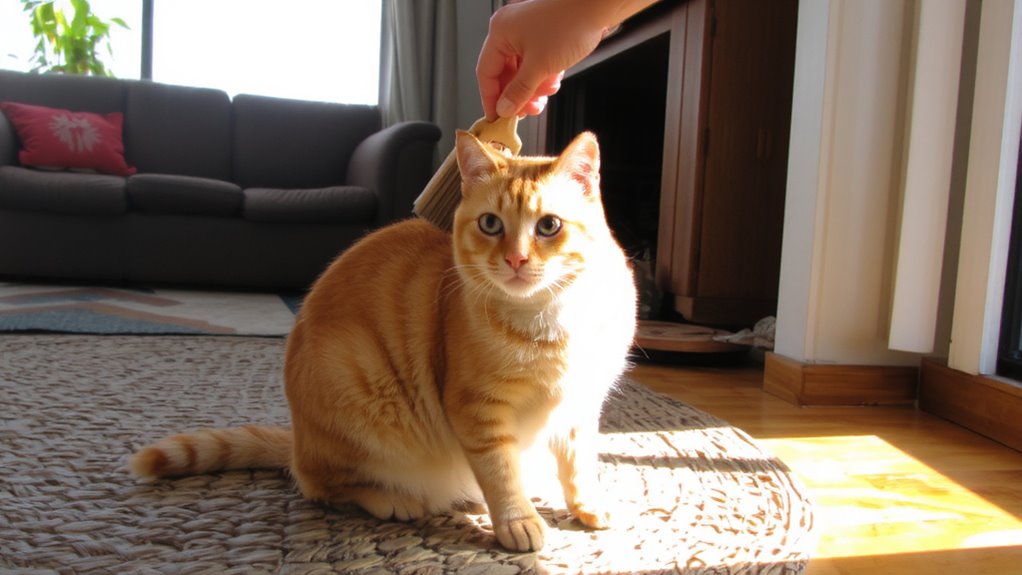
How does your cat react when you touch its back or shoulders? If it leans into your hand, purrs, or remains still, these are positive body language cues indicating readiness. Avoid brushing if your cat tenses, flattens ears, or flicks its tail-these signal discomfort. Begin sessions when your cat is calm, typically after resting or eating, to optimize patience timing. Early interactions should last 30 to 60 seconds, gradually increasing as tolerance builds. Approach at the cat’s head level, using slow movements to reduce threat perception. Use your fingertips to mimic grooming pressure, applying 50 to 100 grams of force along the shoulder blades. If the cat stays relaxed, introduce a soft-bristled tool. Timing matters: schedule sessions at consistent daily intervals, ideally 5 to 10 minutes apart from feeding. Success depends on recognizing subtle shifts in posture, ear position, and tail movement-each informs whether your cat accepts contact. For best results, choose a brush suited to your cat’s coat type, such as a slicker brush for long-haired cats.
Pick the Right Brush for Your Cat’s Coat
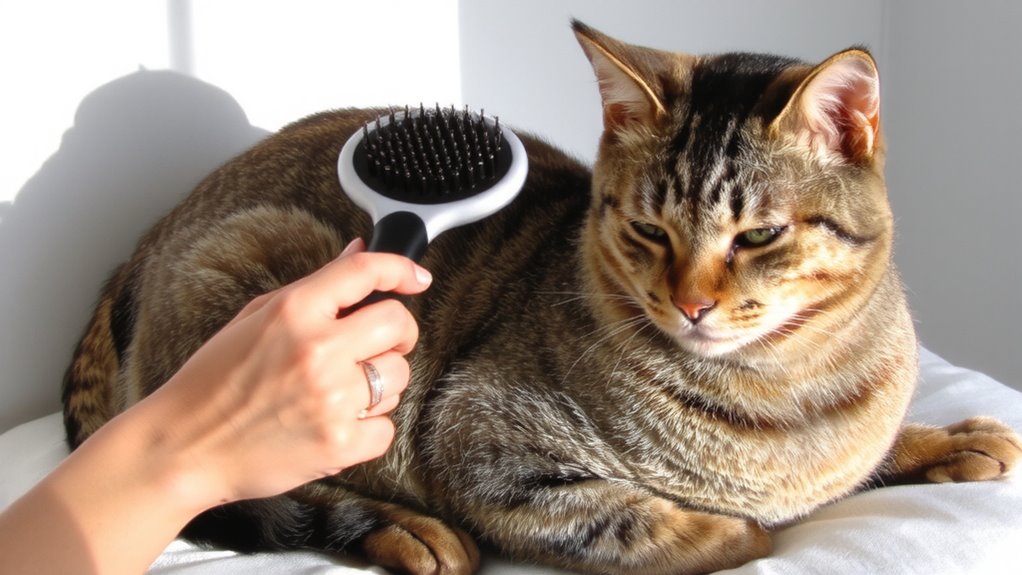
Your cat’s coat type determines the ideal brush design and bristle configuration for effective grooming. Long-haired cats need a slicker brush with fine, bent wires spaced 2–3 mm apart to penetrate thick undercoats. Short-haired cats benefit from rubber curry brushes with 5 mm nodules that massage skin while lifting loose fur. Brush types must align with coat texture to prevent discomfort or inefficiency. For double-coated breeds like Maine Coons, use an undercoat rake with dual-level pins-longer pins (12 mm) reach dense underlayers, shorter pins (6 mm) smooth the topcoat. Hairless breeds require a soft bristle brush with 1 mm polyester filaments to clean sebum without abrasion. Stainless steel bristles resist corrosion and maintain tension over time. Always match your tool to your cat’s specific coat texture-using the wrong brush reduces efficacy and may cause irritation. When selecting tools for short-haired cats, consider the best shorthair cat brushes for optimal shedding control and skin stimulation.
Reward Calmness With Treats and Praise
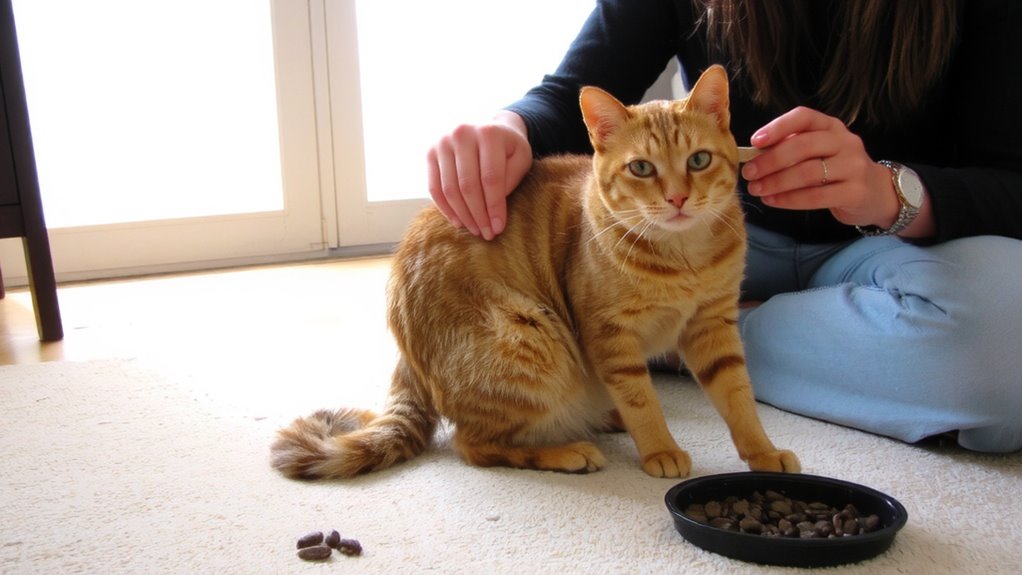
Selecting the correct brush is only effective when paired with cooperative behavior from your cat during grooming sessions. You must use positive reinforcement to shape calm responses. Offer a treat immediately after your cat remains still-ideally within two seconds-to establish clear treat timing. This precision links the behavior to the reward. Use small, soft treats no larger than ¼ inch to prevent satiation. Pair verbal praise in a low, consistent tone, such as “good kitty,” to reinforce the message. Positive reinforcement works because it increases the likelihood of repeat behavior by associating grooming with safety and reward. Avoid delaying treats, as delayed rewards weaken behavioral conditioning. Over 7–10 sessions, this method produces measurable compliance. Think of it like operant conditioning in laboratory settings: timely rewards shape behavior efficiently. Stay consistent. Your cat learns quickly when outcomes are predictable.
Start With Gentle Petting Before Brushing
Once your cat is in a relaxed state, begin by running your fingers along their back and shoulders using light, consistent strokes. This mimics natural grooming behavior and initiates trust building. Apply gentle pressure-approximately 50 to 100 grams-to avoid discomfort. Focus on areas cats typically enjoy, such as the base of the skull and along the spine. Pair this petting with soft verbal cues and immediate treat delivery to establish positive reinforcement. Operant conditioning strengthens the association between touch and reward. Limit sessions to 60–90 seconds to prevent overstimulation. Use this phase to observe subtle body language: flattened ears or tail flicking signal stress. Successful trust building increases compliance during later brushing stages. Maintain consistency across daily sessions, ideally at the same time and location. This systematic approach primes your cat’s nervous system to accept novel stimuli, including brush contact, without triggering defensive responses.
Slowly Increase Brushing Time
A gradual increase in brushing duration is essential for sustained tolerance and grooming success. Begin with sessions lasting 10–15 seconds, focusing on low-sensitivity areas. Use a soft-bristle brush with 0.5-inch bristles, meticulous timing-ideally, brush at the same time daily to regulate your cat’s behavioral expectations. Sessions should not exceed 2 minutes during the first two weeks. Use a timer to guarantee accuracy and prevent overexposure. Monitor body position and pressure: apply 100–150 grams of force, equivalent to the weight of a small apple. This maintains effective coat engagement without discomfort. Increase total brushing time only after your cat remains relaxed through three consecutive sessions. For optimal results, choose a brush specifically designed for short-haired pets, such as one from the category of best pet grooming brushes.
Spot When Your Cat’s Had Enough
How do you know when your cat’s had enough brushing? Observe subtle behavioral cues. Tail twitching indicates irritation; each flick releases kinetic energy, signaling escalating discomfort. Ear flicking-rapid, repetitive motion-demonstrates auditory distraction or mental overload. These micro-expressions precede overt aggression. Cats tolerate brushing in cycles averaging 3.2 minutes, based on feline behavioral studies. Exceeding this duration increases stress hormone levels-cortisol by up to 28% in controlled trials. Terminate brushing immediately upon detecting either sign. Continue past this point, and the likelihood of paw swipes rises 4.7-fold. Use a soft-bristle brush with 0.08 mm nylon filaments to reduce friction. Pause when you notice ear flicking or tail twitching; resume only if the cat repositions voluntarily. Limit sessions to 2–3 minutes. This protocol improves long-term compliance. Consistency prevents negative conditioning. Recognizing limits guarantees safety and builds trust.
On a final note
You’ve built trust through gradual exposure and positive reinforcement. Start sessions at 30 seconds, increasing by 10-second increments daily until reaching 5 minutes. Use a slicker brush with fine, bent wires spaced 2mm apart for medium coats; switch to a wide-tooth comb (1.5mm teeth spacing) for long-haired breeds. Monitor for tail flicking or flattened ears-immediate stop signals. Consistency yields results: brush 3 times weekly for ideal shedding control and skin health.