Teaching Your Cat to Sit on Cue Using Target Training and Treat Rewards
Use high-value, aromatic treats like freeze-dried chicken or tuna flakes, each no larger than ¼ inch (1–3 mm), to maintain focus and minimize delay. Pair a 6-inch plastic target stick with a lightweight, BPA-free clicker emitting a sharp 2–4 kHz sound-ideal for feline hearing. Mark the exact moment your cat’s rear touches the ground with a click, then deliver the treat within 0.5 seconds. Shape the behavior progressively, reinforcing weight shifts, crouching, and partial sits before expecting a full sit. Use the “sit” cue precisely as hips begin to lower, not before, and avoid repetition to prevent confusion. Train in quiet environments with zero distractions, conducting three to five 3–5 minute sessions daily, spaced hours apart. Include 60–90 second play breaks with wand toys to sustain engagement. Most cats achieve reliable response within 7–10 days when timing and reinforcement remain consistent. You’ll discover advanced shaping techniques and troubleshooting methods next.
Notable Insights
- Use a target stick to guide your cat’s nose upward, encouraging a natural sit through gentle rear-end lowering.
- Click or say “yes” the moment your cat’s bottom touches the ground, pairing the marker with a high-value treat immediately.
- Offer ¼-inch soft, aromatic treats like freeze-dried chicken to minimize eating time and maximize repetition.
- Say “sit” only as the hindquarters begin to lower, aligning the verbal cue precisely with the action.
- Conduct short 3–5 minute sessions twice daily in a quiet space, using play breaks to maintain engagement and focus.
Pick High-Value Treats and Essential Tools
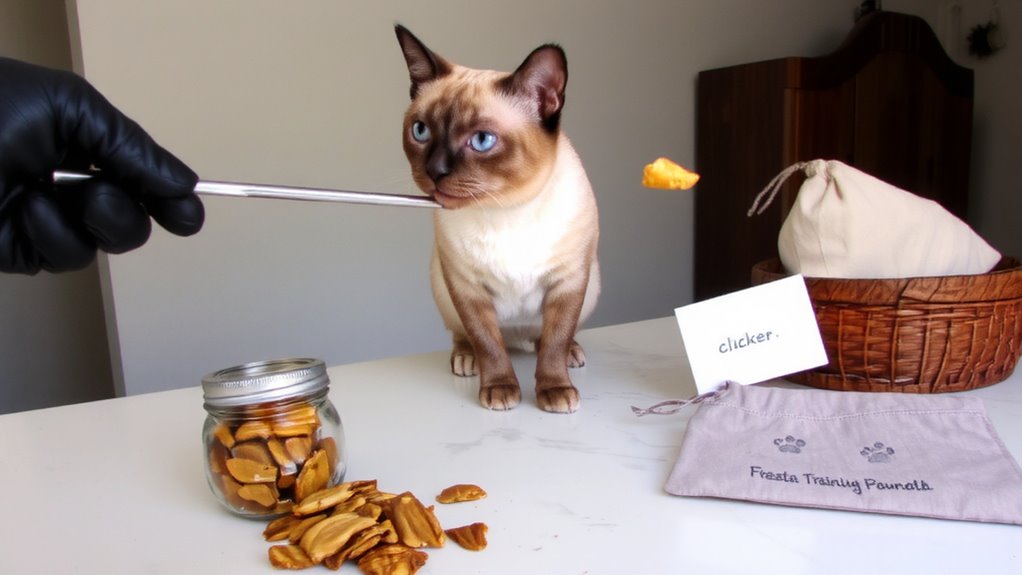
One essential step in training your cat to sit is selecting high-value treats that reliably motivate your feline. Choose treats with strong aroma and soft texture, such as freeze-dried chicken or tuna flakes, to maximize engagement. Treat variety prevents habituation and sustains responsiveness-rotate proteins like salmon, duck, and liver every few sessions. Use pieces no larger than ¼ inch to minimize consumption time and maintain training flow. Tool selection is equally critical: a 6-inch plastic target stick with a ball tip enables precise cue delivery. Pair it with a lightweight, BPA-free clicker for accurate marking of desired behavior. Guarantee all tools are clean and odor-free to avoid interference. High-value reinforcement and proper equipment establish a reliable foundation-like calibrating instruments before an experiment-they guarantee consistency, precision, and measurable progress in shaping feline compliance through operant conditioning. For optimal results, consider the best high-value dog treats as a reference when selecting nutritionally dense, palatable options suitable for high-motivation training scenarios.
Start Shaping the Sit: Reward Small Movements
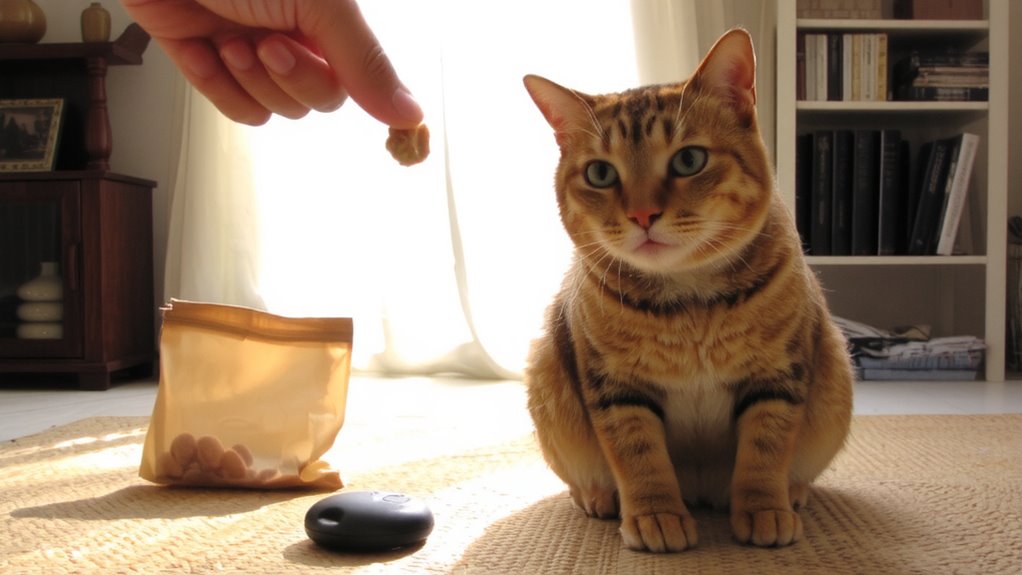
You’ve selected high-value treats and gathered the necessary tools-now you’re ready to shape the sit through incremental reinforcement. Begin by observing your cat’s natural body language; slight shifts in weight or crouching indicate potential movement toward sitting. Reward even minor changes in posture immediately. Use a target stick to guide your cat subtly, encouraging rear-end lowering. Each rewarded behavior becomes a step in the gradual progression toward a full sit. Reinforce knees bending, hip lowering, and partial sits-no complete action is too small. Position the treat just above eye level to encourage upward nose movement, naturally prompting the sit. Sessions should last 3–5 minutes, once or twice daily, to maintain focus. Consistent timing and repetition solidify learning. Track progress by noting behavioral milestones during each session.
Mark the Behavior With a Clicker or Sound
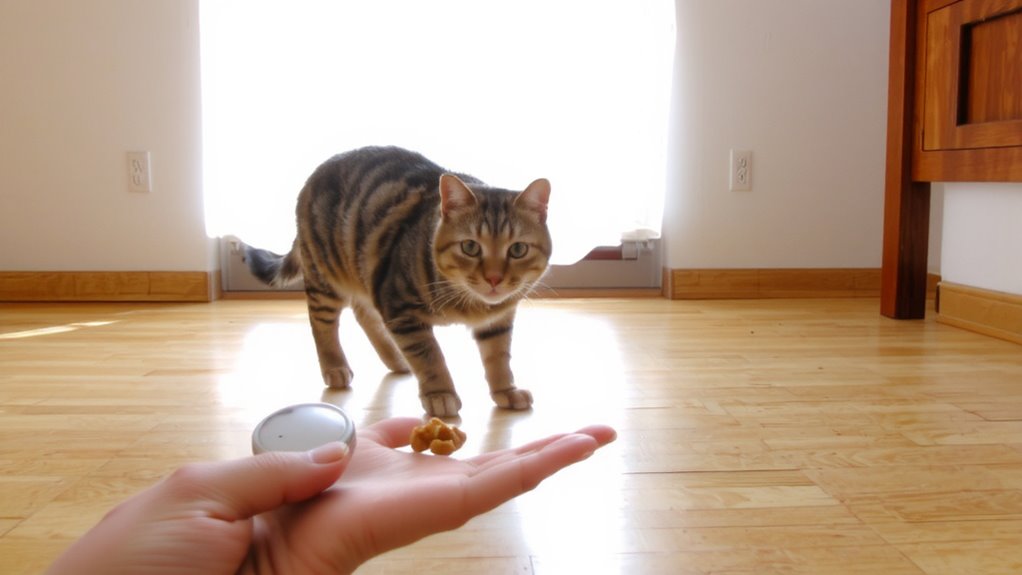
A well-timed click is the linchpin of precision training. You must deliver the click the exact instant your cat’s bottom touches the ground. Delayed click timing reduces learning efficiency by up to 70%, according to animal behavior studies. Use a mechanical clicker or a consistent verbal marker like “yes” to signal correct behavior. Maintain sound consistency across sessions-volume, pitch, and duration should not vary. Inconsistent cues confuse cats, slowing associative learning. The auditory signal bridges the behavior-reward gap, allowing your cat to link action with consequence. Operant conditioning relies on this immediate feedback loop. Test your reflexes: practice clicking at precise moments using a metronome or video playback. Choose a clicker with a sharp, 2–4 kHz frequency-optimal for feline hearing. Pair each click with a high-value treat within 0.5 seconds. Repeat without variation. This regimen builds reliable response patterns.
Teach the Sit Command Clearly
Timing and clarity shape the foundation of effective command instruction. Use consistent timing to mark the exact moment your cat sits, immediately following with a treat. This strengthens the connection between behavior and reward through positive reinforcement. Say “sit” only when your cat begins to lower its hindquarters, guaranteeing the verbal cue aligns precisely with the action. Avoid repeating the command, as this dilutes clarity. Reinforce correct associations by rewarding only full sits-where all four paws remain planted and the spine is upright. Conduct this phase in low-distraction environments to maximize focus. Use high-value treats, such as freeze-dried chicken pieces no larger than ¼ inch, to maintain motivation. Each session should reinforce accuracy over repetition, prioritizing clean execution. Properly timed cues, paired with consistent reinforcement, condition reliable responses. Precision in delivery guarantees faster learning and long-term retention of the command.
Keep Training Sessions Short (And Fun!)
Consistently, the most effective cat training occurs in brief, focused bursts. Limit sessions to 3–5 minutes to maintain your cat’s attention and support ideal energy management. Cats have short attention spans; prolonged sessions cause mental fatigue and reduce learning retention. Conduct 2–3 sessions daily, spaced several hours apart, to reinforce consistency without overstimulation. Integrate play breaks between repetitions to reset focus and prevent frustration. Use a timer to guarantee precision in session length. Immediate reinforcement with high-value treats (e.g., freeze-dried chicken, 1–3 mm in size) strengthens the sit behavior. Play breaks should last 60–90 seconds and involve wand toys to dissipate excess energy. This approach aligns with feline behavioral rhythms, improving response reliability. Short, structured training cycles yield faster acquisition, with most cats mastering the sit cue within 7–10 days when protocols are followed precisely.
Fix Common Training Problems Quickly
Even with short, well-timed sessions, you might hit roadblocks-some cats resist sitting, while others offer random behaviors like spinning or biting. Ignore unwanted actions and reward only the target behavior: sitting. Immediate reinforcement strengthens correct responses. If your cat disengages, check your treat value; higher-quality rewards like freeze-dried chicken often increase motivation. Overcoming distractions is essential-start training in a quiet, low-stimulus environment, then gradually introduce mild distractions. Maintain consistency by using the same verbal cue (“sit”) and hand signal every time. Training should occur daily, with each session lasting 3–5 minutes. Consistent repetition over 7–10 days solidifies learning. Avoid variable reinforcement until the behavior is reliable. If progress stalls, revert to earlier steps and rebuild. Patience and structure are necessary for success.
On a final note
Consistency yields results. Train daily in 5-minute sessions using high-value treats like freeze-dried chicken. Use a clicker to mark exact behavior within 0.5 seconds of the sit. Pair the physical action with a verbal cue (“sit”) only after reliable repetition. Reinforce correct responses with immediate reward-within 1 second. Troubleshoot delays by reverting to earlier shaping steps. Accuracy improves when sessions stay brief, focused, and free of distractions.