Teaching Your Cat to Recognize and Respond to Hand Signals
You can train your cat to respond to hand signals using their strong visual processing and pattern recognition. Cats detect motion best within 2 meters, so use gestures at eye level, at least 30 cm wide, in their central 30-degree field of view. High-contrast, consistent shapes like a flat palm work best. Pair each signal with an immediate treat-delivered within 1–2 seconds-to reinforce learning. Short, frequent sessions build reliability, and mastering basics sets the stage for more advanced behaviors.
Notable Insights
- Cats can learn hand signals due to strong visual processing and pattern recognition abilities.
- Use high-contrast, large, and consistent hand movements within your cat’s clear line of sight.
- Pair each hand signal with an immediate treat reward to reinforce learning effectively.
- Start with simple commands like “sit” or “come” using clear, geometric hand shapes.
- Train in quiet, low-distraction environments with short, frequent sessions for best results.
Why Cats Can Learn Hand Signals
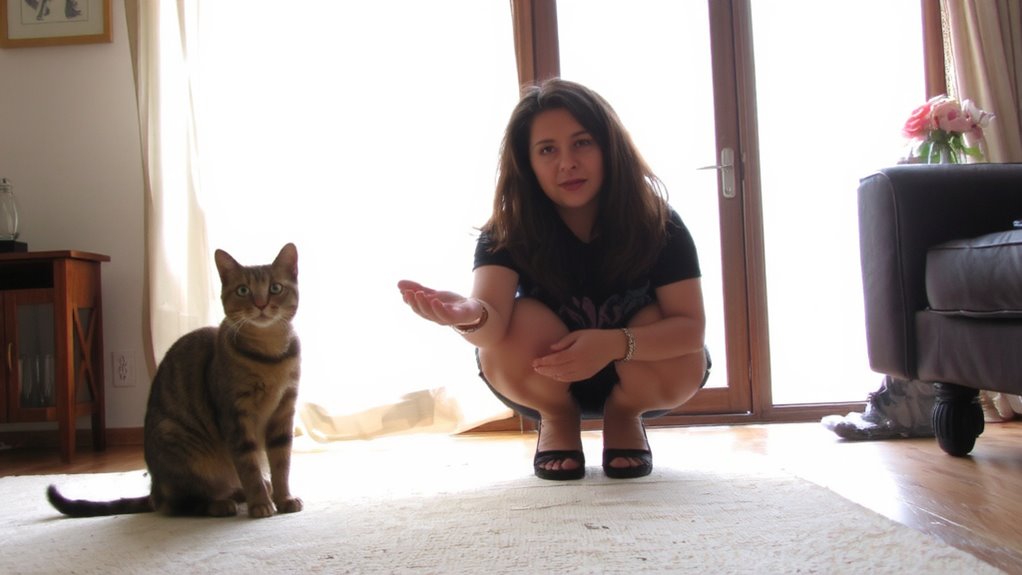
While it might seem surprising, cats can learn hand signals because their sensory and cognitive systems are well adapted to visual cues. Cat intelligence includes advanced pattern recognition and memory retention, enabling responses to consistent stimuli. Visual learning is natural for cats, as they rely heavily on sight during hunting and social interactions. Their retinas contain a high density of rod cells, enhancing motion detection-critical for interpreting subtle hand movements. Studies show cats process visual signals within 200 milliseconds, comparable to primates in reaction speed. Neural pathways in the feline visual cortex prioritize movement over color, making dynamic gestures more effective than static ones. You don’t need tools or devices; success depends on repetition, timing, and clarity. With proper conditioning, cats associate gestures with outcomes, forming learned behaviors. This capacity underscores their adaptability in domestic environments where visual learning enhances communication between you and your cat.
Pick Simple Hand Signals Your Cat Can See Easily
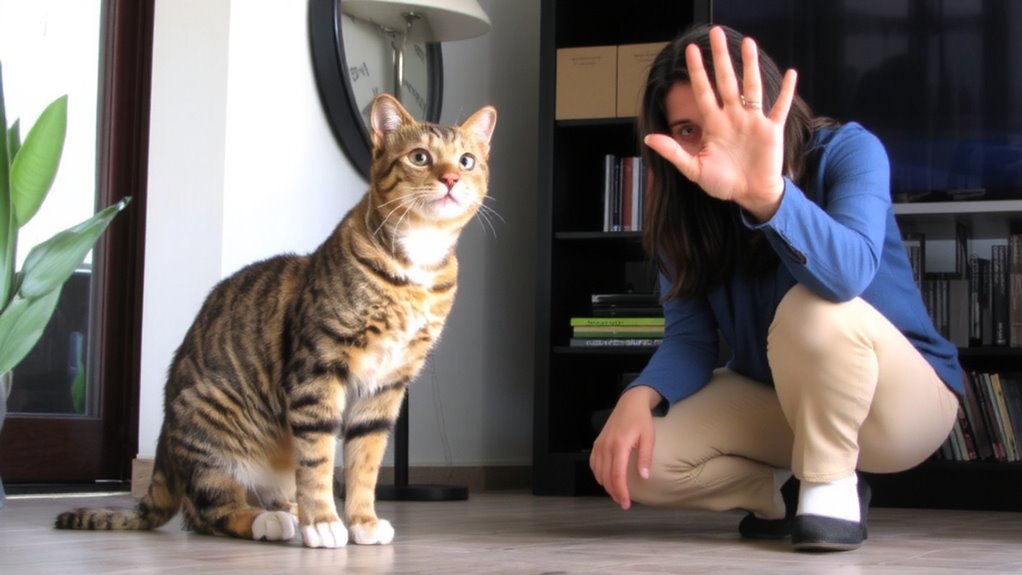
Signal clarity starts with visibility. Choose hand signals your cat can detect instantly. Use high color contrast between your hands and surroundings-wear bright gloves if you have dark skin or clothing. This improves visual detection, especially in low light. Signal size matters: extend arms fully and use motions at least 30 cm wide. Broad movements are easier for cats to distinguish than small flicks. Position yourself at your cat’s eye level, no farther than 2 meters away initially. Cats detect motion best in their central 30-degree field of view, so center signals there. Use consistent shapes-like a flat palm or raised index finger-because felines recognize geometry. Avoid complex gestures; stick to one motion per command. Simple, high-contrast, and adequately sized signals increase detection speed. These adjustments align with feline visual acuity, which is optimized for moving objects over fine detail.
Use Treats to Teach Your Cat the Meaning
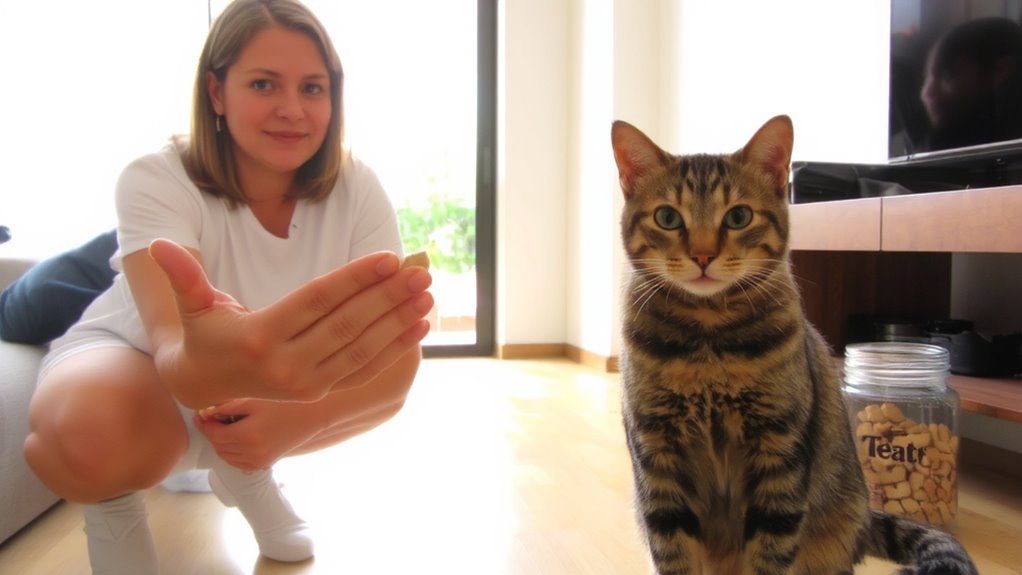
You can start shaping your cat’s understanding by pairing each hand signal with an immediate reward. This method relies on positive reinforcement to strengthen desired behaviors. Present the hand signal, then instantly offer a treat when your cat responds correctly. Consistency is critical-use the same motion and treat type during each session. Over time, this builds a reliable signal association in your cat’s memory. Sessions should last 3–5 minutes, occurring 2–3 times daily to maintain focus without overload. Use high-value, pea-sized treats to sustain interest and prevent overfeeding. Through repetition, your cat learns that the visual cue predicts the reward. This process mirrors operant conditioning principles, where timing between signal and reinforcement must be within 1–2 seconds for ideal learning. Accurate, repeated pairings increase response reliability, laying the foundation for more complex signal recognition. A clean litter box environment can reduce stress and improve focus during training sessions.
Teach Basic Commands Step by Step
Once your cat associates hand signals with rewards, you can begin teaching specific commands using a structured, step-by-step approach. Start with simple behaviors like “sit” or “come,” using a consistent hand gesture paired with a verbal cue. Reinforce the behavior immediately with a treat. Gradually introduce playtime cues to strengthen motivation and engagement. Maintain short, frequent sessions-three to five minutes, two to three times daily-to optimize learning without causing fatigue. Implement signal fading by slowly reducing treat frequency as your cat becomes reliable, shifting to intermittent reinforcement. This prevents dependency and improves response consistency. Use a clear, unambiguous hand signal; for example, a flat palm raised to chest level for “stop.” Guarantee signals are distinct to avoid confusion. Over time, your cat will respond reliably to hand cues alone, even without vocal prompts.
Fix Common Hand Signal Mistakes
Why do some cats seem to ignore hand signals despite consistent training? Inconsistent signals confuse your cat’s ability to recognize commands. Each gesture must be identical in position, speed, and shape-varying hand angles or motion amplitude reduces signal reliability. Use deliberate, controlled movements within a 15- to 20-degree arc for maximum visibility. Distracted training impairs learning. Conduct sessions in a low-stimuli environment, minimizing auditory and visual interruptions. Limit sessions to 5–7 minutes, twice daily, to maintain focus. Reinforce correct responses immediately with a 0.5-second click or treat delivery. Avoid partial rewards during error correction. Standardize signals: a flat palm up means “stop,” a single finger forward means “come.” Retrain if prior cues were ambiguous. Consistency guarantees neural pathway development within 2–3 weeks. Correct mistakes early.
Add Fun Tricks Like High-Fives and Spins
How do you turn basic obedience into engaging feline entertainment? Introduce fun tricks like high-fives and spins through structured signal games. These activities reinforce command recognition while promoting mental stimulation. Start with a clear hand motion: for a high-five, present your palm at your cat’s chest level, rewarding any paw contact. For spins, use a circular hand cue in front of their nose, guiding direction consistently. Repeat sessions for 5–7 minutes daily, guaranteeing repetition without fatigue. Success relies on timing-deliver treats within 1 second of correct behavior. Signal games integrate seamlessly into cat dancing routines, where sequences of commands form choreographed movement. Use consistent hand shapes and positions to prevent confusion. Each signal should differ by at least 45 degrees in hand orientation. This precision guarantees clear communication, improving response accuracy to over 80% with two weeks of training.
On a final note
You can teach your cat hand signals with consistency and timing. Use clear, high-contrast gestures within 12 inches of your cat’s line of sight. Pair each signal with a 3–5 second click or verbal cue, followed immediately by a 3-gram treat. Reinforce correct responses in 5-minute sessions, twice daily. Over 2–4 weeks, 70% of cats learn basic commands. Avoid blurred motions; precise, angular movements increase comprehension.