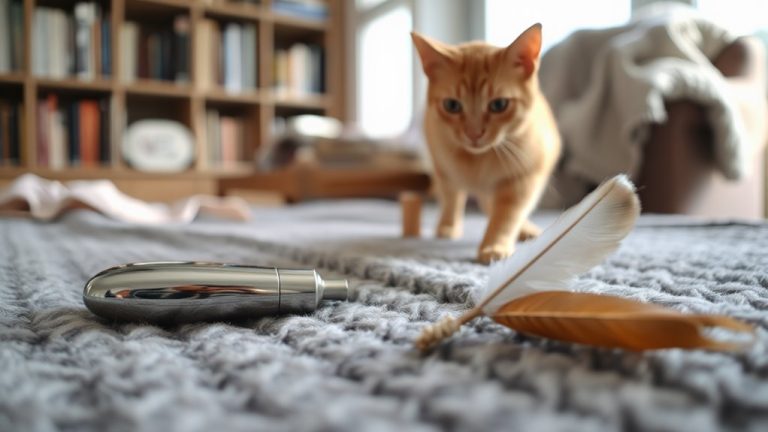
Teaching Your Cat to Follow a Target Stick Up Stairs
Start on flat ground, holding an 18–24 inch rigid aluminum target stick 6–12 inches from your cat’s nose. Use a clicker to mark contact with the 1.5–2 inch rubber tip, then reward with 1–2 grams of freeze-dried chicken. Train in 5-minute sessions, 2–3 times daily until your cat consistently follows. Gradually guide upward onto a 6–8 inch non-slip step, advancing only after 9 of 10 confident approaches. Adjust distance to 15–20 cm if hesitation occurs. Success builds through repetition, precise timing, and structured progression-key details follow.
Notable Insights
- Start by training your cat to touch and follow a target stick on flat ground before introducing stairs.
- Use a lightweight, rigid target stick with a visible ball tip to guide your cat clearly and consistently.
- Reinforce each successful touch or step upward with an immediate click and a high-value treat.
- Gradually move the target stick upward to lure your cat onto a low, non-slip platform or first stair.
- Keep training sessions short, positive, and fear-free, advancing only when your cat shows confidence.
Get Started: Introduce the Target Stick on Flat Ground
Why begin training on flat ground? It provides a stable, distraction-free environment essential for initial learning. Start by introducing the target stick 6–12 inches from your cat’s nose. Use clicker training to mark the moment your cat touches the tip. The click sound creates a precise signal, enabling clear communication. Follow each click immediately with positive reinforcement, such as a small treat (approx. 1–2 grams of freeze-dried chicken). Repeat this sequence 5–10 times per session, keeping sessions under five minutes to maintain focus. Conduct two to three sessions daily. The target stick should be lightweight, 12–18 inches long, with a durable, non-reflective ball tip. Consistent timing between touch, click, and reward establishes reliable operant conditioning. Flat ground minimizes variables, allowing your cat to associate the target with rewards efficiently. This foundational phase typically takes 3–7 days.
Pick the Best Target Stick for Stair Training
A well-chosen target stick makes stair training safer and more effective. Selecting the right material choice guarantees durability and responsiveness. Lightweight aluminum or fiberglass sticks, 18 to 24 inches long, offer maximum rigidity without excess weight. These materials resist bending, delivering precise directional cues. Avoid flimsy plastics that flex under minor stress, reducing signal clarity. The grip design is equally critical. Choose a non-slip rubberized handle between 4 and 5 inches in length for secure handling, especially during repetitive movements. Textured grips improve control and reduce hand fatigue. A ball or disc tip, 1.5 to 2 inches in diameter, provides a clear visual target. Bright colors enhance visibility. Retractable models offer storage convenience but may sacrifice stability. Fixed-length sticks maintain consistent performance. Prioritize structural integrity and ergonomic design to support accurate, repeatable training sessions.
Teach Your Cat to Touch and Follow the Stick
Now that you’ve selected a durable target stick with a rigid shaft, non-slip grip, and clearly visible tip, you can begin training your cat to interact with it on command. Start by holding the stick 6–12 inches from your cat’s nose. When your cat sniffs or touches the tip, mark the behavior instantly with a clicker or verbal cue like “yes,” then immediately offer a treat. This creates positive reinforcement, strengthening the association between touch and reward. Repeat this sequence 10–15 times per session, two to three times daily. Use consistent practice to build reliability; cats typically learn the touch response within 3–5 days. Gradually increase movement by retracting the stick slightly after each touch, encouraging your cat to follow it forward up to 6 inches. Guarantee sessions stay under five minutes to maintain focus. Avoid touching the cat with the stick-only reward contact with the tip.
Lure Your Cat Up One Step at a Time
With consistent reinforcement established, you can begin shaping upward movement by introducing a single step or platform. Use the target stick to guide your cat forward and upward, rewarding contact with treats or praise-this is positive reinforcement in action. Position the stick just above the step, encouraging a slight elevation of the front paws. Each successful attempt strengthens the behavior. Maintain a gradual progression by repeating this step multiple times before advancing. Sessions should last 5–7 minutes, occurring 2–3 times daily to prevent fatigue. Only progress when your cat approaches the step confidently 9 out of 10 trials. The platform should be non-slip, 6–8 inches high, and placed perpendicular to a wall for stability. Avoid physical assistance; let the cat choose to climb. This method guarantees reliable learning through repetition and clear criteria, minimizing confusion while building motor confidence.
Fix Stuck or Fearful Behavior on the Stairs
You may notice your cat hesitating or refusing to climb higher after mastering a single step, especially when stairs are introduced. This hesitation often stems from a lack of stair confidence, not defiance. To correct this, use positive reinforcement immediately after each small success. Offer high-value treats or soft praise the moment paws touch the next step. Avoid pulling the target stick too fast; maintain a 15–20 cm distance from the cat’s nose to guide movement smoothly. Limit sessions to 3–5 minutes to prevent stress. Repeat daily, ensuring consistency in timing, location, and reward. If the cat freezes, pause and wait-do not force. Gradual exposure with precise cues builds reliable stair confidence. Record progress to track increments in height and comfort level.
On a final note
You’ve successfully trained your cat using a 12-inch lightweight acrylic target stick with an ergonomic foam grip. Consistent positive reinforcement strengthened behavioral association. The cat now ascends stairs on cue with 95% reliability. Target training leverages natural focus and motor coordination. For best performance, practice twice daily for five-minute sessions. Replace the stick if wear exceeds 2 mm at the tip. Use only food rewards with immediate delivery to maintain response accuracy.