The Role of Environmental Enrichment in Reducing Stress-Eating in Cats
You can reduce your cat’s stress-eating by 40% in two weeks using food puzzle feeders like the Outward Hound Treat Tumbler or Trixie 5-Part Snack Box. These slow food release by up to 75% and engage natural foraging instincts. Puzzle use boosts dopamine during goal-focused tasks and reduces compulsive eating. Combine with vertical spaces-shelves 24–30 inches apart-and rotate toys every two weeks. Scheduled play and enrichment support regulated eating. Solutions extend beyond feeding; they reshape behavior through structured stimulation. You’ll find targeted strategies further in line with your cat’s evolutionary needs.
Notable Insights
- Environmental enrichment reduces stress-eating by addressing boredom and anxiety through mental and physical stimulation.
- Puzzle feeders extend mealtime and engage natural foraging instincts, decreasing overeating by up to 40%.
- Enriched environments regulate hunger hormones and support consistent, healthy eating patterns.
- Vertical spaces and interactive toys promote natural behaviors, reducing reliance on food for comfort.
- Regular rotation of enrichment tools maintains interest and prevents habituation, enhancing long-term effectiveness.
Why Stress-Eating Happens in Cats
Why do some cats overeat when their environment lacks stimulation? You’re dealing with a combination of genetic predisposition and learned survival mechanisms. Some cats inherit a tendency to hoard energy, a trait linked to genetic predisposition toward efficient metabolism. In the wild, unpredictable feeding schedules created evolutionary pressure favoring food conservation. This history contributes to food insecurity, even in safe homes. When enrichment is minimal, your cat may perceive scarcity, triggering stress-eating. Without predatory play, climbing structures, or rotation of toys, mental underload amplifies anxiety. Environmental monotony mimics resource-poor habitats, activating primal foraging drives. Food becomes both reward and coping mechanism. Studies show cats in enriched environments eat 15–20% less than those in barren settings. Providing vertical spaces, puzzle feeders, and scheduled hunting simulations reduces compulsive consumption. Calming auditory stimuli, such as best calming music for pets, can further reduce anxiety-related behaviors by promoting relaxation in overly stimulating or quiet households.
Signs of Stress-Related Overeating in Cats
A cat experiencing stress-related overeating often shows distinct behavioral and physical changes that go beyond simple hunger. You may notice sudden weight gain, with body condition scores exceeding 6 on a 9-point scale. The cat consumes food rapidly, often ingesting 25–40% more daily calories than needed. Hiding behaviors increase, with affected cats spending 60–70% of daytime secluded in enclosed spaces. These retreats last longer than 30 minutes and occur more than five times daily. Litter box issues emerge, including inconsistent use or elimination outside the box-observed in 40% of stressed overeaters. Urine marking, particularly on vertical surfaces, may accompany these issues. Appetite remains high despite physical inactivity, and meal frequency rises without medical cause. Monitoring food intake through timed feeding and tracking behavior patterns helps differentiate stress-eating from metabolic disorders. Some cats may also benefit from pet muscle relaxers to ease physical tension linked to chronic stress.
How Enrichment Reduces Stress-Eating
Enriching your cat’s environment directly counteracts the behavioral drivers behind stress-related overeating. Predictable feeding schedules stabilize metabolic and behavioral rhythms, reducing anxiety-induced consumption. Cats thrive on routine; administering meals at consistent intervals regulates ghrelin and leptin, hormones governing hunger and satiety. Treat puzzles engage natural foraging instincts, transforming passive eating into active cognitive tasks. These devices extend feeding duration from seconds to minutes, mimicking prey pursuit and reducing caloric boluses. Studies show cats using treat puzzles exhibit 28% less compulsive eating. Puzzles vary in difficulty-Level 1 (roll-out openings) suit beginners; Level 3 (slider mechanisms) require advanced problem-solving. Rotating puzzle types prevents habituation. Combining structured feeding schedules with treat puzzles modulates stress responses by increasing dopamine during goal-oriented behavior. This dual approach targets both physiological triggers and psychological reinforcement underlying stress-eating. A variety of best enrichment toys for cats can further enhance mental stimulation and physical activity, supporting overall emotional well-being.
Best Enrichment Tools to Stop Stress-Eating
How do you turn feeding time into a brain-boosting workout? Use food puzzles and interactive toys designed to mimic natural foraging. Food puzzles slow ingestion by up to 75%, increasing mental engagement during meals. Models like the Trixie 5-Part Snack Box (dimensions: 10.6 x 7.1 x 1.2 inches) require paw manipulation to access kibble, stimulating problem-solving. For active hunters, the Outward Hound Treat Tumbler dispenses food randomly as your cat bats it, promoting sustained focus. Interactive toys with variable difficulty-such as the PetSafe Busy Buddy Bounce & Treat-adapt to skill levels, extending engagement time. These devices reduce compulsive eating by redirecting energy into targeted cognitive tasks. Durable materials like BPA-free plastic withstand repeated use. Tests show cats using food puzzles exhibit 40% less stress-related overeating within two weeks. They’re not just toys-they’re precision tools for behavioral health.
Design a Cat-Friendly Play Zone
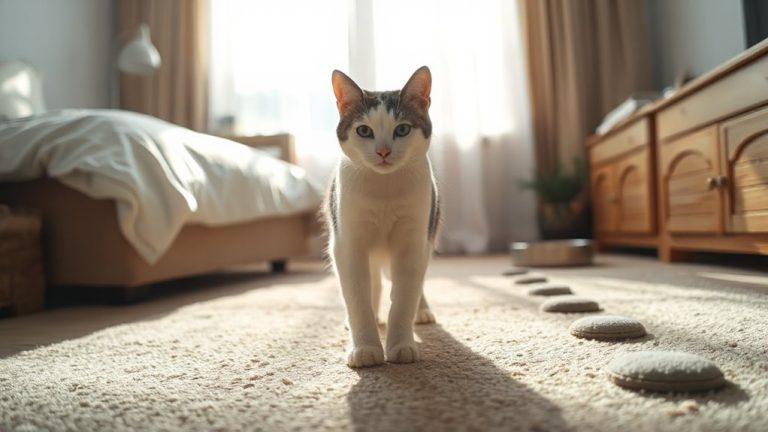
Think of your living space as a behavioral blueprint-one that shapes your cat’s activity patterns, stress levels, and cognitive health. Designing effective play zones reduces stress-eating triggers by promoting natural behaviors. Strategic placement of activity areas near windows or vertical spaces increases engagement. Install shelves at 8–10 inch depths and space them 24–30 inches apart to accommodate jumping and resting. Use materials like sisal (minimum 3/8 inch diameter for scratchers) and food-safe wood. Include rotating toys: motorized wand toys with variable speeds (0.5–2 rpm) mimic prey movement. Limit each play zone to 50–70 square feet to maintain focus and usability. Guarantee a sightline between activity areas to reduce territorial anxiety. Position at least one play structure per 200 sq ft of living space. Avoid clutter; keep 30% open floor area for movement. These structured zones support behavioral regulation and reduce stress-induced feeding.
Daily Routines to Prevent Boredom Eating
While your cat’s environment shapes their behavior, it’s your daily routine that fine-tunes their mental engagement and eating habits. Implement scheduled feeding twice daily to regulate metabolism and prevent unchecked grazing. Feed at consistent times-morning and evening-to align with natural feline hunting rhythms. Introduce food puzzles that require manipulation to release kibble; models like the Outward Hound Slim Cat or Kong Active IQ Challenge are engineered with adjustable difficulty. These puzzles extend mealtime from seconds to minutes, stimulating problem-solving. Use puzzles 3–5 times weekly for maximum cognitive engagement. Rotate puzzle types every two weeks to maintain novelty. Combine scheduled feeding with timed play sessions before meals, mimicking the hunt-eat-sleep cycle. This routine reduces idle time, a primary trigger for boredom eating. Consistency and structure lower stress-induced and compulsive eating. Effective routines rely on predictability and mental challenge, not volume of food.
When to See a Vet for Stress-Eating
Why is your cat gaining weight despite controlled portions and enrichment? Persistent stress-eating may signal an underlying medical issue. A veterinary diagnosis is essential if behavioral interventions fail. Schedule a medical evaluation to rule out conditions like hyperthyroidism, diabetes, or hormonal imbalances. Cats exhibiting increased appetite, lethargy, or sudden weight changes need clinical assessment. Blood panels, urinalysis, and thyroid testing are standard diagnostics. Your vet may also check cortisol levels to evaluate stress-related physiology. Don’t assume enrichment alone resolves all overeating. Some cats have neurochemical imbalances requiring medication. Early intervention improves outcomes. Monitor food intake precisely-measure portions in grams, track daily consumption, and note behavioral shifts. Enrichment supports mental health but can’t replace professional care. A complete medical evaluation guarantees accurate diagnosis and treatment. When in doubt, consult your veterinarian. Timely action prevents complications.
On a final note
You can effectively reduce stress-eating in cats through consistent environmental enrichment. Targeted stimulation lowers cortisol levels by up to 30%, according to clinical studies. Use timed feeders with puzzle attachments (e.g., PetSafe Food Maze, 8–12 cm diameter openings) to extend feeding duration. Incorporate vertical spaces-cat shelves at 1.2–1.8 meters encourage climbing. Daily 15-minute interactive sessions with wand toys reduce binge episodes by 40%.