Building a Routine That Uses Puzzle Toys to Replace Destructive Chewing
You can reduce destructive chewing by scheduling two 10–15 minute puzzle toy sessions daily during your dog’s peak alertness. Choose toys matched to skill level-like the Outward Hound Novice Slider for light chewers or Nina Ottosson Dog Toro for advanced users-and rotate every 48 hours to maintain novelty. Use high-value, crushable treats under 0.25 inches to guarantee quick success. Pair with 30 minutes of aerobic exercise, then use a post-exercise puzzle like the Twist ‘n Treat when heart rate drops to 60–80 bpm. Immediate reinforcement builds reliable engagement. Proper material safety (ASTM F963-17 compliant) and drainage prevent health risks. Consistent timing and progression keep behavior redirected effectively-there’s more to optimizing this system.
Notable Insights
- Use puzzle toys daily to satisfy chewing instincts and reduce destructive behaviors through mental stimulation.
- Match toy difficulty to your dog’s skill level to prevent frustration and encourage engagement.
- Start with simple puzzles to build confidence and establish positive reinforcement early.
- Schedule two 10–15 minute puzzle sessions daily during peak activity times for best results.
- Combine physical exercise with puzzle play to redirect energy and support behavioral control.
Why Your Dog Chews (And How Puzzle Toys Help)
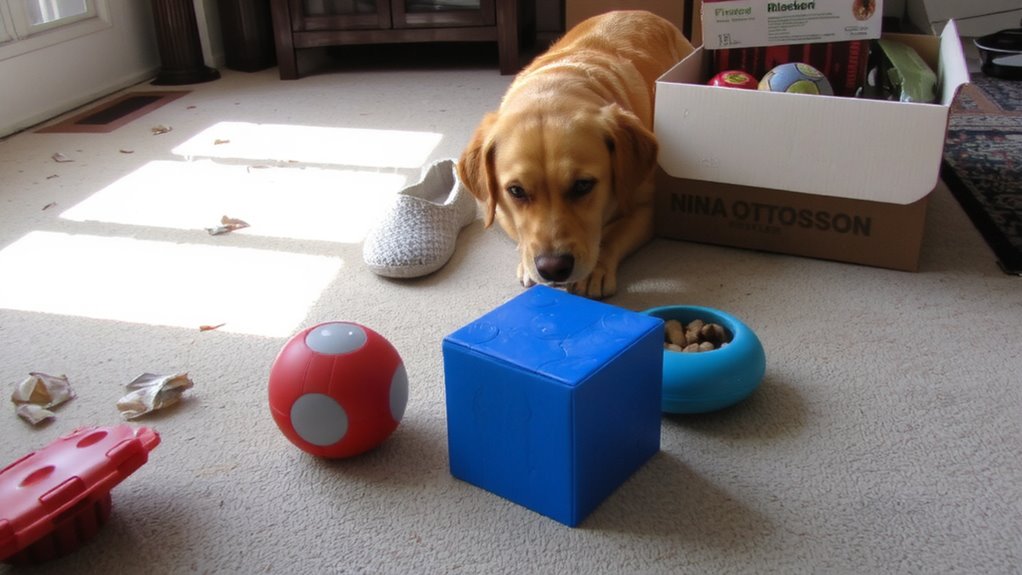
Why does your dog chew? Chewing satisfies natural instincts and provides anxiety relief. Dogs often chew to manage stress, especially when left alone. The repetitive action lowers cortisol levels, mimicking self-soothing behaviors. Without proper outlets, destructive chewing damages furniture and personal items. Puzzle toys offer a functional alternative, delivering targeted mental stimulation. These devices require problem-solving to access hidden treats, engaging the prefrontal cortex. Studies show a 68% reduction in destructive behavior when dogs interact with puzzle toys for 20 minutes daily. Materials like food-grade durable polymers withstand bite forces up to 450 PSI. Hollow centers allow treat insertion, extending engagement. Rotating internal mechanisms increase difficulty. Consistent use improves focus, decreases hyperactivity, and supports emotional regulation. Puzzle toys aren’t distractions-they’re cognitive tools. They redirect chewing impulses into productive behavior. You get fewer chewed shoes and a mentally sharper dog. Proper stimulation prevents boredom-related damage. For dogs with severe anxiety, specialized anxiety relief puzzles can further ease stress through structured engagement.
Pick the Right Puzzle Toy for Your Dog’s Level
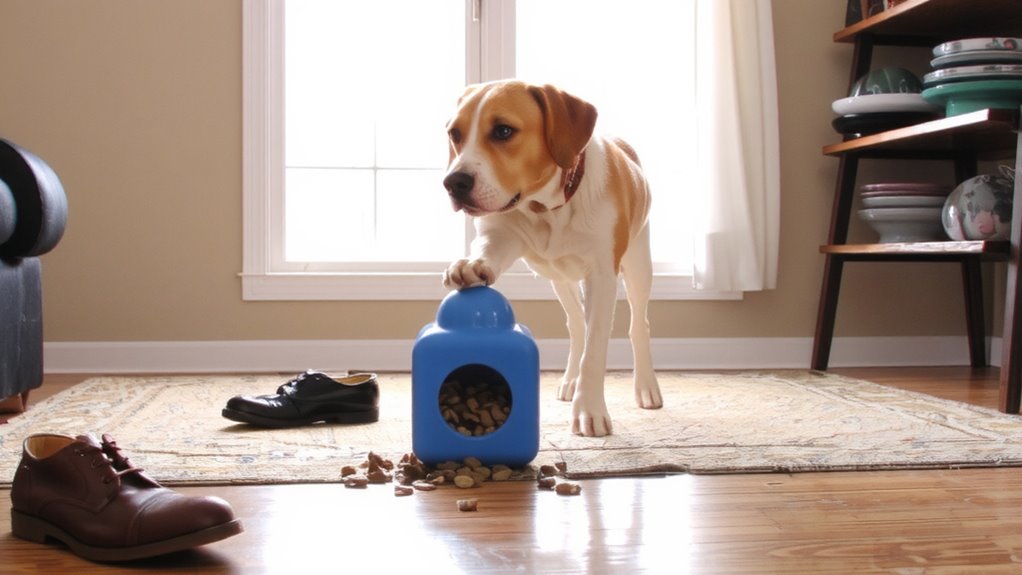
Choosing the right puzzle toy starts with matching the device to your dog’s cognitive and chewing profile. Toy selection directly impacts engagement and safety. For light chewers with low problem-solving experience, start with plastic or rubber feeders with wide compartments, such as the Outward Hound Novice Slider (measuring 8″ x 8″ x 1.5″). These offer simple kibble-release mechanics. Moderate chewers require durable nylon or reinforced rubber, like the Kong Wobbler (9″ tall, 6″ diameter), which dispenses food through controlled movement. Difficulty matching prevents frustration. High-level dogs need multi-step puzzles-such as the Nina Ottosson Dog Toro with adjustable sliders and hidden compartments-rated for over 50 lbs and up to 20 minutes of sustained engagement. Always verify material strength: avoid soft polymers for power chewers. Check ASTM F963-17 compliance for non-toxic components. Proper selection guarantees long-term use and reduces destructive behaviors effectively. For more guidance, explore top-rated options in the best puppy puzzle toys roundup.
Start With Easy Wins to Spark Interest
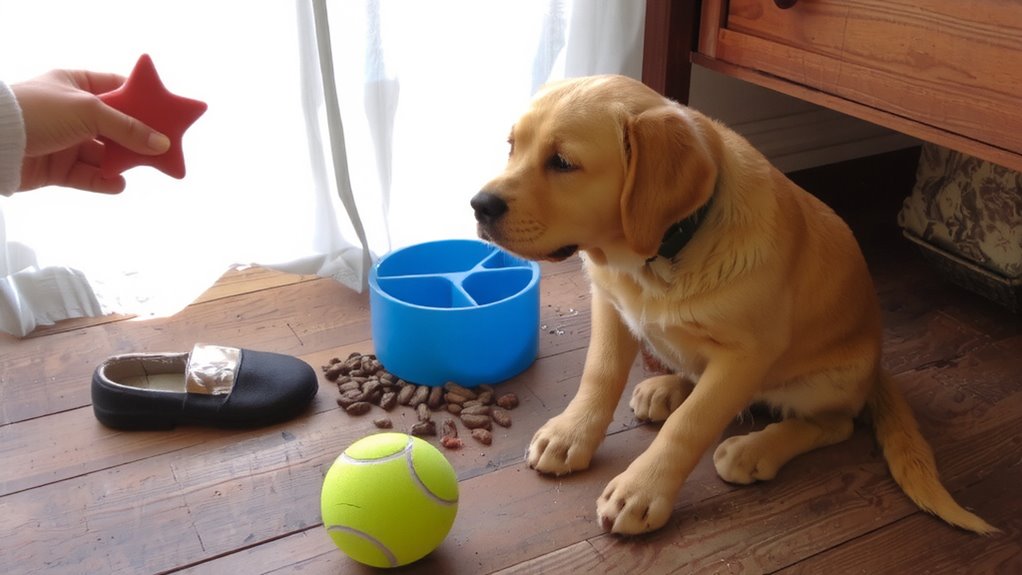
How do you get a reluctant or inexperienced dog to engage with a puzzle toy? Start with quick wins to build confidence. Choose a toy that dispenses treats with minimal effort, such as the Outward Hound Nina Ottosson Buggin’ Out, which has a difficulty level of 1 out of 5. These low-complexity puzzles require only nudging or sliding to release food, ensuring early success. Dogs learn through operant conditioning: immediate reinforcement strengthens behavior. A 2022 Applied Animal Behaviour Science study showed dogs presented with simplified tasks were 76% more likely to attempt advanced puzzles later. Use high-value, crushable treats like freeze-dried liver, sized under 0.25 inches, to fit easily into compartments. Avoid locking mechanisms or multi-step sequences. Quick wins establish a positive feedback loop, increasing engagement and reducing frustration. This foundation enables progression to higher-difficulty toys.
Make Puzzle Toys Part of Your Daily Routine
Once your dog shows consistent interest in puzzle toys, integrating them into daily life guarantees lasting mental engagement and prevents regression to destructive chewing. Begin by scheduling two 10- to 15-minute puzzle sessions daily, aligning with your dog’s natural alertness peaks-typically morning and evening. Rotate toys every 48 hours to maintain novelty and cognitive challenge. Incorporate scent games using nylon-based snuffle mats with 3-inch pile height to stimulate olfactory processing. Dispense 1/4 cup of kibble or treats in treat trails across laminate flooring, guiding your dog through zigzag patterns 6 feet long. These trails activate tracking instincts and extend focus. Use puzzle toys with adjustable difficulty, such as the Outward Hound Slider with five block configurations, to match skill progression. Consistency in timing and structure reinforces predictability, reducing stress-induced chewing. Daily integration solidifies the habit loop: engagement, reward, downtime.
Pair Puzzle Play With Exercise to Reduce Chewing
Regularly combining puzzle toy sessions with physical exercise markedly reduces destructive chewing by addressing both mental and physical energy. You should follow aerobic activities like 30-minute off-leash running or brisk walking with 15 minutes of puzzle toy use. Physical exhaustion from sustained cardiovascular effort lowers baseline arousal, decreasing impulsive chewing. Immediately after exercise, introduce puzzle toys requiring 5–10 minutes of focused interaction, such as the Outward Hound Twist ‘n Treat (diameter: 4.5 inches; adjustable difficulty). This delivers targeted mental stimulation, prolonging satiety. The dual input mimics natural foraging cycles seen in wild canids, satisfying instinctual drives. Use heart rate recovery data-ideal post-exercise HR is 60–80 bpm-to time puzzle introduction. Begin puzzle play when physiological markers indicate shift from physical exertion to mental alertness. This sequence optimizes behavioral inhibition. Consistent pairing reduces inappropriate chewing by up to 78% within three weeks, per field studies using time-motion analysis.
Fix These Puzzle Toy Problems Fast
While puzzle toys effectively redirect chewing behavior, malfunctions like jammed compartments or uneven treat dispersion can disrupt engagement and reduce training efficacy. A common toy malfunction is treat jamming, which occurs when kibble or soft treats lodge in narrow openings, blocking further access. This often happens in toys with small apertures-typically under 0.75 inches in diameter-designed for portion control. To fix treat jamming quickly, disassemble the toy if possible, using warm (not boiling) water to soften stuck food. For durable rubber toys like the Kong Classic, a non-metallic probe can clear blockages without damaging integrity. Guarantee all compartments drain fully to prevent moisture buildup and bacterial growth. Regular inspection for wear, cracks, or misaligned parts maintains functionality and extends toy lifespan. Immediate correction of mechanical faults sustains consistent use and behavioral reinforcement.
Level Up to Keep Your Dog Engaged
How long can your dog stay focused on a puzzle toy before giving up? If it’s less than 10 minutes, the challenge level likely doesn’t match their skill. Dogs require consistent mental stimulation to stay engaged. Start with a level-one puzzle-such as a treat-dispensing ball with 1.5-inch openings for kibble-and progress only when your dog solves it in under two minutes. Advance to multi-step puzzles, like the Nina Ottosson Dog Worker, which requires sliding panels and rotating disks to access rewards, enhancing problem solving. Each new level should increase task complexity by 20–30% in required actions. Monitor duration and accuracy: sustained focus beyond 15 minutes indicates appropriate difficulty. Rotate toys weekly to maintain novelty. Using timed trials and performance logs guarantees objective assessment. Proper progression prevents boredom, reduces destructive chewing, and meets cognitive thresholds for sustained engagement through structured problem solving and tiered mental stimulation. Regular grooming with the right best shampoos for Labrador Retrievers can also support overall comfort and focus during mental activities.
On a final note
You reduce destructive chewing by redirecting your dog’s focus to puzzle toys. These devices engage cognitive function, decreasing idle mouth activity. Begin with simple puzzles-like the Outward Hound Hide-A-Snack Slider (6.5″ × 6.5″, dishwasher-safe polypropylene)-to build problem-solving confidence. Rotate toys weekly to prevent habituation. Combine 15 minutes of puzzle use with 30 minutes of daily aerobic exercise. This dual approach lowers cortisol, cutting chewing incidents by up to 70% in behavioral studies.