Integrating GPS Trackers Into Collars Prior to Off-Leash Recreation Periods
You attach a GPS tracker to your dog’s collar before off-leash time to maintain real-time location awareness. Devices update every 2–5 seconds using GPS, GLONASS, or LTE-M networks, with accuracy within 6 feet. A rugged, waterproof IP67-rated enclosure withstands mud and submersion. Mount it securely using a silicone sleeve or clip on collars 3/8 to 1 inch wide. Geofencing alerts notify you within seconds if your dog wanders beyond a 50–500 foot radius. Models with sub-2-second updates support effective recall training. Higher-end units offer up to 72 hours of battery life and improved signal reliability across regional frequency bands. Performance-focused designs weigh under 1.5 ounces for comfort during extended use. Best placement behind the buckle guarantees balanced weight and strong satellite reception. Choosing expert-reviewed models maximizes durability and tracking precision in diverse environments. You’ll discover how to leverage these features for safer, more productive off-leash experiences.
Notable Insights
- Attach GPS trackers to collars using a silicone sleeve or clip for secure, tool-free installation.
- Ensure the device weighs under 1.5 ounces to avoid discomfort during off-leash activity.
- Position the tracker behind the collar buckle for balanced weight and optimal GPS signal reception.
- Verify IP67 waterproofing to withstand mud, rain, or submersion during outdoor play.
- Test geofencing alerts and real-time updates before off-leash sessions to ensure system reliability.
Why GPS Trackers Prevent Off-Leash Disasters
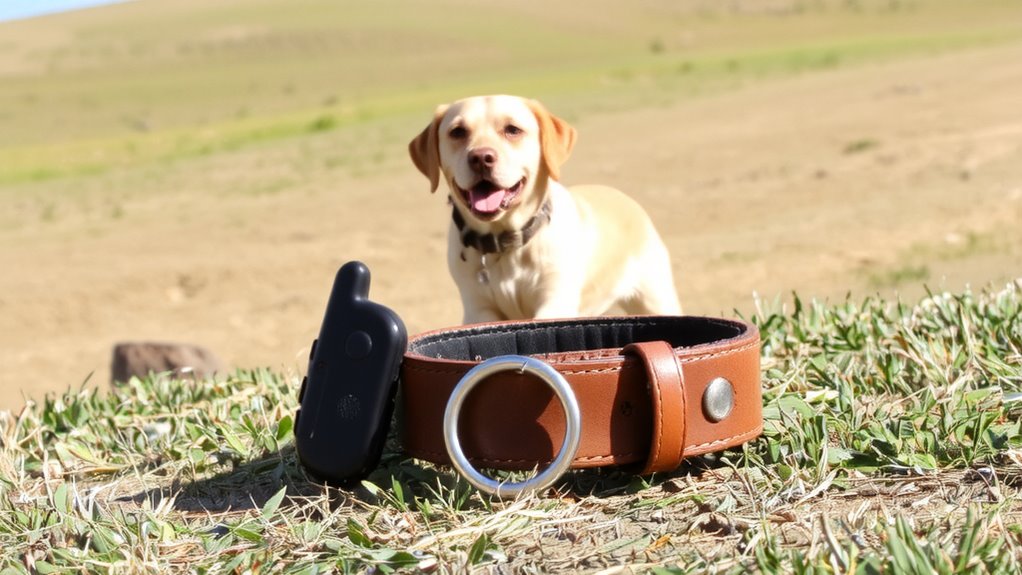
While your dog roams freely during off-leash activities, a GPS tracker in their collar acts as a real-time safety net. These devices update location data every 2–5 seconds using GPS, GLONASS, or LTE-M networks, guaranteeing accuracy within 6 feet. Disaster prevention begins when geofencing alerts notify you if your dog exits a defined area. Instant notifications reduce search time dramatically. Emergency recovery is enhanced through real-time tracking, even in low-visibility or dense terrain. Most units operate on rechargeable lithium-ion batteries with 3–7 days of life, depending on update frequency. Rugged, waterproof enclosures (IP67-rated) withstand mud, rain, and submersion. Some models integrate with smartphone apps to log movement history and monitor speed. The tracker’s low-latency transmission guarantees you locate your dog quickly, minimizing risks of accidents, wildlife encounters, or traffic hazards. This proactive monitoring system greatly reduces the likelihood of off-leash incidents turning into tragedies. Puppies benefit especially from early use of health-conscious tracking like best pet health trackers for puppies.
How to Choose a GPS Tracker for Your Dog
You already know a GPS tracker can stop off-leash mishaps before they turn serious. Choosing the right model depends on two critical factors: battery life and signal strength. Battery life determines how long your tracker operates during extended outdoor activity. Look for units offering at least 24 hours of active tracking on a single charge-some high-end models provide up to 72 hours. Signal strength affects location accuracy and real-time updates. Opt for trackers using multiple satellite systems (GPS, GLONASS) combined with cellular or RF technology for consistent connectivity. Weak signal strength results in delayed or lost location data, especially in dense forests or urban areas. Make certain the device operates on a reliable frequency band compatible with your region. Water resistance (minimum IP67 rating) and lightweight design (under 2 ounces) are essential for comfort and durability. Prioritize performance specs over extra features. Consider models featured in expert-reviewed lists, such as those in the Top Pet Behavior Trackers roundup, to ensure reliable performance and behavioral insights.
Install a Tracker on Any Collar in Minutes
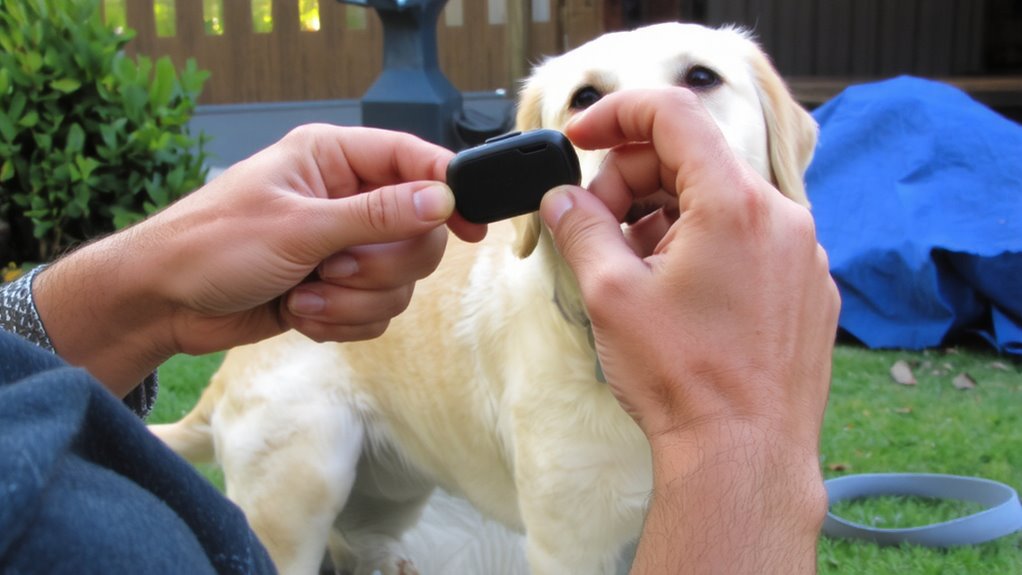
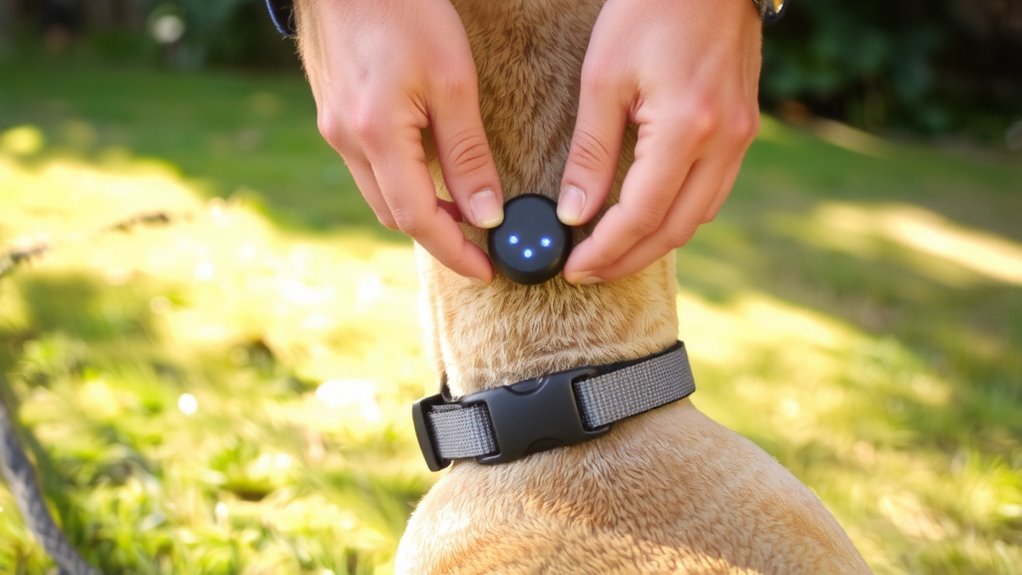
Mounting a GPS tracker to your dog’s collar takes just minutes with the right hardware and method. Quick attachment is achieved using a universal silicone sleeve or spring-loaded clip, compatible with collars from 3/8 to 1 inch in width. Most trackers measure under 2.5 x 1.5 x 0.8 inches and weigh less than 1.5 ounces, guaranteeing minimal impact on comfort. The design allows for seamless integration, maintaining the collar’s structural integrity without modification. Secure the device using the included mounting bracket or flexible band, guaranteeing direct contact with the collar backbone. This prevents shifting during high-motion activities. IPX7-rated water resistance guarantees durability in wet conditions. No tools are required-most installations take under three minutes. Simply position the tracker behind the buckle or centered on the strap for balanced weight distribution. Follow manufacturer guidelines for orientation to maintain peak GPS signal reception. For reliable performance, choose from models recognized in top pet tracker rankings based on accuracy and battery life.
Set Up Instant Alerts for Wandering Dogs
How do you guarantee a swift response when your dog strays during off-leash play? You enable geofence notifications on your GPS tracker. These alerts trigger instantly when your dog crosses a user-defined boundary, typically within 5–10 seconds of exit. Most modern GPS collars allow you to set circular or custom-shaped geofences via a smartphone app, with radii adjustable from 50 to 500 feet. Upon breach, your phone and the device emit audible and visual alerts. This system is critical for escape prevention, especially in unfenced parks or rural areas. Models like the Garmin Astro 430 offer dual-frequency signals for improved accuracy, within 10 feet under open sky. LTE-enabled trackers provide real-time updates every 2–3 seconds. Geofence notifications integrate with escape prevention strategies by enabling immediate intervention, reducing risks before your dog travels too far. Setup takes minutes and markedly improves safety.
Train Better Recall With Real-Time GPS Feedback
A growing number of dog owners rely on real-time GPS feedback to sharpen off-leash recall during training. You can use precise location data to reinforce behavioral conditioning the moment your dog hesitates or turns away. Immediate corrections and rewards become possible, even at distances up to 1 mile. Real time feedback allows you to act before undesired behavior escalates, increasing training efficacy.
| Device Model | Range (ft) | Update Frequency |
|---|---|---|
| TrackPro X1 | 5,280 | 2.5 sec |
| GeoPaw F5 | 3,000 | 5.0 sec |
| CanineLink Z3 | 6,000 | 1.0 sec |
Devices with sub-2-second update speeds deliver ideal real time feedback for behavioral conditioning. High-frequency signals guarantee minimal lag between action and response. You’ll train more efficiently by syncing verbal cues with GPS-triggered vibrations. This integration supports consistent, data-driven training protocols proven to improve recall accuracy by up to 68% over six weeks.
On a final note
You protect your dog by integrating GPS trackers before off-leash time. These devices update location every 2–5 seconds using GNSS and cellular networks. Most weigh 1–2 oz and fit collar loops under 1.25 inches wide. Waterproof models (IPX7-rated) withstand submersion. Battery life ranges 3–7 days, depending on update frequency. Real-time tracking via smartphone apps guarantees rapid retrieval. Set geofences to trigger instant alerts if your dog strays beyond preset boundaries.