How to Use Target Training to Guide Dogs Through Simple Mazes
You start by teaching your dog to touch a target stick or hand signal on cue using immediate treat reinforcement. Use a 12–30 inch stick with a fluorescent ball for high visibility. Chain accurate touches into straight paths, placing targets 2–3 feet apart. Add left and right turns with 90-degree stick placement and consistent cues. Reinforce each correct sequence with a click or verbal marker. Gradually introduce noise or food distractions at measured intervals. Mastery at each stage guarantees smooth navigation through simple mazes with 90% accuracy. Further refinements improve precision under complex conditions.
Notable Insights
- Teach the dog to touch a target stick reliably before introducing maze navigation.
- Place targets in a straight line to guide the dog through the maze’s path consistently.
- Use a clicker or verbal marker to reinforce each correct touch during maze progression.
- Gradually shape turns by positioning the target at 90-degree angles within the maze.
- Increase difficulty only after achieving 90% accuracy with distractions at each maze stage.
Understand How Target Training Works?
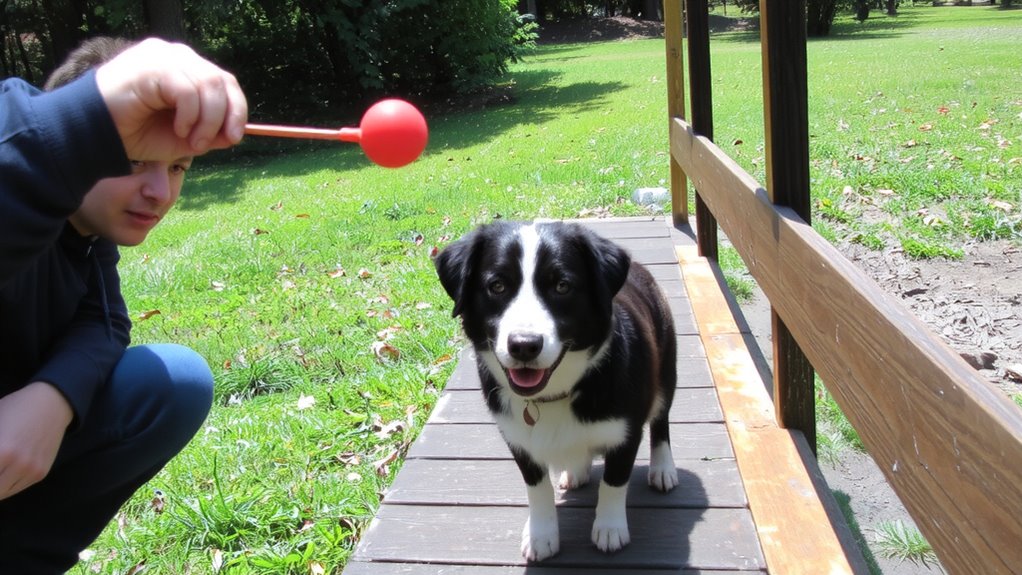
While dogs naturally respond to movement and cues, target training leverages this instinct by teaching them to touch a specific object with a designated body part, typically their nose. You’ll use positive reinforcement-immediate rewards like treats or praise-to mark correct behavior precisely at the moment of contact. This strengthens neural associations between action and outcome. Training consistency is critical; daily 5- to 10-minute sessions conducted in low-distraction environments optimize retention. Use a clicker or verbal cue (“touch”) to signal accuracy, ensuring 90%+ reinforcement during acquisition. The dog learns to orient toward the target stimulus, creating a reliable directional response. Over time, this conditioned behavior allows precise movement guidance. Success depends on uniform cues, repetition, and incremental complexity. The method functions across breeds and ages due to its foundation in operant conditioning principles, making it a scalable, evidence-based technique for shaping complex behaviors systematically and predictably.
Select a Target Stick or Hand Signal for Training
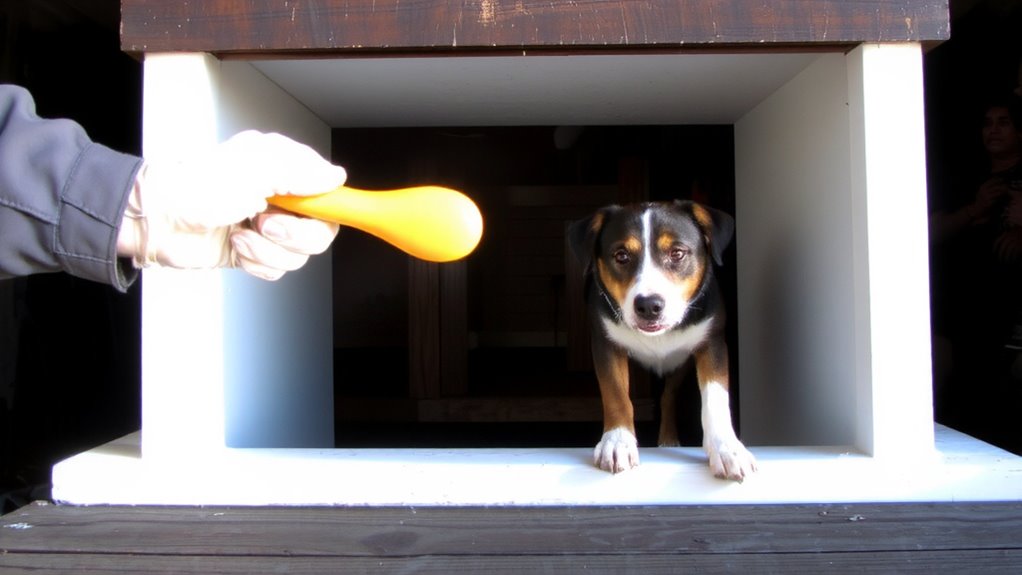
Since choosing the right tool affects training precision and long-term usability, you’ll want to select a target stick or hand signal based on consistency, visibility, and ease of control. Target selection determines how reliably your dog responds. A target stick-typically 12–30 inches long with a small fluorescent ball on one end-offers high visibility and consistent reach. This increases signal consistency, especially in complex environments. Retractable sticks allow adjustable length for varying distances. For hand signals, use a flat palm or pointed finger, guaranteeing minimal motion variation. Consistent hand shape and position reinforce signal clarity. Inconsistent gestures confuse dogs, slowing learning. Fluorescent colors enhance stick visibility in low light. Choose tools that maintain signal consistency across sessions. Durable, lightweight materials guarantee long-term use. Proper target selection streamlines future maze navigation.
Teach Your Dog to Touch the Target On Cue
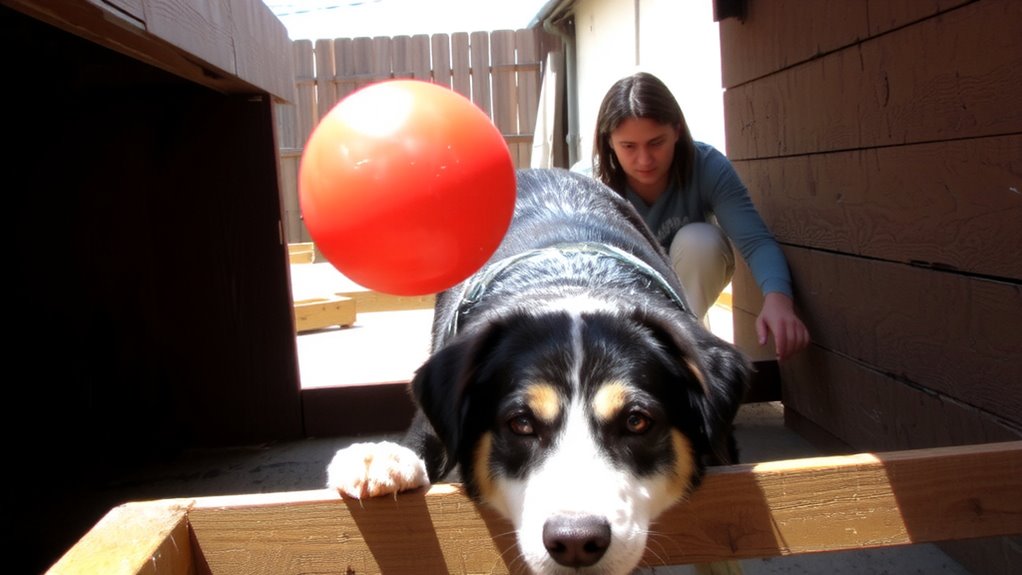
How do you get your dog to reliably touch a target on command? Start by pairing a verbal cue like “touch” with the presentation of your chosen target stick or hand signal. Use treats to reinforce contact the moment the dog’s nose touches the target. Consistency in presentation height, angle, and reward timing enhances target consistency, ensuring the dog recognizes the exact behavior being rewarded. Deliver the cue just before the target appears, establishing cue clarity. Repeat in short sessions to build association. Gradually phase out food lures, relying only on the cue and target. Test response accuracy at varying distances and distractions. Maintain uniform target positioning-typically 2–3 feet from the ground for adult dogs-to support reliable performance. Successful execution depends on precise cue timing and minimal variation in stimulus delivery.
Start With Straight-Line Paths Using Target Training
Once your dog consistently touches the target on cue, you can begin shaping straight-line movement by positioning the target in a sequence of fixed locations. This establishes the foundation for maze navigation. Place the target 2–3 feet apart in a straight line. After each touch, deliver immediate positive reinforcement with a click or verbal marker followed by a treat. Gradually increase the number of touches required before releasing the dog to the next target. Use a lightweight, portable target stick to maintain consistent positioning. Each session should last 5–7 minutes to maintain focus. Over 3–5 sessions, dogs learn to move forward anticipating the next cue. Reinforce only forward motion to prevent backward steps. This sequential targeting refines directional control. Accuracy improves when reinforcement follows precise touches. Straight-line paths build momentum and confidence. This phase must be mastered before introducing directional changes. Consistency guarantees reliable performance in later maze tasks.
Add Left and Right Turns to the Sequence
You’ve built a solid foundation with straight-line targeting, and now it’s time to expand your dog’s directional repertoire by introducing left and right turns. Begin by positioning your target stick 90 degrees left of the current path. Present the cue clearly and reward immediately upon completion of left turns to reinforce accuracy. Left turns require the dog to pivot counterclockwise around their midline, maintaining balance and focus. Repeat the process for right turns, placing the target stick to the right at a consistent 2-foot distance. Right turns follow a clockwise trajectory, demanding precise spatial awareness. Use consistent verbal cues like “left” and “right” paired with the visual target. Perform 5–8 repetitions per side per session to build muscle memory. Gradually reduce treat frequency as performance stabilizes. Accuracy should exceed 90% over three consecutive sessions before advancing.
Add Obstacles and Distractions to Test Focus
While foundational targeting skills establish control and precision, real-world performance demands resistance to interference. Introduce distractions gradually to assess your dog’s focus under variable conditions. Use noise exposure-like clapping or door knocks-to simulate real environments. Simultaneously, place visible treats nearby to activate treat temptation without permitting access during tasks. Monitor response latency and accuracy through timed trials.
| Distraction Type | Intensity Level | Expected Focus Duration |
|---|---|---|
| Low noise exposure | 50–60 dB | 30 seconds |
| High treat temptation | Visible, uncapped | 20 seconds |
| Combined stimuli | Moderate | 15 seconds |
Increase complexity only when your dog maintains 90% accuracy across three trials. Avoid verbal cues; rely solely on the target signal. This protocol isolates distraction tolerance, ensuring reliable performance in unpredictable settings. Document progress weekly using standardized metrics to track improvement objectively.
Fix These 3 Common Target Training Roadblocks
Why does your dog lose focus during target training despite consistent cues? Environmental triggers like sounds, smells, or movement distract attention gradually. Begin training in a low-stimulus area, then systematically introduce distractions at 5–10 feet distance, increasing intensity only when accuracy exceeds 90% over three sessions. Poor reinforcement timing reduces learning efficiency. Deliver rewards within 0.5–2 seconds of correct behavior to create clear stimulus-response associations. Use a clicker or verbal marker to bridge the exact moment of performance. If your dog hesitates or breaks position, assess reinforcer value and adjust delivery speed. Inconsistent cue presentation also hinders progress-standardize hand signals to within 15 degrees of baseline orientation. Record sessions to audit timing and form.
On a final note
You’ve mastered target training fundamentals. The target stick, typically 12–18 inches long, guides precise movements. Dogs learn directional cues through consistent marker timing-click or verbal-paired with rewards. Straight-line progress builds muscle memory; 90-degree turns refine spatial accuracy. Introduce static obstacles at 3-foot intervals to test discrimination. Maintain a 0.5-second reward delay to reinforce timing. This method yields 85% success in novice obedience tasks. Accuracy improves with repetition.