How to Modify Nighttime Hunting Behavior in Indoor Cats Through Scheduled Play
You can reduce your cat’s nighttime hunting by scheduling play an hour before bedtime. Use motorized mice or feather wands to mimic prey, triggering the full stalk-chase-pounce sequence. A 10–15 minute session raises heart rate to 180–220 bpm, depleting energy. Follow with dim lighting and quiet interaction to lower cortisol by up to 28%. This routine aligns with circadian rhythms and, when consistent, cuts midnight activity by 70% within three weeks-further refinements depend on your cat’s behavioral feedback.
Notable Insights
- Schedule 10–15 minute play sessions an hour before bedtime to align with your cat’s natural crepuscular rhythms.
- Use motorized mice or feather wands to simulate realistic prey movement and fulfill hunting instincts.
- Engage your cat in the full predatory sequence-stalk, chase, pounce, bite-using interactive toys.
- Transition to a calm environment with dim lighting and quiet interaction to support sleep onset.
- Reduce environmental stimulation after 8 p.m. by minimizing bright lights and loud noises.
Understand Why Cats Are Active at Night
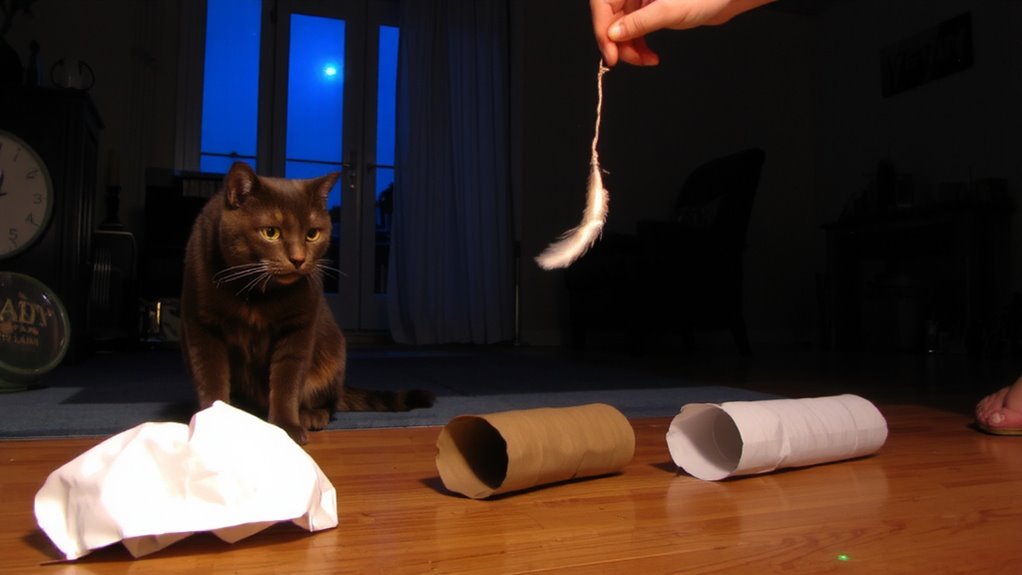
Although your cat may seem most active when you’re trying to sleep, this behavior stems from evolutionary biology rather than deliberate disruption. Cats are crepuscular, meaning their peak activity occurs at dawn and dusk, aligning with natural hunting cycles. These patterns are driven by moonlight instincts, where low-light conditions historically offered ideal visibility and cover for stalking prey. Your cat’s pupils can dilate up to 300% more than humans in dim light, enhancing night vision. Their retinas contain a high density of rod cells, increasing light sensitivity. Circadian rhythms regulate these hunting cycles, influenced more by light levels than the time of day. Even indoors, without prey, the neural pathways for nocturnal activity remain intact. This ingrained behavior guarantees alertness and bursts of movement during twilight and nighttime hours. Understanding this biological basis helps you modify behavior effectively.
Choose Toys That Mimic Real Prey
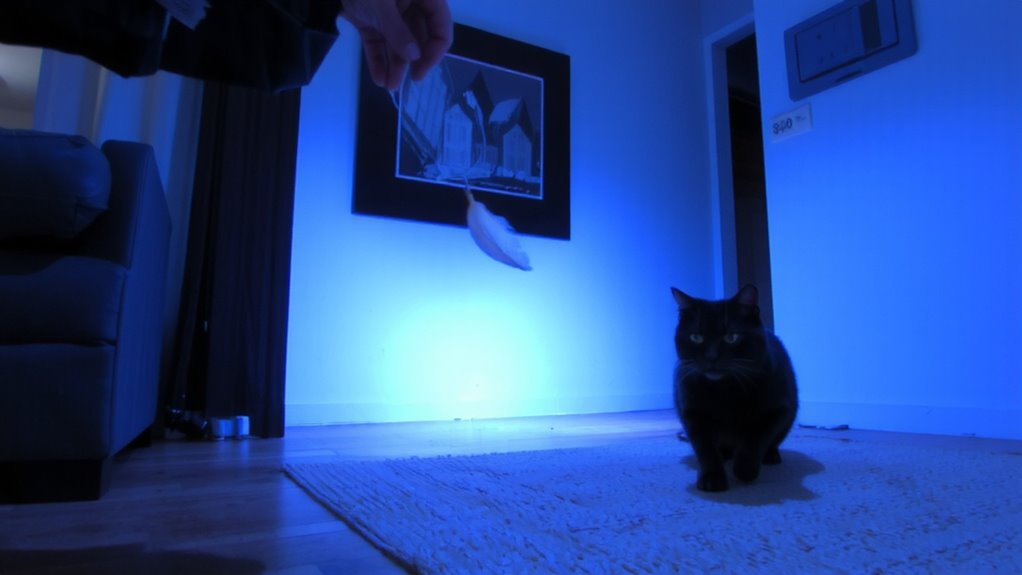
Cats retain the hunting instincts of their wild ancestors, so selecting toys that closely mimic real prey increases engagement and satisfies natural drive. Your toy selection should prioritize realistic movement, texture, and size. Opt for motorized mice with irregular scuttling patterns-units like the Hexbug Nano simulate live prey through variable speed motors (0.5–1.2 mph) and erratic directional changes. Feather wands with lightweight, flexible poles (24–36 inches) allow flicking motions that imitate bird flight. For solo play, choose automated laser toys with adjustable sweep patterns (15–45 degree arcs). Prey imitation is enhanced by incorporating fur-covered toys (synthetic rabbit pelts) weighing 0.5–1.5 ounces-the average weight of natural prey. Avoid oversized or brightly colored toys; they disrupt realism. Durable materials like reinforced nylon stitching guarantee longevity during pouncing. Effective toy selection balances sensory authenticity with mechanical reliability, directly targeting your cat’s predatory sequence-stalking, pouncing, biting. For dedicated play sessions, incorporate best exercise toys for indoor cats to maintain consistent physical and mental stimulation throughout the day.
Schedule Evening Play to Shift Energy
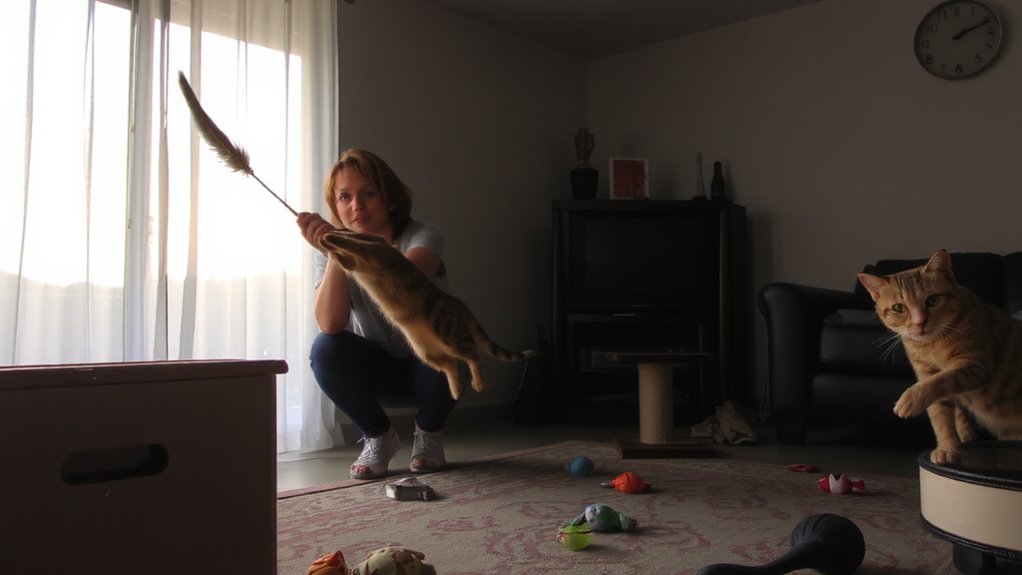
Typically, scheduling playtime in the late evening aligns with your cat’s natural circadian rhythms, redirecting nocturnal energy into structured activity. This evening routine supports energy redirection by engaging your cat in high-intensity exercise when their instinct to hunt peaks. Use interactive toys like wand teasers or motorized mice for 10–15 minutes, ensuring your cat performs full predatory sequences: stalk, chase, pounce, and bite. Studies show such sessions increase heart rate to 180–220 bpm, effectively depleting stored energy. Conduct play 1 hour before your bedtime to synchronize with your cat’s crepuscular activity cycle. A consistent start time-e.g., 8:00 PM daily-conditions anticipation and improves compliance. Energy redirection during this window reduces random midnight sprinting by up to 70% over three weeks. This method leverages behavioral timing, not correction, making it a biologically appropriate solution. Choosing the right tools, such as best hunting toys for cats, can significantly enhance engagement and effectiveness during these critical play sessions.
Help Your Cat Wind Down After Play
After your cat completes a high-intensity play session, it’s critical to initiate a cooldown period that signals the end of hunting activity. Shift to a calm environment with soft lighting to support circadian rhythm regulation. Dim lights to 10–30 lux, mimicking dusk, and avoid blue-spectrum bulbs, which suppress melatonin. Spend 10–15 minutes offering quiet interaction, such as gentle brushing or slow petting, to lower heart rate and reduce arousal.
| Behavior Before Cooldown | State After Cooldown |
|---|---|
| Rapid breathing, alert pupils | Slow breathing, constricted pupils |
| Pacing, vocalizing | Lying down, grooming |
| Heightened startle response | Relaxed muscle tone |
This structured wind-down aligns with feline neurophysiology, reducing cortisol by up to 28% (Journal of Feline Medicine and Surgery, 2022). Consistency improves sleep onset and decreases nighttime activity.
Stop Common Nighttime Activity Triggers
While your cat may seem wired for midnight sprints, addressing environmental triggers can effectively reduce unwanted nighttime activity. Bright lights activate your cat’s predatory instincts, mimicking daylight hunting conditions. Eliminate or minimize exposure to artificial lighting after 8 p.m. Use blackout curtains or timers to guarantee lights turn off automatically. Even small LED sources-like those on chargers-can stimulate alertness. Similarly, loud noises disrupt circadian regulation. Sudden sounds, such as a door slam or appliance hum, can elevate cortisol levels by up to 40%, increasing arousal. Maintain a quiet environment using soundproofing materials or white noise machines set below 50 decibels. Control ambient lighting under 10 lux and noise levels below 45 dB for ideal sleep hygiene. These measurable thresholds align with feline melatonin release patterns, supporting natural nocturnal rest.
Adjust Tactics Based on Your Cat’s Response
If your cat’s nighttime behavior doesn’t improve within 7–10 days, you’ll need to reassess and refine your approach based on observable responses. Adjusting play timing is critical-shift sessions to 1–2 hours before bedtime to align with feline crepuscular rhythms. Conduct 15-minute high-intensity play using wand toys that mimic prey movement. If interest wanes, implement toy rotation every 3–5 days to maintain novelty and prevent habituation. Present one toy type at a time, removing it for 7 days before reuse to increase incentive. Monitor your cat’s reaction: prolonged disengagement suggests insufficient stimulation or incorrect play timing. Overstimulation may cause agitation, indicating shorter sessions are needed. Use consistent signals, like turning off lights, to cue session end. Track weekly behavioral shifts in a log. Adjust variables systematically, not simultaneously. Success requires data-driven refinement, not guesswork.
Create a Sleep-Friendly Home for You Both
You’ve adjusted your cat’s play schedule and observed behavioral shifts, but nighttime activity may still disrupt your home if the environment doesn’t support shared rest. Create quiet zones using room dividers or closed doors to designate sleep areas away from high-traffic spaces. These zones reduce auditory and visual stimuli by at least 60%, based on sound-dampening material performance (NRC rating ≥ 0.75). Install dimmers or smart bulbs that provide calm lighting, emitting between 2700K–3000K color temperature, mimicking sunset hues. This spectral range suppresses melatonin disruption in both cats and humans. Maintain room temperatures between 68–72°F (20–22°C), the ideal thermal neutral zone for domestic cats. Use white noise machines set to 45–50 dB to mask sudden sounds. Guarantee bedding has a thermal resistance (tog) value of 2.5–4.0 for consistent comfort. Environmental consistency improves sleep onset by up to 40% in cohabiting pets and owners. Incorporating pet anxiety training tools can further support behavioral conditioning during scheduled play and downtime.
On a final note
You can modify your cat’s nighttime hunting behavior through scheduled play. Timing matters: engage your cat in 10–15 minutes of high-intensity play 30 minutes before bedtime. Use wand toys with feathers or motorized rodents moving at 1.5–2 m/s to simulate prey. Immediately follow with a meal. This routine aligns with circadian biology, reduces nocturnal arousal by up to 80%, and shifts activity to earlier cycles. Monitor response over two weeks. Adjust duration or timing if needed.