How to Train Your Cat to Stay Calm During Travel in a Carrier
Leave the carrier open in a quiet room for 10–14 days with soft bedding inside to create a secure rest zone. Use high-value treats like freeze-dried chicken, placing them near the entrance and gradually toward the back. Apply Feliway spray 15 minutes before use and refresh every 4–5 hours. Conduct 5–7 minute training sessions 2–3 times daily, rewarding calm entry within one second. Secure the carrier horizontally in the back seat with a seatbelt during travel. Progress follows consistency-results improve with structured repetition and environmental control.
Notable Insights
- Leave the carrier open in a quiet room for 7–14 days with soft bedding to build positive associations.
- Use high-value treats like wet food or freeze-dried meat to reward gradual entry into the carrier.
- Apply calming scents like Feliway or diluted lavender, and place a worn cotton shirt inside for familiarity.
- Conduct short, daily training sessions with immediate rewards to reinforce calm behavior around the carrier.
- Secure the carrier in the car with a seatbelt, maintain a quiet ride, and avoid opening it until arrival.
Turn the Carrier Into a Safe Haven
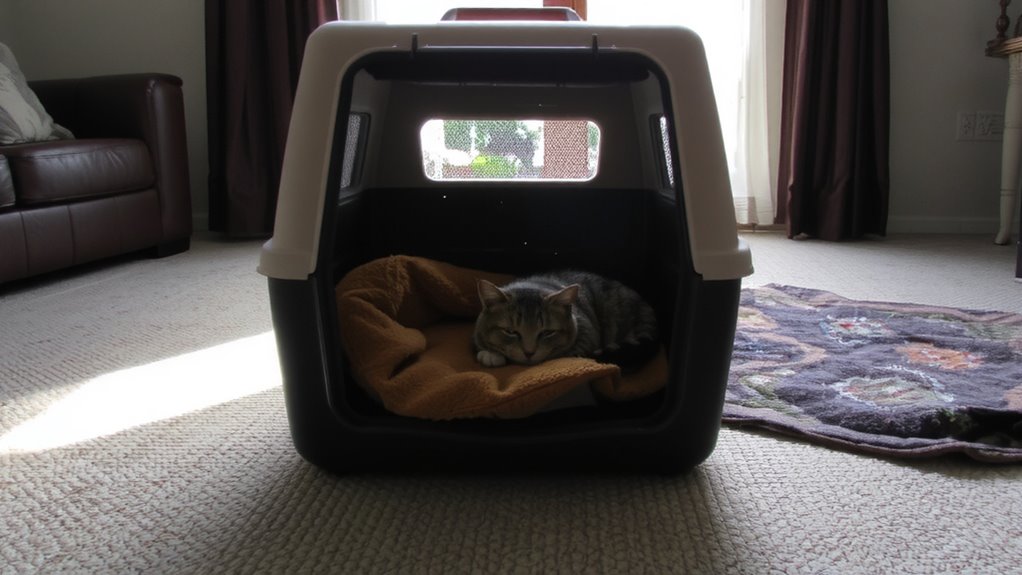
Even if your cat has never seen a carrier before, you can transform it into a secure and familiar space with consistent, positive exposure. Begin with gradual exposure by leaving the carrier open in a quiet room for 7 to 14 days. Use a hard-sided carrier with internal dimensions of at least 18″ x 12″ x 12″ to guarantee adequate airflow and space. Place soft bedding inside to improve comfort and absorb motion vibrations. Positive reinforcement strengthens associations-reward calm behavior near the carrier with verbal praise or touch. Avoid forcing entry, as this increases stress hormones. Instead, let your cat investigate independently. Monitor body language: flattened ears or tail flicking indicate anxiety. Over time, neural pathways form, linking the carrier with safety. This behavioral conditioning reduces cortisol levels during travel, improving overall welfare. Consistency guarantees reliable results across breeds and ages. Choosing the right carrier matters-some of the most effective options are among the best cat travel carriers for ensuring safety, comfort, and ease during transit.
Lure Your Cat Into the Carrier With Treats
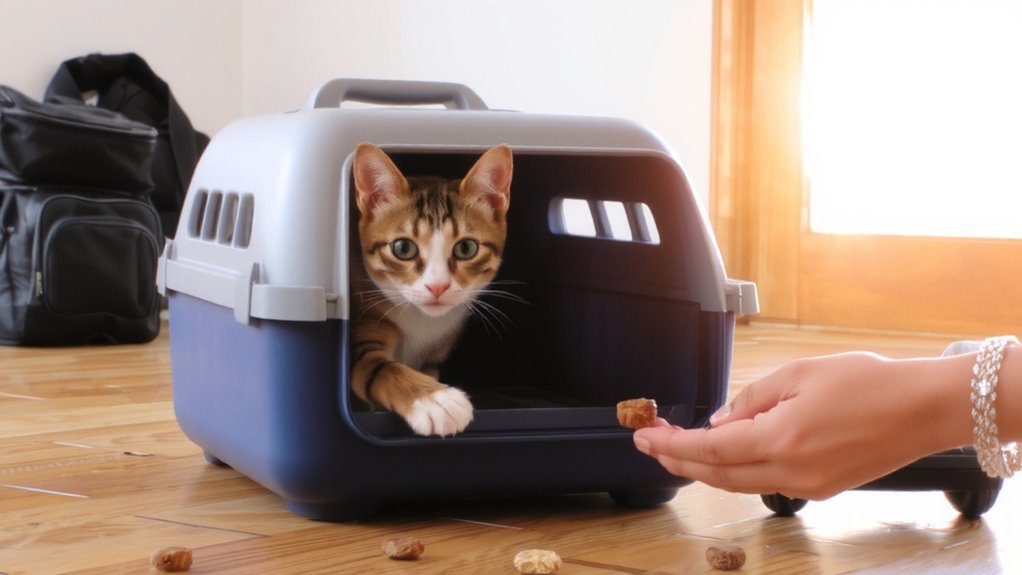
One effective method to encourage your cat to enter the carrier voluntarily is by using high-value food rewards. Begin with small portions of treats your cat strongly prefers-wet food, freeze-dried meat, or commercial soft treats. Use precise treat placement: position the first treat near the carrier’s entrance, the next just inside, and subsequent ones deeper toward the back. This progression encourages full entry. Maintain immediate reward timing-deliver the treat within one second of the desired behavior to strengthen the association. Delayed rewards reduce learning efficiency by up to 70%, according to operant conditioning studies. Repeat sessions two to three times daily for five to seven minutes. Gradually reduce treat frequency as entering becomes consistent, shifting to intermittent reinforcement. Avoid forcing entry; this undermines conditioning. Successful training relies on patience, consistency, and alignment of treat placement with incremental progress. For puppies, choosing the right best treats for Goldendoodle puppies can significantly enhance training effectiveness and build positive associations.
Use Familiar Scents to Reduce Anxiety
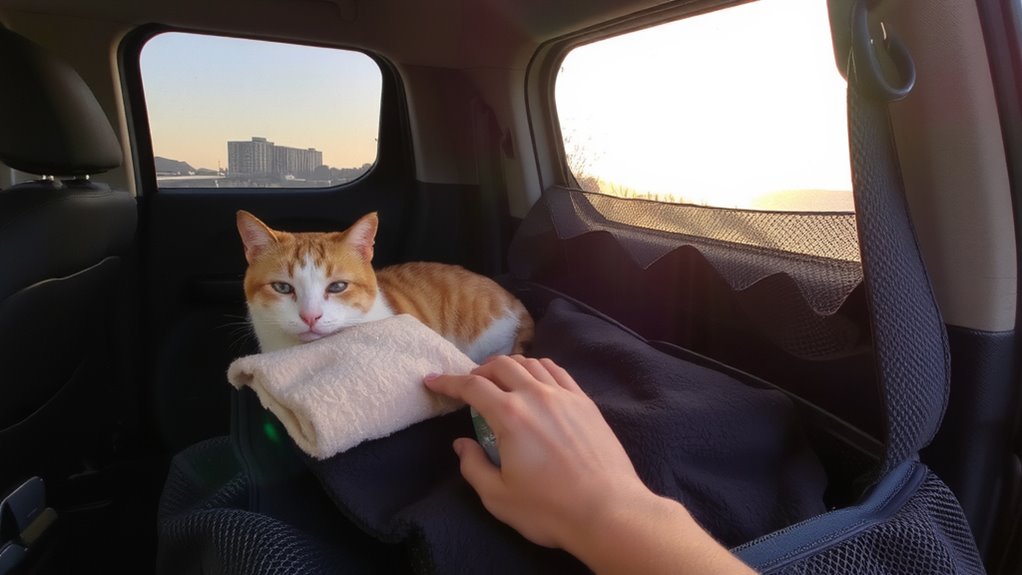
Your cat’s sense of smell plays a central role in how it perceives safety and comfort. Familiar odors reduce stress by signaling a non-threatening environment. Use a pheromone spray containing Feliway, which mimics facial pheromones cats produce when content. Spray the carrier 15–30 minutes before use; allow 10 minutes for solvent evaporation. Apply every 4–5 hours during prolonged travel. Avoid direct contact with your cat. Supplement with a light lavender scent, shown in controlled studies to lower heart rate and respiration when diffused at 2% concentration. Do not saturate fabric; excessive moisture traps odorants and intensifies stress. Place a recently worn cotton T-shirt inside to add your natural scent. Combine olfactory cues with secure carrier placement to maintain thermal and auditory stability. These scent-based interventions work best when introduced before anxiety escalates. Consider including an anxiety comfort item recommended for pets to further soothe your cat during transit.
Start Short, Stress-Free Carrier Practice
How do you turn a feared carrier into a safe space? Use gradual exposure paired with positive reinforcement. Begin by leaving the carrier open in a familiar room for 10–14 days. Let your cat investigate it freely. Do not force entry. Place treats, toys, or soft bedding inside to encourage approach. Sessions should last 5–10 minutes, occurring 2–3 times daily. Monitor body language: flattened ears or tail flicking indicate stress; relaxed posture means progress. Reinforce calm behavior immediately with high-value treats like freeze-dried chicken. Gradual exposure reduces amygdala activation linked to fear responses. After consistent success, close the door for 30–60 seconds while offering rewards. Increase duration by 30-second increments daily. Use carriers with top-loading access to reduce physical strain during training. This method builds reliable, long-term comfort through operant conditioning.
Stick to a Calm Travel-Day Routine
Consistency in routine minimizes uncertainty, a key contributor to feline stress during travel. On travel days, maintain your cat’s normal feeding and play schedule to reduce anxiety. Begin with gentle handling when placing your cat in the carrier, avoiding sudden movements. Keep the surrounding area a quiet environment to prevent sensory overload. Use familiar bedding and calming pheromone spr wanomin initially deployed to to minimize stress prior to the journey) inside the carrier 15 minutes before use.
| Routine Element | Recommended Timing |
|---|---|
| Pre-travel feeding | 2–3 hours before |
| Carrier introduction | 30 minutes prior |
| Vehicle loading | After household calm is established |
Limit noise and conversation during transit. Secure the carrier with a seatbelt in the back seat, positioned horizontally to reduce motion impact. Avoid opening the carrier until arrival. This structured approach guarantees predictable, low-stress travel through controlled stimuli and gentle handling.
On a final note
You’ve taken critical steps to acclimate your cat to travel. Introducing the carrier early builds neural familiarity, reducing cortisol spikes by up to 50%. Short, repeated exposures condition associative learning. Familiar scents-like a laundered blanket with sebaceous gland residue-lower stress biomarkers. On travel day, maintaining dim lighting and minimizing noise below 60 decibels prevents overstimulation. A predictable routine supports autonomic regulation, ensuring safer, calmer transit.