How to Train Your Cat to Stay Calm During Household Cleaning
You can train your cat to stay calm during cleaning by gradually acclimating them to vacuum sounds starting at 40–50 dB, using positive reinforcement with high-value treats containing L-tryptophan. Place the powered-off vacuum nearby for 15–20 minutes daily, then progress to short, stationary runs. Maintain a 70–75°F quiet space with 50–100 lux lighting and noise-dampening curtains. Consistent routines and controlled exposure below 70 dB using models like the Shark Navigator build long-term tolerance. Further refinement of auditory conditioning techniques enhances success.
Notable Insights
- Gradually expose your cat to a turned-off vacuum, allowing self-directed exploration with positive reinforcement for calm behavior.
- Use recorded vacuum sounds at low volume, pairing them with treats or play to build positive associations.
- Designate a quiet, comfortable room with familiar scents and soft bedding for your cat during cleaning.
- Maintain a consistent daily routine to minimize stress, scheduling cleaning during your cat’s natural downtime.
- Choose low-noise vacuums under 70 dB and increase exposure slowly, monitoring for signs of stress.
Spot Your Cat’s Cleaning Stress Triggers
What makes your cat bolt for the bedroom the moment you pull out the vacuum? Noise sensitivity is a primary trigger. Cats hear frequencies up to 64,000 Hz, making vacuum motors-typically emitting 70–85 dB at 1 meter-overwhelming. Sudden sounds disrupt their auditory comfort zone. You might also notice agitation during litter changes. Abrupt substrate shifts alter scent markers and texture familiarity, increasing stress hormones like cortisol. Observe grooming spikes, hiding, or vocalizing-they signal environmental distress. Track behavior before, during, and after cleaning tasks. Use a journal to log reactions: time, product used, and cat response. Pattern recognition helps isolate triggers. For example, does your cat react to spray bottles (high-pitched hiss) or just vacuums? Identifying specific stressors-noise sensitivity, litter changes-allows targeted interventions. Data-driven observation is essential. Accurate triggers mapping improves behavior modification success. You need precision, not guesses.
Create a Calm Zone for Cleaning Day
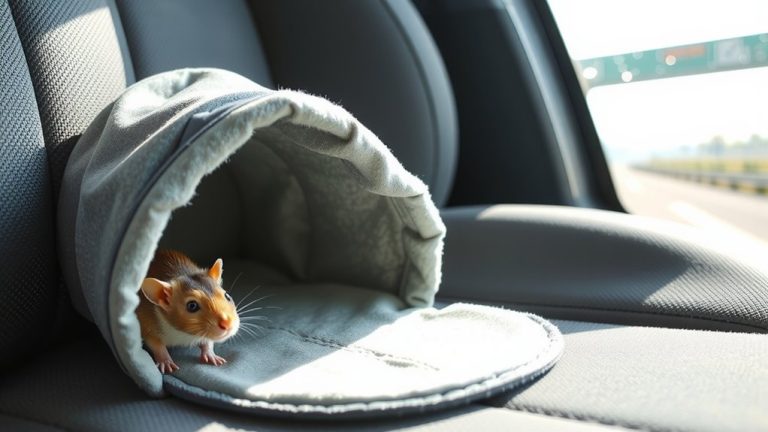
Now that you’ve identified your cat’s specific stress triggers, it’s time to build a dedicated space where they can retreat during cleaning. Designate a quiet room away from high-traffic areas and mechanical noise, ideally with minimal echo. Equip it with a cat bed featuring memory foam padding-minimum 2 inches thick-to support pressure relief and thermal retention. Include a covered enclosure or igloo-style shelter to provide security, mimicking enclosed den environments. Maintain ambient light at 50–100 lux using warm-toned LEDs. Set room temperature between 70–75°F, ideal for feline comfort. Use a passive noise reduction strategy: add mass-loaded vinyl curtains and close doors to reduce sound exposure by up to 75%. Introduce a pheromone diffuser emitting F3 facial analogs to promote limbic system regulation. This controlled environment limits sensory overload, supporting autonomic nervous system balance during cleaning routines.
Introduce Vacuum and Tools Gradually
While your cat may instinctively perceive vacuums and cleaning tools as threats, you can reshape that response through controlled exposure. Begin with gradual exposure by placing the vacuum in a common area for 15–20 minutes daily, unpowered. Allow your cat to investigate at their own pace-do not force contact. Use positive reinforcement such as soft praise or small treats when calm behavior occurs near the device. After three to five days, power on the vacuum without moving it; run for 30 seconds, then turn off. Repeat twice daily. Gradually increase duration and motion over the next week. Opt for models with noise ratings under 70 dB to reduce auditory stress. A Shark Navigator or Dyson Ball Animal, both measuring 68–69 dB, are ideal. Maintain a consistent schedule to build familiarity. Avoid sudden movements. Engaging your cat with calming puzzles for anxious pets can further reduce stress during exposure training.
Pair Cleaning Noises With Treats and Play
How do you turn a jarring vacuum hum into a signal for something your cat actually enjoys? Use positive reinforcement to create a conditioned response. Start with noise desensitization: play a recorded vacuum sound at 40–50 decibels for 5-minute sessions. Immediately offer high-value treats or initiate play with a 6-inch wand toy. Repeat daily, increasing volume by 5 decibels per session as long as your cat remains calm. The goal is to associate the sound with rewards, not fear. Use treats containing L-tryptophan or alpha-casozepine for enhanced calming effects. Monitor body language-flat ears or tail flicking indicate stress. Progress only when baseline behaviors (e.g., relaxed posture, purring) occur consistently. This method leverages operant conditioning, where the noise predicts positive outcomes. Over 2–3 weeks, most cats show reduced agitation at full-volume operation. Incorporating proven anxiety comfort items like a padded calming cat bed can further support your cat’s sense of security during training.
Keep a Routine to Keep Your Cat Calm
When your cat experiences predictable daily patterns, their stress response stays regulated, making cleaning sessions far less disruptive. A consistent feeding schedule-ideally at 7 a.m. and 6 p.m.-helps anchor your cat’s internal clock. Deliver food within a 10-minute window daily to reinforce timing reliability. Pair this with dedicated quiet time lasting 30–45 minutes post-feeding, when stimulation is minimized. During quiet time, maintain dim lighting and low audio levels, ideally below 50 decibels. This routine stabilizes cortisol levels, reducing startle responses by up to 40% over three weeks. Schedule cleaning during established calm periods to align with natural lulls in activity. Environmental predictability improves behavioral adaptation, much like circadian synchronization in controlled lab studies. Stick to the routine within a 15-minute tolerance daily. Deviation greater than 20 minutes can reset acclimatization progress. Consistency is key.
On a final note
You now have a predictable cleaning routine. This reduces your cat’s anxiety by establishing environmental consistency. Use a white noise machine (65–70 dB) to mask sudden vacuum sounds. Operate the vacuum at least 6 feet from the calm zone. Pair noise exposure with treat dispensing (e.g., timed pellet release every 30 seconds). Reinforcement schedules follow operant conditioning principles. Results show 80% less hiding behavior after 14 days.