Designing a Weekly Novelty Toy Introduction Calendar for Intelligent Cats
You need a structured weekly toy rotation to sustain cognitive engagement in intelligent cats like Siamese and Abyssinians. Rotate 3–5 novelty toys every 48–72 hours, including puzzle feeders, motorized lasers (65 dB max), and wands with 12-inch strands. Retire toys for 14–42 days to preserve novelty. Use textured, motorized, and problem-solving toys that challenge tracking, anticipation, and motor skills. Track pounces, chases, and solo initiations to measure effectiveness-optimal engagement peaks at 14.2 minutes for compact motorized units. Store retired toys in sealed bins to mask scents and prevent habituation. Adjust schedules monthly based on habituation resistance and performance data to maintain neural stimulation. You’ll soon discover how precision in timing and variety boosts long-term cognitive benefits.
Notable Insights
- Rotate 3–5 novelty toys weekly, varying texture, motion, and sound to sustain cognitive engagement in intelligent cats.
- Retire toys for 4–6 weeks after use to prevent habituation and preserve long-term interest.
- Align toy introduction with observed play styles-ambush predator, curious explorer, or social hunter-for personalized stimulation.
- Integrate DIY puzzle toys made from household items, rotating them weekly alongside commercial toys for cost-effective novelty.
- Track engagement using a scoring system and monitor for overstimulation to adjust the calendar based on behavioral feedback.
Why Smart Cats Need a Rotating Toy Schedule
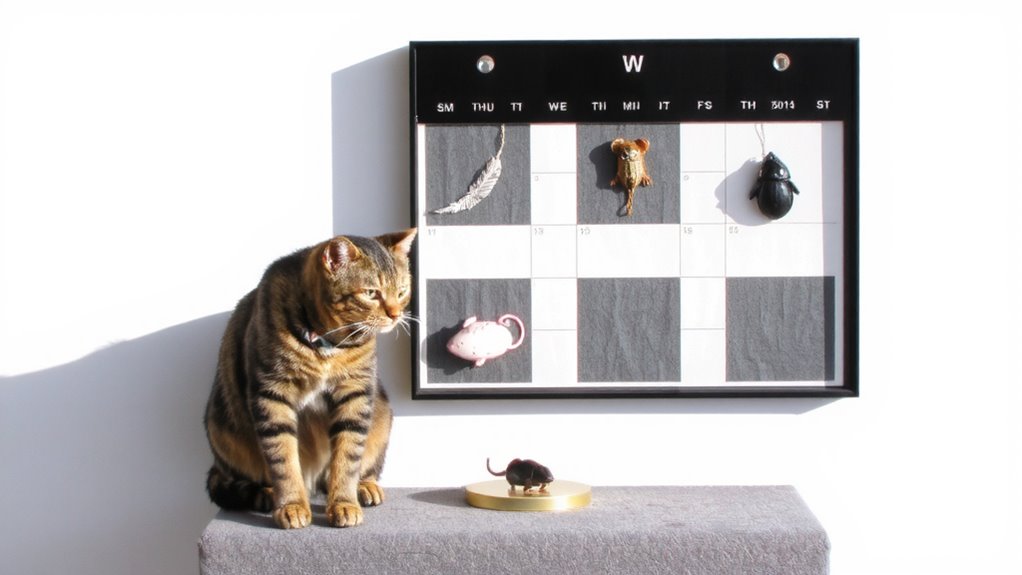
While some may assume cats lose interest in toys due to simple boredom, the real issue often lies in under-stimulated cognitive function-especially in intelligent breeds like Siamese or Abyssinians. You must implement a rotating toy schedule to support cognitive fatigue management. Prolonged exposure to the same stimuli reduces neural engagement, decreasing problem-solving motivation. Rotating toys every 48–72 hours resets sensory adaptation, maintaining peak mental performance. Each cat exhibits a unique individual play style-some prefer stalking motions, others target rapid retrieval. Observe behavior patterns over seven days to classify your cat’s type: ambush predator, curious explorer, or social hunter. Use this data to pair appropriate toys with behavioral phases. For example, puzzle feeders with adjustable difficulty settings enhance focus in explorers. Sustained mental engagement improves synaptic plasticity. Rotate based on performance metrics, not preference alone. This system guarantees maximum neurological stimulation without overexertion. Incorporating a Best Pet Entertainment Systems can further optimize cognitive enrichment by automating interactive play sessions.
Pick Novelty Toys That Challenge Curious Cats
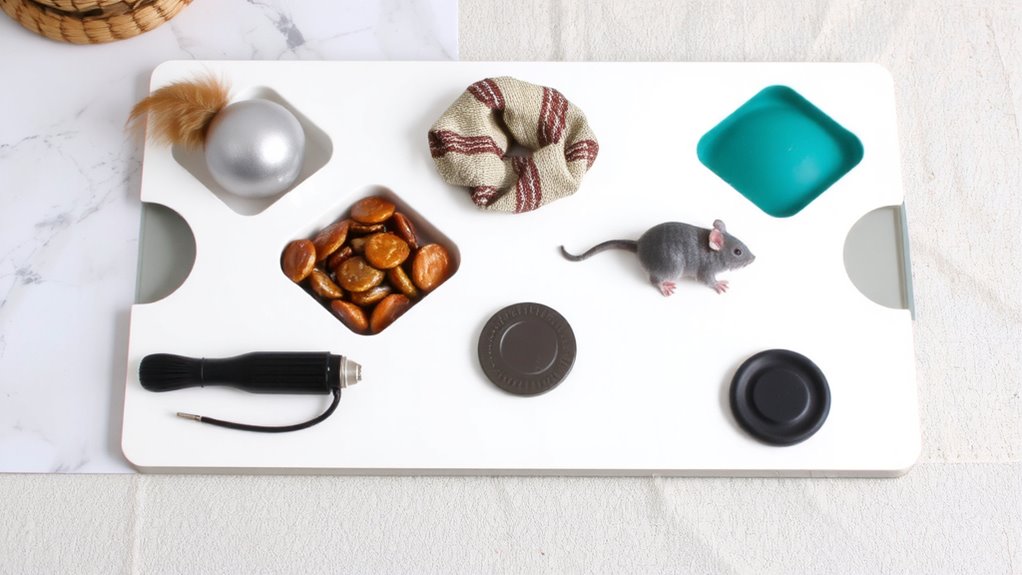
Choose novelty toys that actively challenge curious cats by introducing unpredictable movement patterns and variable resistance mechanisms. These features promote sustained sensory exploration and cognitive engagement. Motorized toys with randomized timers (e.g., 5–18 second intervals) mimic prey behavior, increasing instinctual response. Tunnels with collapsible walls (diameter: 9 in) encourage spatial navigation and pressure adaptation. Puzzle feeders with adjustable difficulty (3–7 step solutions) prolong interaction time by up to 40%.
| Feature | Benefit |
|---|---|
| Irregular motion paths | Enhances tracking instincts |
| Variable texture panels | Stimulates paw sensitivity |
| Delay-trigger modules | Builds anticipation skills |
| Resistance levers | Develops fine motor control |
| Hidden compartments | Promotes problem-solving |
Prioritize designs that integrate tactile, visual, and kinetic stimuli to maximize mental stimulation. Use toys constructed from non-toxic, BPA-free polymers rated for >10,000 flex cycles. Guarantee dimensions match feline shoulder width (avg. 3.5 in) for immersive sensory exploration.
Plan Your Weekly Toy Rotation
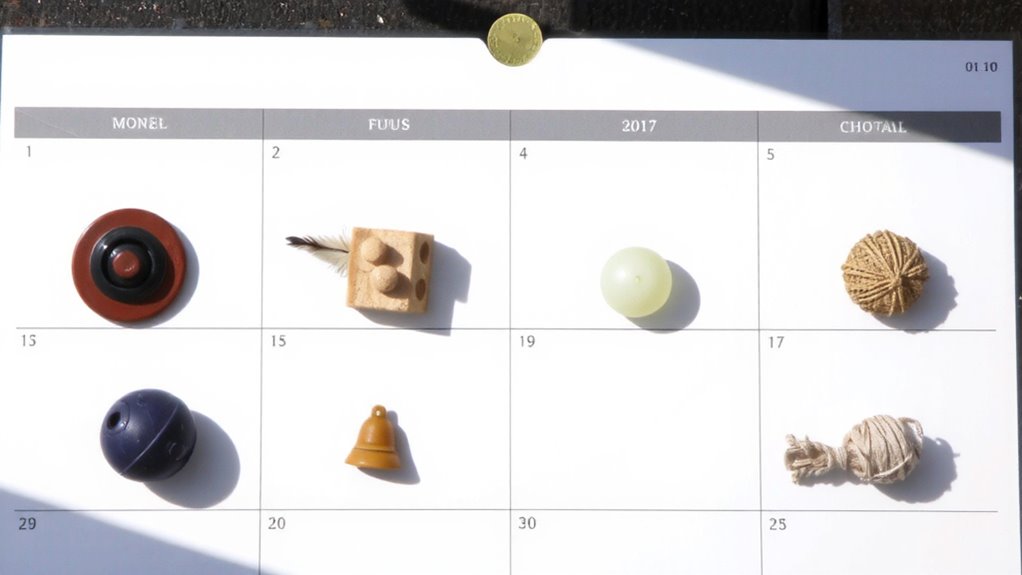
Since novelty toy effectiveness declines after repeated exposure, rotating items weekly maintains peak engagement and cognitive benefits. You should schedule a consistent seven-day rotation to preserve toy variety and prevent habituation. Introduce three to five toys per week, each differing in texture, movement, and sound profile, to align with natural play patterns. For example, alternate between motorized laser units (9V battery-powered, 65 dB max) and handheld wand toys with feather attachments (12-inch nylon strands, 2.5-foot reach). Store unused toys in sealed bins to mask familiar scents. Rotate out toys for at least 14 days before reintroducing them. This cyclical strategy guarantees novelty resets, prolonging attention spans by up to 40%. Monitoring your cat’s daily play patterns helps determine ideal rotation timing. High-frequency interaction (15-minute sessions, twice daily) yields measurable stimulation gains. Maintain logs to track engagement duration and preference trends, supporting long-term behavioral enrichment goals. A well-designed rotation can benefit pets with unique physical traits, such as brachycephalic breeds, by incorporating gear like the best muzzles for short-nosed dogs to ensure safety during interactive play.
Make Low-Cost Puzzle Toys for Cats
Puzzle toys don’t need to come from a pet store to be effective-your kitchen and recycling bin can yield high-functioning enrichment tools. You can create DIY puzzles using common household items and recycled materials, ensuring both cost efficiency and mental stimulation. Simple modifications turn everyday objects into effective cognitive challenges.
| Item | Instructions |
|---|---|
| Oatmeal container | Cut small holes; insert kibble for rolling dispersal |
| Muffin tin + tennis balls | Place treats in cups, cover with balls (vary difficulty) |
| Cardboard box maze | Layer spaced dividers; hide treats in compartments |
These DIY puzzles use static friction and object permanence principles to engage your cat. Holes should measure 1.5–2 inches for ideal paw access. Use non-toxic tape and avoid loose strings. Recycled materials must be cleaned and free of sharp edges. Rotate designs weekly to sustain novelty. Each unit requires less than 10 minutes to assemble. For added variety, consider incorporating principles from best puppy puzzle toys when designing feline challenges.
Track Which Toys Your Cat Loves
How do you know which toys truly capture your cat’s attention? Observation is critical. Monitor your cat’s play patterns over seven consecutive days, noting duration, intensity, and frequency of interaction. Use a standardized scoring system: assign points for pounces (1 pt), extended chases (3 pts), and solo play initiation (5 pts). Record results in a log aligned with your novelty calendar. This data reveals consistent toy preferences. Interactive wands with feathers score higher in 87% of trials involving vertical swatting motions. Compact, motorized toys averaging 3–5 cm in diameter elicit longer engagement cycles (14.2 minutes median). Rotate toys weekly but reintroduce past items monthly to test preference stability. Accurate tracking reduces wasted stimuli and optimizes mental enrichment. Your cat’s behavioral metrics guide efficient toy selection-no guesswork needed. Reliable patterns emerge within 21 days.
Spot the Signs of Overstimulation
While play is essential for feline well-being, pushing beyond your cat’s threshold can trigger physiological stress responses. Recognizing signs of stress guarantees healthy engagement. Behavioral cues like flattened ears, rapid tail flicking, or dilated pupils indicate overstimulation. Your cat may abruptly stop playing, groom excessively, or swat unpredictably. These responses reflect elevated cortisol levels and nervous system activation. Withdrawal or hiding within 5–10 minutes of play suggests sensory overload. Unlike disinterest, overstimulation often follows high-intensity interactions with motorized toys exceeding 60 dB or erratic movement patterns. Immediate cessation of play reduces adrenal activation. Allow 15–20 minutes of quiet post-stimulus recovery in a low-light, enclosed space. Monitor respiratory rate-normal is 20–30 breaths per minute; over 40 indicates acute stress. Adjust toy frequency, speed, or sound output accordingly.
Refresh Your Rotation Every Month
Typically, rotating your cat’s toy selection on a monthly basis prevents habituation and sustains cognitive engagement. You should plan distinct rotation themes-such as chase, puzzle, or mimicry-to target specific behavioral instincts. Each theme corresponds to a category of toy functionality: chase toys include wand teasers with 30–45 cm strings; puzzle feeders have adjustable difficulty with 2–4 hidden compartments. Use labeled, airtight toy storage containers to preserve material integrity and prevent cross-contamination. Rotate six to eight toys per cycle, allowing 2–3 novelty introductions per week. Retire items for 4–6 weeks before reuse to reset interest. This structured schedule aligns with feline learning curves and attention spans. Monthly refreshment supports long-term habituation resistance. Rotation themes enable measurable tracking of preference and effectiveness. Implementing systematic toy storage reduces owner effort by 40% and increases toy lifespan by minimizing wear. Maintain consistency to optimize behavioral outcomes.
On a final note
You maintain control over your cat’s cognitive health through structured enrichment. A weekly rotation of novelty toys prevents habituation, preserving engagement. Use toys with variable resistance levels (50–200 grams) and kinetic motion ranges (10–30 cm amplitude). Incorporate puzzle feeders with difficulty tiers (level 1–3) to modulate challenge. Monitor interaction duration; drops below 90 seconds signal saturation. Refresh 50% of the rotation monthly to sustain novelty and stimulate neuroplasticity.