Cleaning Corneal Abrasions in Cats Using Saline Solution Only
Flush your cat’s eye immediately with sterile, preservative-free saline solution to clean corneal abrasions. Use 10–20 mL delivered via syringe (no needle) or eye cup, rinsing for 30–60 seconds per eye. The solution must be at room temperature to prevent thermal shock. This removes debris and supports healing by maintaining tear film integrity. Proper technique guarantees effective decontamination while minimizing stress. You’ll learn the correct way to restrain your cat and apply saline safely.
Notable Insights
- Flush the affected eye with preservative-free sterile saline solution to remove debris and reduce irritation.
- Use a 10–20 mL syringe without a needle to deliver a gentle, consistent stream of saline.
- Rinse for 30–60 seconds per eye, ensuring complete coverage of the corneal surface.
- Administer saline at room temperature to prevent thermal shock to the injured eye.
- Repeat flushing as needed, but seek veterinary care if signs persist beyond a few hours.
What Is a Cat Corneal Abrasion?
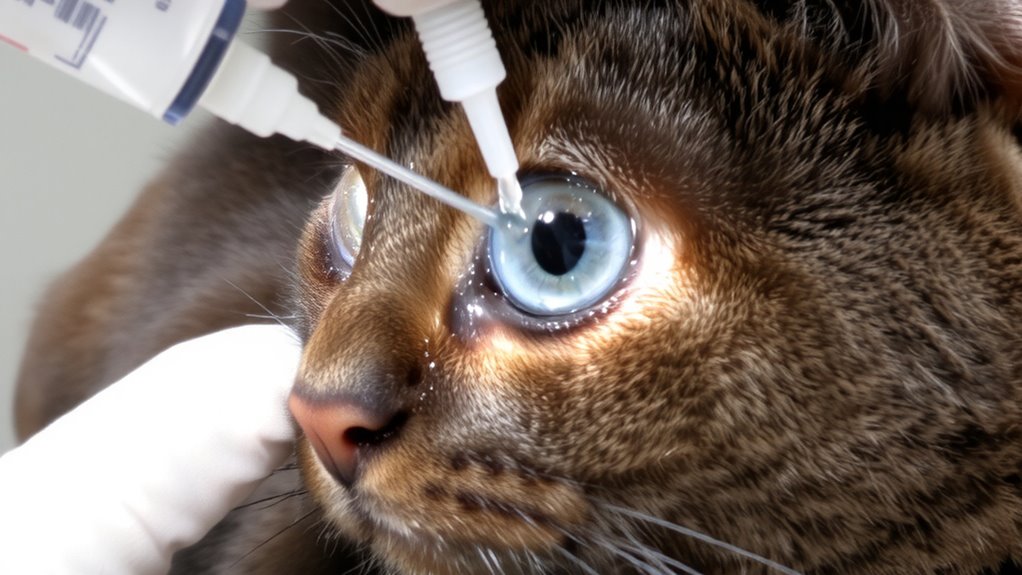
A corneal abrasion in cats is a scratch or superficial wound on the outermost layer of the eye, known as the cornea. This delicate part of cat anatomy plays a vital role in maintaining clear vision and protecting inner eye structures. The cornea consists of five layers, with the epithelium being the outermost and most vulnerable to trauma. Because of its dense nerve supply, even minor damage causes significant discomfort. Understanding feline eye structure helps you recognize how quickly an abrasion can compromise ocular health. The cornea lacks blood vessels, relying on tear film and aqueous humor for nourishment, which slows healing if disrupted. Immediate intervention with sterile saline solution helps remove debris without irritating the damaged surface. Proper rinsing supports natural recovery by preserving the integrity of surrounding tissues. You must act promptly yet carefully to avoid worsening the injury.
Signs of an Eye Scratch in Cats
Discomfort is often the first clue your cat has an eye scratch. Your cat may paw at the eye or keep it partially closed. A swollen eyelid is a common physical sign, resulting from inflammation due to corneal irritation. The swelling typically appears within hours of injury and can affect one or both lids. Excessive blinking, known as blepharospasm, occurs as a protective reflex to minimize exposure and further damage. Blink rates may increase from the normal 1–2 times per minute to 10 or more. Photophobia often accompanies these symptoms, causing your cat to avoid bright areas. You might also notice tearing or ocular discharge, though the eye surface remains clear without ulceration in mild cases. These signs indicate superficial trauma requiring prompt care. Always examine the eye in natural light, supporting the head gently to prevent movement. Do not apply pressure.
Flush the Eye With Saline Immediately
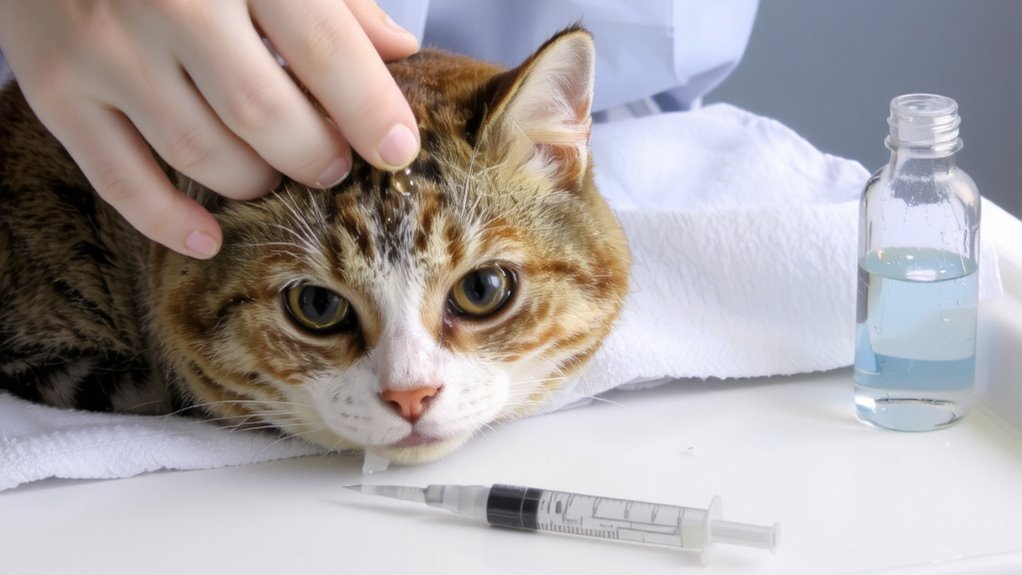
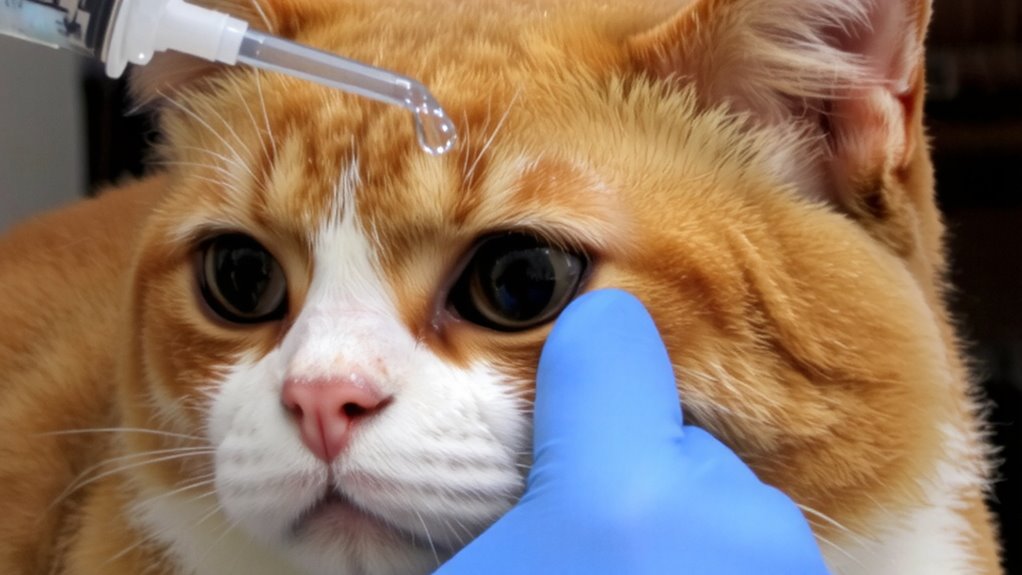
Always flush the eye with sterile saline solution at the first sign of a corneal abrasion to remove debris and reduce irritation. This initial step is essential for effective eye irrigation. Use preservative-free saline to avoid chemical irritation. Saline rinsing helps maintain the eye’s natural pH and osmolarity, supporting corneal healing. Deliver the solution at room temperature to prevent thermal shock. Use a 10–20 mL syringe without a needle or a sterile eye cup for consistent flow. Administer the rinse gently to avoid further trauma. Flush for 30 to 60 seconds per eye, ensuring complete coverage. Proper technique dislodges foreign material effectively. Saline rinsing does not replace veterinary care but stabilizes the condition. Immediate irrigation may reduce healing time by up to 48 hours. Always use single-dose saline vials or unopened bottles to maintain sterility. Repeated exposure to contaminants delays recovery.
How to Hold Your Cat for Eye Care
Once the eye’s surface is irrigated, securing your cat properly becomes the next priority. Proper cat handling guarantees safety and precision during care. Support your cat’s head gently but firmly to maintain correct eye positioning. Use a towel wrap if needed to minimize movement. Keep your cat facing forward, avoiding neck twisting that could alter ocular alignment.
| Step | Action |
|---|---|
| 1 | Cradle head with one hand, stabilizing the bridge of the nose |
| 2 | Use your thumb to gently hold the lower eyelid |
| 3 | Keep fingers clear of the cornea to prevent pressure |
| 4 | Position at eye level to maintain proper angle |
| 5 | Work quickly to reduce stress and increase accuracy |
Effective cat handling reduces motion artifacts. Proper eye positioning guarantees saline reaches the intended site without contamination.
Step-by-Step: Rinse the Eye at Home
If you’ve properly restrained your cat and positioned its head, you’re ready to begin rinsing the affected eye with sterile saline solution. Hold the eyelids open gently to guarantee full exposure. Use a syringe without a needle or a sterile eyewash bottle to deliver a steady, low-pressure stream. Aim the flow from the inner to outer corner of the eye to flush debris effectively. Use at least 5–10 ml per rinse to guarantee thorough cleaning. Sterile 0.9% sodium chloride solution matches natural tear composition, promoting eye comfort and minimizing irritation. Avoid tap water-it’s not isotonic and can damage corneal cells. Practice safe handling by keeping movements calm and deliberate. Wrap your cat in a towel to limit movement if needed. Never reuse saline from an opened container. Perform rinsing for no more than 30 seconds per eye to prevent stress. Consistent technique supports healing while reducing the risk of further injury.
When to See the Vet for Eye Injuries
How do you know when a cat’s eye injury goes beyond what home care can handle? Look for emergency symptoms like persistent squinting, cloudy corneas, or excessive discharge. These signs demand immediate professional diagnosis. Saline rinsing helps minor abrasions, but it won’t treat infections or ulcers. If you notice redness lasting over 24 hours or the cat avoids light, vet evaluation is critical. Early intervention prevents permanent damage.
| Symptom | Action Needed |
|---|---|
| Squinting or closed eye | See vet within 12 hours |
| Cloudy or blue cornea | Seek emergency symptoms assessment |
| Yellow/green discharge | Requires professional diagnosis |
| Bleeding or tearing | Visit clinic immediately |
| No improvement after 48 hours | Schedule vet exam promptly |
Prevent Cat Eye Scratches at Home
Why do so many cat eye injuries happen right in the safety of your home? Most occur during play or climbing on poorly designed cat furniture. Sharp edges, unstable platforms, or overcrowded structures increase collision and scratch risks. Effective scratch prevention starts with selecting cat furniture built with smooth, rounded edges and non-abrasive materials. Guarantee platforms are at least 18 inches wide and spaced 10–12 inches vertically to reduce missteps. Use sisal-covered posts, not carpet remnants, which can shed fibers into eyes. Place furniture away from high-traffic areas to limit disturbances. Trim claws every 10–14 days to reduce injury severity. Install corner guards on shelves and avoid dangling strings near the face. Regularly inspect all structures for loose parts or fraying. Proper scratch prevention isn’t just about behavior-it’s about engineered safety. Design matters.
On a final note
You should clean your cat’s corneal abrasion with sterile saline solution only-no additives, no exceptions. Use preservative-free 0.9% sodium chloride ophthalmic solution at room temperature. Flush gently for 30–60 seconds using a 5–10 mL syringe without a needle. Saline loosens debris without irritating exposed nerves. This method supports natural healing but won’t treat infection. If squinting or tearing persists past 24 hours, see a vet.