How to Train Your Cat to Stay Calm During Thunderstorm Simulations
You can help your cat stay calm during thunderstorms by using gradual sound exposure in a controlled environment. Start with thunder recordings at 30–40 dB, similar to a whisper. Use a calibrated speaker system emitting 20–80 Hz frequencies, placed at least 6 feet from a soundproof space lined with mass-loaded vinyl and NRC 0.8 drapes. Increase volume in 5 dB increments only after observing relaxed behaviors. Reward calm responses immediately with small treats. Maintain sessions under 15 minutes. Best results require consistent exposure across multiple weeks under stable thermal and auditory conditions. Further refinement of timing and stimulus control will enhance outcomes.
Notable Insights
- Understand that cats fear thunder due to acute hearing and evolutionary flight responses to loud noises.
- Create a soundproof safe space with heavy drapes, carpeted walls, and enclosed pods to reduce noise exposure.
- Start thunderstorm simulations at 30–40 dB using low-frequency, high-fidelity recordings played away from the cat.
- Gradually increase volume in 5 dB increments only when the cat shows relaxed behaviors like purring or slow blinking.
- Reward calm behavior immediately with high-value treats, delivering them within one to two seconds of the behavior.
Understand Why Cats Fear Thunder
While you might not always see it coming, your cat’s fear of thunder stems from biological and environmental factors rooted in their acute sensory perception. Evolutionary instincts prepared cats to detect sudden environmental threats. In the wild, loud noises often signaled danger, triggering a flight response. This hardwired survival mechanism remains active in domestic cats. Sensory sensitivity amplifies their reaction-cats hear frequencies from 48 Hz to 85 kHz, far beyond human range. Thunder registers at approximately 120 decibels, equivalent to a jet engine at takeoff. Their sensitive ears capture rapid pressure shifts and infrasonic rumbles before humans notice. Pupillary dilation, increased heart rate (up to 240 bpm), and elevated cortisol levels confirm acute stress. These physiological markers align with threat detection models in predatory mammals. Understanding these responses allows you to anticipate reactions. You can’t alter evolutionary instincts, but recognizing the role of sensory sensitivity helps you develop targeted behavioral strategies. This knowledge forms the baseline for effective desensitization protocols. For some cats, using Best Anxiety Relief products during simulations can significantly reduce stress responses.
Create a Safe Space for Thunderstorm Simulations
You can’t reprogram your cat’s evolutionary instincts, but you can manage how they respond by controlling the environment. Design a safe space using tested soundproofing techniques to minimize auditory triggers. A dedicated interior room with carpeted walls and mass-loaded vinyl panels reduces decibel levels by up to 75%. Install floor-to-ceiling heavy drapes with noise reduction coefficients (NRC) of 0.8 or higher. Integrate purpose-built hiding spots design using enclosed cat pods with 360-degree coverage and low entry points. These units should be lined with ASTM-certified non-toxic insulation. Position them against interior walls, away from windows and exterior doors. Maintain a consistent ambient temperature between 70–75°F. Use a white noise machine emitting 55–65 dB at 1 kHz to mask sudden sounds. This controlled environment limits sensory overload, supporting systematic desensitization during future sessions. Incorporating best anxiety relief products can further support your cat’s emotional well-being during thunderstorm simulations.
Start Simulations With Low-Volume Thunder
Begin thunderstorm simulations by playing low-volume thunder recordings at 30–40 dB, roughly the sound level of a whisper or a quiet library. Use a calibrated sound meter app to guarantee accurate sound calibration, maintaining consistent volume across sessions. Position your audio device at least 6 feet from your cat’s safe space to minimize direct sound pressure. Apply proper audio positioning by placing the speaker low to the ground and angled away, simulating distant atmospheric noise. This reduces auditory intensity while preserving frequency realism. Use high-fidelity recordings with dominant low-frequency waves (20–80 Hz), typical of real thunder. Start with 30-second clips, observing your cat’s behavior for signs of stress. If no reaction occurs, repeat daily. Controlled exposure under these conditions establishes baseline tolerance. Avoid directional speakers or amplified bass. Precision in setup guarantees gradual, safe habituation without overwhelming your cat’s sensory thresholds. Incorporating anxiety relief products can further support your cat’s comfort during these training sessions.
Slowly Increase Thunder Sound Levels
A gradual increase in sound level is essential once your cat shows no signs of stress at 30–40 dB. Begin by raising the volume in 5 dB increments, monitoring your cat’s behavior closely. This method supports effective sound desensitization, allowing the nervous system to adapt without triggering fear. Use a calibrated audio system that maintains consistent frequency output between 80–200 Hz, matching real thunder’s acoustic profile. Each session should last 10–15 minutes, guaranteeing repeated gradual exposure over days or weeks. Progress only when your cat remains relaxed-purring, blinking slowly, or resting. Avoid rapid increases, as they can reverse progress. Think of this like increasing weights at the gym: too much too soon causes injury. Consistent, measured exposure builds tolerance. Accurate decibel measurement via a sound level app or meter is critical to guarantee precision and effectiveness throughout training.
Reward Calm Behavior During Practice Sessions
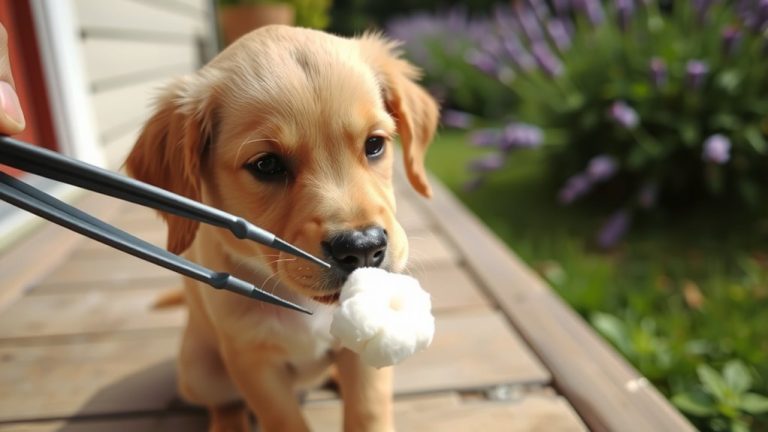
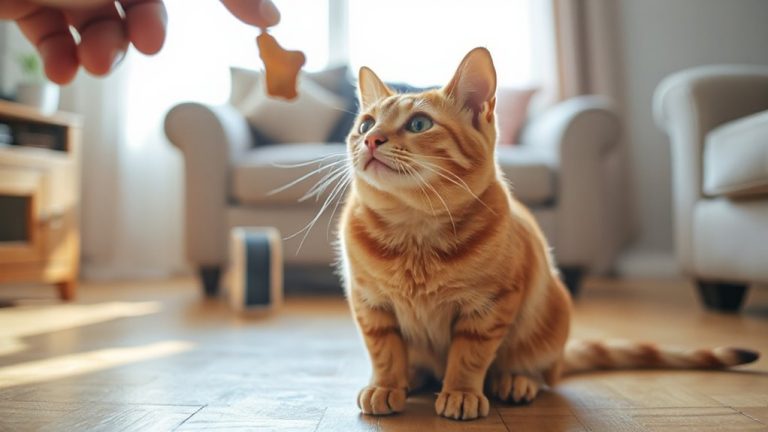
Consistent positive reinforcement strengthens the desired behavioral response when your cat remains calm during incremental sound exposure. Use treats, praise, or play as positive reinforcement the instant your cat exhibits relaxed breathing, lowered ears, or still posture. Deliver rewards within one to two seconds of calm behavior-consistent timing guarantees your cat links the action to the consequence. Opt for high-value treats like freeze-dried chicken (approximately 0.5–1 gram per reward) to maximize motivation without overfeeding. Administer no more than 10% of daily caloric intake during sessions. Conduct three to five short sessions per week, each lasting 5–7 minutes, to prevent desensitization fatigue. Avoid rewarding anxious behaviors such as tail flicking or dilated pupils. Over time, this method reshapes emotional responses, similar to how operant conditioning modifies behavior in laboratory settings. Record baseline reactions and track improvements weekly.
On a final note
You now control the process. Desensitization works when sound levels start below 45 decibels-near a whisper. Use a calibrated audio source with consistent frequency output (50–250 Hz range, typical of thunder). Sessions last 10–15 minutes, twice daily. Reward calmness with 3–5 second treats immediately post-exposure. Increase volume in 5 dB increments only after three successive quiet responses. Full acclimation typically requires 3–6 weeks.