How to Introduce Your Puppy to People With Walking Frames
Keep your puppy on a leash and start exposure 10–15 feet away from the walking frame. Its 4-foot height and 3-foot width move unpredictably, triggering fear. Allow observation with soft eyes and loose posture before advancing. Use ½-inch freeze-dried liver treats within 1–2 seconds of calm behavior. Approach in 1-foot increments, pausing 在玩家中
Notable Insights
- Start by letting your puppy observe the walking frame from a distance of 10–15 feet to prevent overwhelm.
- Reward calm behavior like soft eyes and loose posture with high-value treats within 1–2 seconds.
- Gradually decrease distance in 1-foot steps, pausing 2 minutes at each to monitor stress signals.
- Use a leash to control proximity and ensure safety during repeated, short 5–7 minute sessions.
- Expose your puppy to various frame types and users to build familiarity with different sounds, sizes, and movements.
Why Puppies Fear Walking Frames
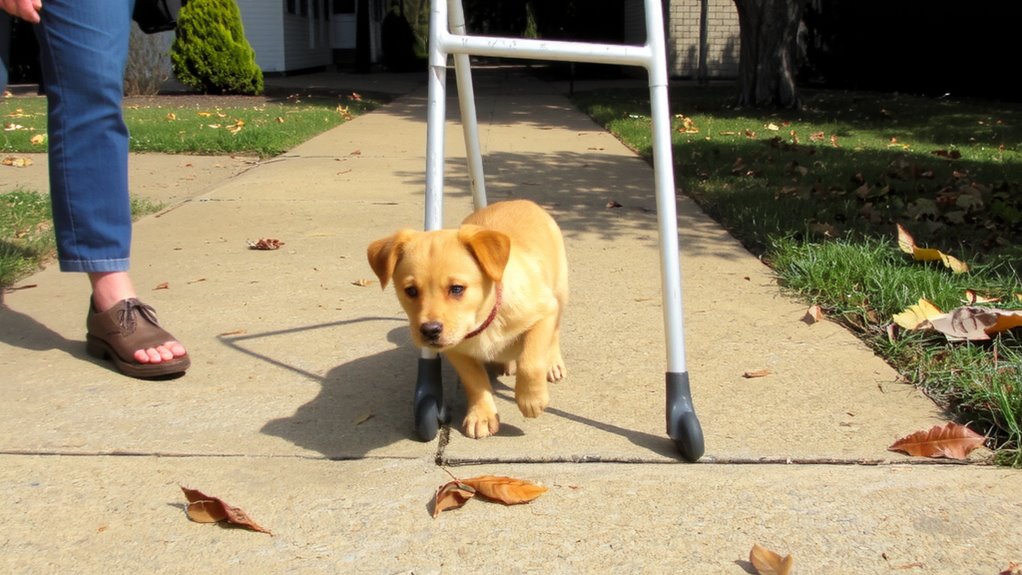
Why do some puppies freeze or retreat when they see a walking frame? The unfamiliar shape and movement trigger innate caution. Metal clatter from the frame’s joints produces sharp, unpredictable sounds. These sudden noises exceed 70 decibels, comparable to barking, which amplifies a puppy’s stress response. The rigid, angular design-often over 3 feet wide and 4 feet tall-moves in erratic, jerky patterns. This motion mimics predator-like unpredictability, activating fear circuits. Puppies interpret this as mobility anxiety, a conditioned aversion to objects that move without clear signals. The frame’s aluminum legs reflect light intermittently, further confusing depth perception. Wheels, typically 5 to 7 inches in diameter, rotate uneven insurgent rhythms on pavement. This disrupts a puppy’s ability to anticipate movement. These stimuli combine neurologically, stimulating the amygdala and triggering flight or freeze behaviors. Understanding these responses helps in structured, gradual desensitization.
Let Your Puppy Observe From a Distance
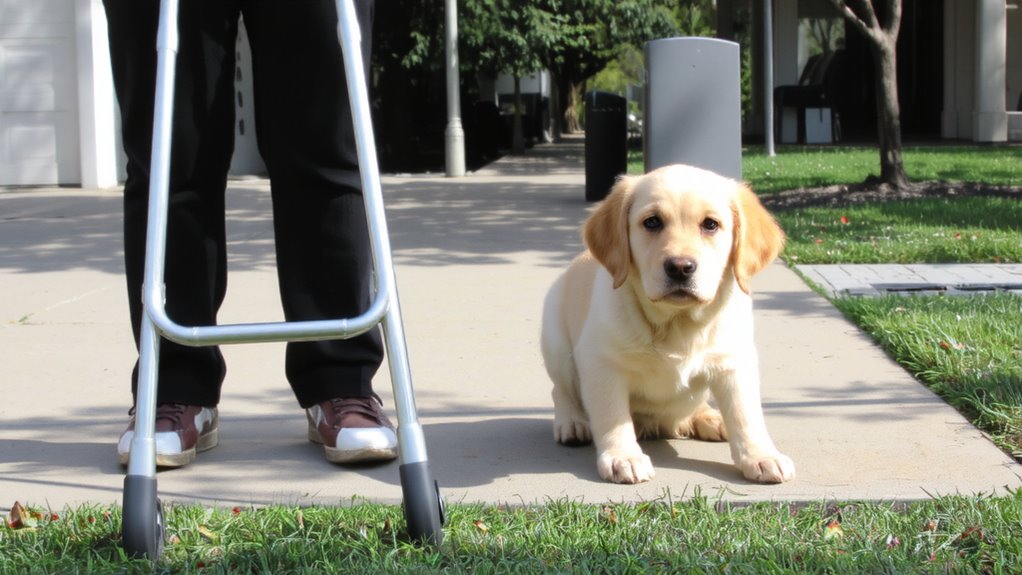
While your puppy may still feel uncertain, starting observation from a safe distance helps build familiarity without triggering fear. Begin visual exposure at 10–15 feet, making certain the walking frame user moves slowly and predictably. Maintain this distance until your puppy shows neutral or relaxed body language-soft eyes, loose posture, and open mouth. Watch puppy body language closely; stiff muscles, pinned ears, or avoidance indicate stress. Limit initial sessions to 5–7 minutes to prevent overload. Use a leash to control proximity and guarantee safety. Repeat daily to reinforce neutral associations. Gradual distance reduction should occur only after three consistent, calm sessions. Visual exposure at this stage is passive-no interaction occurs. Think of it like calibrating a sensor: repeated, controlled input improves response accuracy. This structured approach guarantees your puppy adapts without overwhelming its developing nervous system.
Reward Calmness Around the Frame
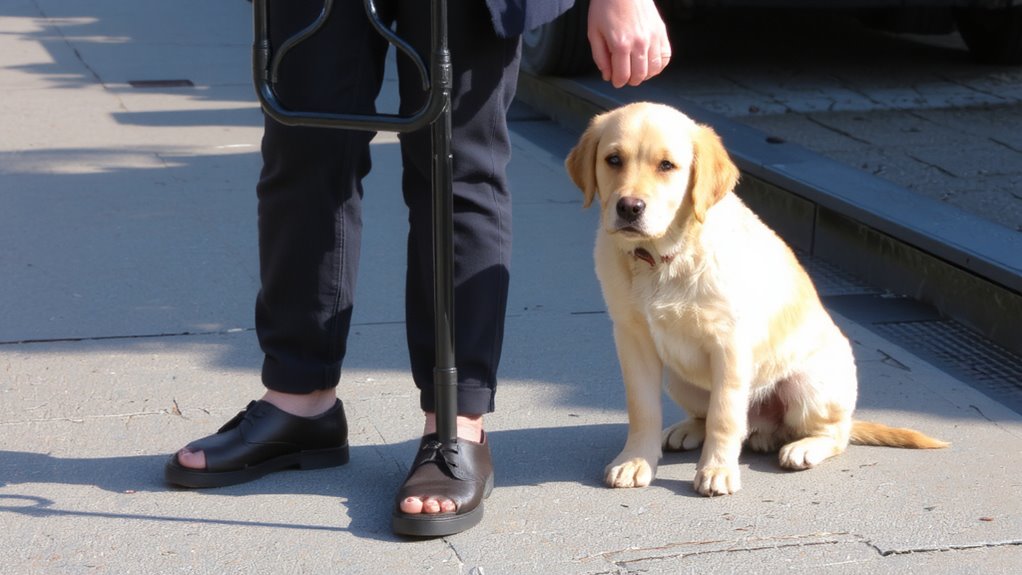
Once your puppy consistently shows relaxed body language from a distance, you can begin reinforcing calm behavior in closer proximity to the walking frame. Use positive reinforcement to reward stillness, soft eyes, and loose posture near the object. Offer small, high-value treats-such as freeze-dried liver cubes measuring ½ inch-immediately after calm behavior occurs. Consistency training is essential; sessions should occur at least twice daily, lasting no more than five minutes to maintain focus. Deliver rewards within 1–2 seconds of the desired behavior to strengthen the association. The frame should remain stationary during these phases to reduce sensory load. Avoid petting or verbal praise if it excites the puppy-stick to food-based reinforcers. Keep a loose leash to prevent tension signals. Calmness must be repeated across five consecutive exposures before progressing. This structured approach builds reliable responses through repetition and precise timing.
Move Closer in Small Steps
If your puppy remains calm at a distance of five feet from the stationary frame, you can begin closing the gap in controlled increments. Use gradual exposure to prevent overstimulation. Approach in steps of one foot, pausing two minutes at each interval. Reward calm behavior immediately with positive reinforcement such as treats or soft verbal praise. Monitor your puppy’s body language closely-relaxed posture indicates readiness; tension signals the need to halt or retreat.
| Distance (ft) | Duration (min) |
|---|---|
| 5 | 2 |
| 4 | 2 |
| 3 | 2 |
| 2 | 2 |
Maintain consistency in timing and reward delivery. Each session should last no longer than eight minutes to avoid fatigue. Controlled proximity paired with predictable outcomes builds reliable associations. Never rush progression-success depends on your precision and patience.
Practice With Different Frames and Users
You’ve established your puppy’s comfort with a stationary walking frame at close range, using measured steps and consistent reinforcement. Now introduce variation in frame materials, such as aluminum, steel, and carbon fiber, each producing distinct auditory and visual stimuli. Aluminum frames are lightweight and reflective, often making faint tapping sounds on pavement. Steel models are heavier, with a lower resonance frequency upon contact. Expose your puppy to at least three models differing in height, width, and material composition to build adaptive recognition. User diversity is critical: include adults and seniors, varying in gait speed and posture. Static and slow-motion approaches simulate real-world conditions. Rotate handlers to prevent single-person association. Controlled exposure across ten structured sessions reduces overgeneralization. Each session should last 8–12 minutes, maintaining a 3-meter start distance, closing gradually to 1 meter.
Watch for Calm Behavior Before Approaching
Though some handlers may be keen to initiate contact, waiting for clear signs of calm behavior guarantees a controlled and predictable introduction. You must prioritize patient observation before allowing interaction. Look for relaxed body posture, slow blinking, and a loose tail-these indicators confirm your puppy is at ease. Avoid forcing encounters; instead, let the person remain stationary while your puppy approaches voluntarily. Use positive reinforcement to reward calmness-offer small treats and quiet praise when your puppy remains composed. This strengthens desired behavior without overstimulation. Movements near walking frames can trigger alertness, so maintain a 3- to 5-foot distance initially. Successful introductions rely on timing and consistency. Each session should last 5–7 minutes to prevent fatigue. Document responses to refine future training. Calm beginnings build reliable long-term behavior.
On a final note
You’ve successfully introduced your puppy to walking frames. Gradual exposure reduces fear. Maintain a minimum distance of six feet initially, decreasing by two-foot increments as calm behavior persists. Use high-value treats, such as small pieces of boiled chicken, delivered within 1.5 seconds of relaxed observation. Reinforce neutral responses consistently. Generalize training across at least three frame types-aluminum, steel, wheeled-and multiple users. This guarantees reliable, safe behavior in real-world environments.