Using Positive Reinforcement for Puppies Meeting Service Dogs
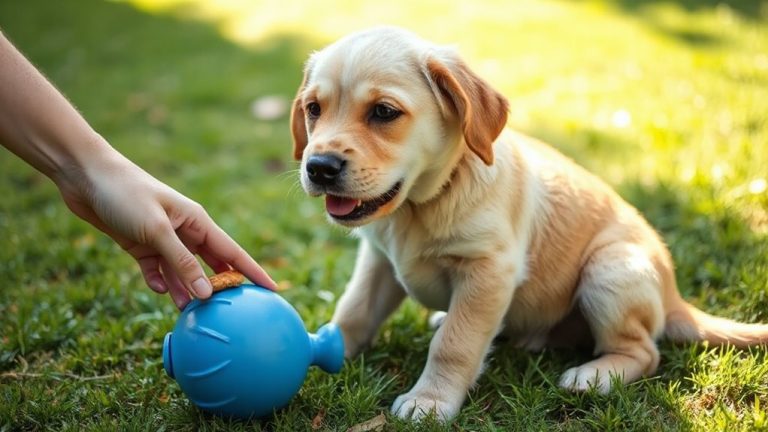
Use high-value treats like boiled chicken or freeze-dried liver to reinforce calm behavior within 0.5–2 seconds during puppy-service dog introductions. Maintain a 6-foot distance using a ½-inch nylon leash and front-clip harness. Conduct two 10–15 minute sessions daily, applying marker-based reinforcement with a “yes” or click. Reward loose leash posture, relaxed ears, and slow tail wags. Continue this structured approach to build reliable, stress-free interactions over time.
Notable Insights
- Use high-value treats to reward calm behavior within 0.5–2 seconds of polite interactions with service dogs.
- Train puppies to maintain a 6-foot distance using positive reinforcement and a front-clip harness.
- Recognize stress signals like lip licking, yawning, or whale eye and end interactions before anxiety escalates.
- Conduct short 5–7 minute sessions in low-distraction areas, gradually increasing exposure intensity.
- Use marker-based reinforcement (click or “yes”) immediately followed by treats to solidify desired greeting behavior.
Prepare Your Puppy for a Service Dog Meet
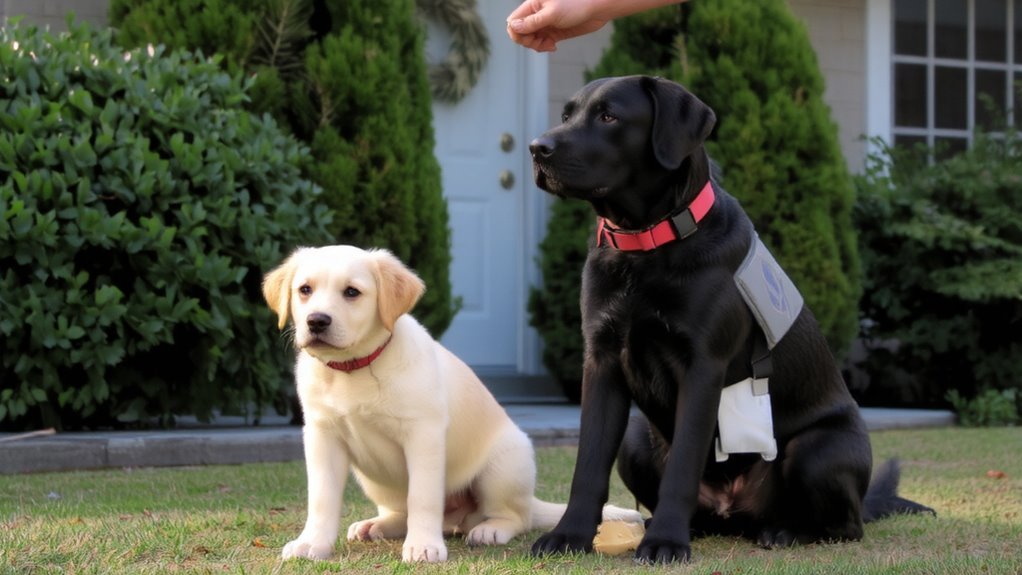
While proper preparation begins well before the actual event, getting your puppy ready for a service dog meet hinges on structured exposure and consistent routine. Begin by aligning with the puppy socialization timeline: introduce controlled interactions between 8–16 weeks, when neural plasticity peaks. Use positive reinforcement to shape responses, offering treats within 1–2 seconds of desired behavior. Expose your puppy to leash manners, focus cues, and calm greetings-skills foundational to service dog etiquette rules. Practice maintaining a 6-foot distance from working service dogs; direct interaction is prohibited. Train a “focus” command using a high-value treat lure. Sessions should last 10–15 minutes, twice daily, to avoid cognitive overload. Use a ½-inch nylon training leash and a front-clip harness to manage pulls. Consistency across environments-home, sidewalk, park-builds reliable behavior. Preparation isn’t situational-it’s cumulative. A well-rounded approach can include a dog training kit to streamline essential tools and techniques.
Read Your Puppy’s Stress Signals
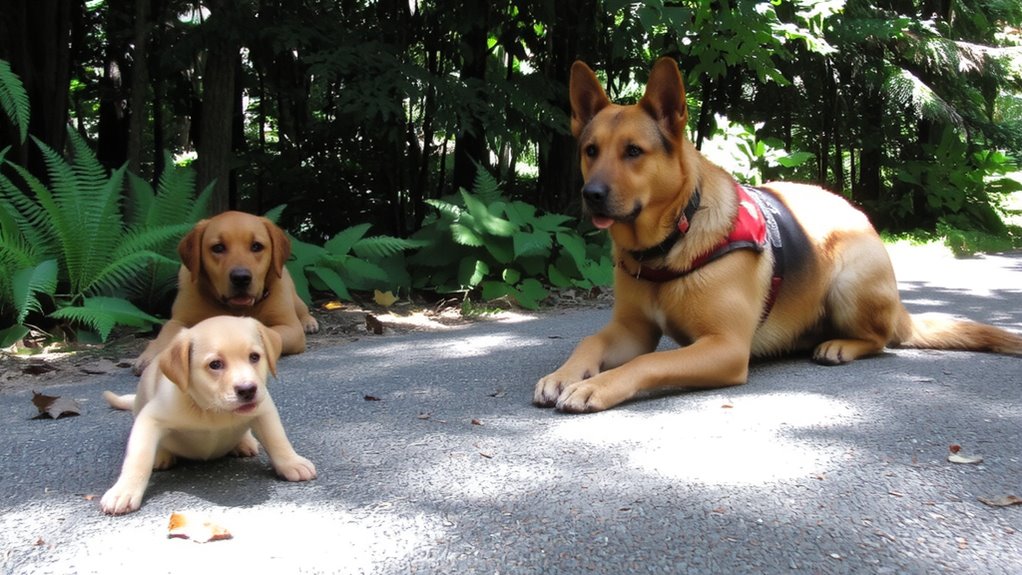
How does your puppy communicate discomfort before it escalates into avoidance or reactivity? Your puppy uses body language to signal stress. Recognizing these stress cues early prevents negative associations. A slow, low tail wag differs from an excited one-this subtle shift indicates uncertainty. Lip licking, yawning, or turning the head away are common stress cues even in quiet environments. Raised hackles or a lowered body posture suggest arousal or anxiety. Pupil dilation and rapid blinking are physiological responses to stress. Freeze behaviors, where your puppy stops moving abruptly, signal internal conflict. Monitor ear position: pinned-back ears often reflect fear. If your puppy lifts a paw or shifts weight rearward, it’s evaluating threat levels. These signals precede vocalizations or retreat. You must observe continuously, as cues are brief and context-dependent. Accurate interpretation guarantees timely intervention, maintaining emotional regulation during service dog encounters.
Reward Calm Greetings Immediately
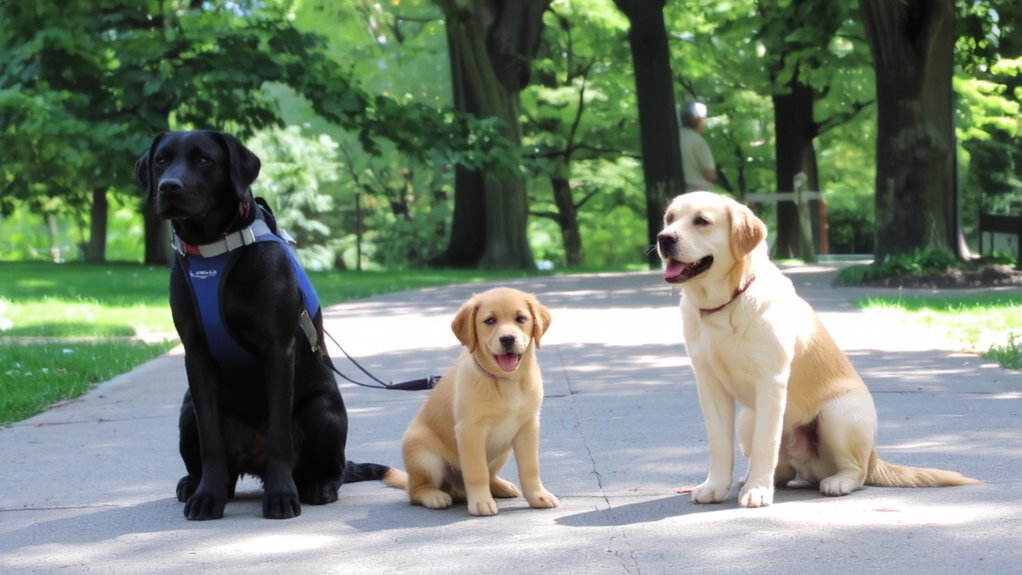
When your puppy approaches a new person or dog without rushing, barking, or pulling, that’s the moment to act. Immediate rewards reinforce calm behavior at its peak expression. Use high-value treats-such as boiled chicken or freeze-dried liver-delivered within 0.5 to 2 seconds of the desired action. This precise timing strengthens associative learning through operant conditioning. Calm behavior includes loose leashes, relaxed ears, and slow tail wags-biomechanical indicators of low stress. Deliver rewards verbally and physically at the puppy’s level to avoid height-induced anxiety. Frequency matters: reinforce each instance consistently across 80–90% of trials to achieve acquisition. Over time, shift from continuous to variable reinforcement schedules to increase response durability. Immediate rewards bridge intent and action, ensuring your puppy links tranquility with positive outcomes. This structured approach accelerates socialization, especially critical during the primary 8–16 week developmental window.
Train Polite Puppy Greetings in 5 Steps
One effective method for shaping socially appropriate greetings in puppies involves a structured five-step training sequence grounded in behavioral science. First, begin training during ideal socialization timing-between 3 and 14 weeks of age-to maximize neural imprinting. Second, introduce your puppy to calm service dogs in controlled environments, minimizing overstimulation. Third, identify your puppy’s dominant play style-predatory, assertive, or submissive-since it influences response to corrections. Fourth, use marker-based positive reinforcement: click or say “yes” within 0.5 seconds of calm behavior, then deliver a high-value treat. Fifth, gradually increase stimulus intensity over sessions, ensuring 80% success rate per trial. Each session should last 5–7 minutes, twice daily, to maintain attention and prevent fatigue. This protocol leverages operant conditioning, shaping polite greetings through consistent, timed rewards aligned with developmental milestones and individual puppy play styles.
Stop These 5 Mistakes When Introducing Puppies
Why do so many puppy introductions go wrong? You’re likely repeating common errors that undermine socialization. First, don’t force face-to-face meetings; close proximity increases stress, leading to leash reactivity causes like barrier frustration. Maintain a 10–15 foot distance initially to allow sniffing and observation without pressure. Second, avoid misreading normal play as aggression-puppy dominance myths falsely suggest puppies seek control, but they’re learning social cues. Third, don’t allow prolonged interactions; limit sessions to 3–5 minutes to prevent overstimulation. Fourth, skipping gradual exposure-such as controlled visual access through gates-reduces habituation. Finally, ignoring body language, like whale eye or tucked tail, escalates tension. You must recognize stress signals early. Use neutral settings, like grassy, distraction-free areas, and keep leashes loose to reduce tension. Correct technique prevents negative associations and supports structured learning.
Use Treats, Not Scolding: Why Positive Training Wins
Though correction-based methods may seem effective in the short term, they often impair a puppy’s ability to learn reliable behaviors under stress. You should use treats, not scolding, to build dependable responses. Positive reinforcement strengthens neural associations linked to desired behaviors. Treat timing is critical-deliver the reward within 0.5 to 2 seconds of the behavior to guarantee accurate learning. Delayed treats confuse puppies, weakening the behavior-reward connection. Reinforcement consistency guarantees the puppy receives the same consequence every time, solidifying learning. Inconsistent rewards result in erratic behavior patterns. Use small, soft treats (½ cm³) to minimize disruption during training sessions. High-value treats, like freeze-dried liver, increase response rates by up to 40%. Immediate, consistent rewards improve obedience retention by 70% over punitive methods. This approach creates predictable, stress-resilient behavior essential during service dog encounters. For optimal results, choose best pet training rewards that are easily digestible and highly palatable to maintain engagement throughout training.
Repeat Positive Encounters: Build Confidence Safely
How do you turn a hesitant puppy into a confident, reliable companion around service dogs? Repetition of positive encounters builds trust and reduces reactivity. Conduct sessions in neutral, low-distraction environments to enable safe exploration. Start at a distance of 10–15 feet, gradually decreasing as your puppy remains calm. Use high-value treats delivered on a 1:1 ratio with calm behavior. Allow brief, controlled playful interactions only if both animals show relaxed body language-soft eyes, loose wag, no stiffening. Limit initial meetings to 5–7 minutes to prevent overarousal. Repeat encounters 2–3 times weekly, ensuring consistency. Each session should follow the same routine: leash check, entry, observation, reward, exit. This structured repetition reinforces predictability. Over 4–6 weeks, most puppies show measurable decreases in stress indicators-heart rate, panting, avoidance-when exposed to service dogs, enhancing overall social reliability.
On a final note
You build reliable service behaviors through consistent positive reinforcement. Each calm interaction strengthens neural pathways linked to focus and obedience. Immediate rewards-small, high-value treats delivered within 1–2 seconds of desired behavior-solidify learning. Repetition across 10–15 controlled meetings raises confidence and reduces stress responses. Avoid corrections; they increase cortisol levels, impairing retention. Structured exposure, paired with precise timing, yields a resilient, task-ready dog. Success hinges on timing, consistency, and data-driven progress tracking.