Building a Scent Trail Maze for Dogs Using Cornstarch and Essential Oils
You can create a scent trail maze for dogs using 7/8 cup food-grade cornstarch mixed with 1/8 cup vet-approved essential oil, like diluted lavender (1:50 ratio). Sieve the powder through a 0.5 mm mesh for consistent texture. Apply 3 mL deposits every 12 inches along a zigzag path with 60-degree turns, keeping trails at least 3 feet apart. Store unused powder in an airtight, light-resistant container at 50°F–70°F. Performance remains ideal for up to six months under proper conditions-further details cover safe training practices and layout refinement.
Notable Insights
- Mix 7/8 cup cornstarch with 1/8 cup dog-safe essential oil for a stable, non-toxic scent powder.
- Use lavender, peppermint, or lemongrass oils diluted at safe ratios to avoid canine respiratory irritation.
- Design a 15-foot zigzag or spiral trail with 90-degree turns using a 1-foot grid layout.
- Apply 3 mL of scent powder every 12 inches, avoiding overlap to prevent saturation.
- Store leftover powder in an airtight, labeled container away from light for up to six months.
Make Scent Trail Powder With Cornstarch and Oils
A small batch of scent trail powder-just 1 cup total-gives you full control over the strength and safety of the training aid. Combine 7/8 cup food-grade cornstarch with 1/8 cup of your chosen oil for a balanced release of aroma. This ratio guarantees consistent powder consistency-fine, free-flowing, and non-clumping-critical for even dispersion along training paths. Scent intensity is directly proportional to oil concentration; exceeding 1/8 cup risks overpowering vapors or residue buildup. Cornstarch acts as a neutral, hydrophilic carrier that stabilizes volatile compounds and slows evaporation. Sieve the mixture through a 0.5 mm mesh to eliminate granules and guarantee uniform particle size. Store in an airtight container away from light to prevent moisture absorption. The resulting powder delivers predictable, repeatable scent trails ideal for structured canine detection training under controlled conditions.
Pick Dog-Safe Essential Oils for Training
Your dog’s sensitivity to volatile organic compounds means not all essential oils are safe for training use-some can overwhelm or irritate their respiratory system. Prioritize dog safety by selecting only non-toxic, veterinarian-approved oils. Oil toxicity varies by concentration and species, so avoid phenol-rich or terpene-heavy oils like tea tree, eucalyptus, and wintergreen. Instead, use diluted, food-grade essential oils known for low reactivity. Below are recommended oils and their safe dilution ratios:
| Safe Oil | Dilution Ratio (Oil:Carrier) |
|---|---|
| Lavender | 1:50 |
| Peppermint | 1:60 |
| Lemongrass | 1:70 |
| Frankincense | 1:50 |
Always dilute in a carrier like cornstarch. Never apply oils directly. Use only 2–3 drops per batch of scent powder to minimize exposure. Proper dilution reduces oil toxicity and guarantees consistent, safe training sessions. The most effective calming oils for pets are also among the safest when used correctly, such as best calming essential oils.
Plan Your Backyard Scent Trail Layout
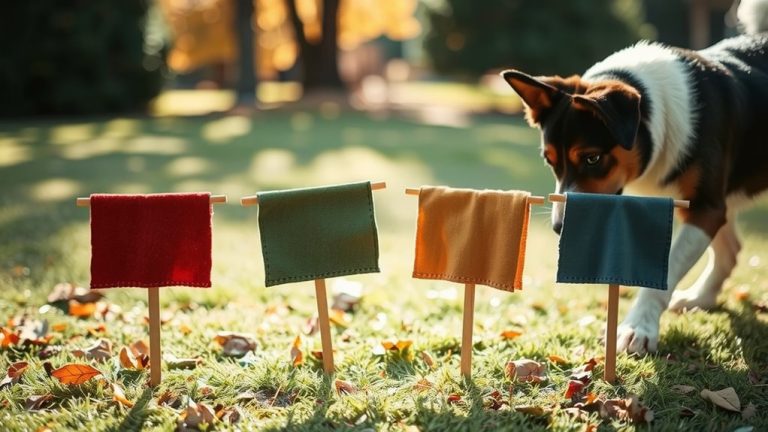
Start with a clear, measurable grid to map out your backyard scent trail, guaranteeing accurate placement of scent zones and markers. Use a 1-foot by 1-foot grid system for precise backyard mapping, allowing consistent spacing and repeatable trail design. Mark grid points with temporary flags or washable chalk for easy adjustments. Your trail should span at least 15 feet to provide adequate challenge, with turns at 90-degree angles to test directional tracking. Avoid straight lines; instead, create a zigzag or spiral pattern within the grid for increased complexity. Maintain a minimum 3-foot distance between parallel segments to prevent scent overlap. Consider terrain variables like grass, soil, and wind exposure when plotting the route. A well-structured trail design enhances focus and minimizes distractions. Use a tape measure and compass for accuracy. Document your layout on graph paper for future replication or modification. This methodical approach guarantees reliable training outcomes and clear performance evaluation.
Lay the Scent Trail in a Fun Pattern
Now that the layout is mapped with precision, it’s time to lay the scent trail following a fun yet structured pattern. Begin by applying a 2% dilution of essential oil in cornstarch solution every 12 inches along a zigzag pattern. Each angle in the zigzag should measure 60 degrees, spanning 3 feet per segment to maintain consistency. This geometry challenges directional tracking while preventing predictability. Shift into a spiral trail with a 2-foot radius, increasing coil density by 6 inches per revolution. The spiral trail enhances scent concentration toward the center, mimicking natural odor plumes. Use a squeeze bottle for precise 3-milliliter deposits per application point. Avoid overlapping deposits to prevent saturation. Maintain trail continuity by ensuring wind direction favors dispersal, not diffusion. The pattern must remain visible to you but not to your dog. Proper spacing and formulation guarantee detectable, durable cues.
Train Your Dog to Follow the Scent Trail
Once the scent trail is properly laid, begin training your dog by introducing them to the starting point with a consistent verbal cue, such as “find it.” Keep the leash loose to allow natural movement but maintain control. Encourage tracking behavior by letting your dog sniff freely at the trail’s origin. Use positive reinforcement-offer small, high-value treats and verbal praise the moment they orient toward the scent line. Repeat this process three to five times per session, limiting sessions to five minutes initially to maintain focus. Gradually increase trail length by 3-foot increments as accuracy improves. Maintain a 90% success rate to reinforce learning. Dogs typically require 5–10 sessions to reliably follow a 15-foot trail. Avoid pulling or guiding; instead, let the dog solve the path independently. This method strengthens scent discrimination and builds confidence. Consistent cues and rewards establish a reliable tracking behavior pattern essential for advanced challenges.
Store and Reuse Scent Powder Safely
Properly storing your scent powder guarantees consistent performance and prolongs its usability for future training sessions. Use airtight storage containers made of opaque, food-grade plastic or glass to protect the powder from moisture, light, and air exposure. These environmental factors degrade essential oil compounds, reducing scent potency and shortening shelf life. Store containers in a cool, dry place, ideally between 50°F and 70°F (10°C–21°C), away from direct sunlight or heat sources. Label each container with the mix date and ingredients to track shelf life-cornstarch-based powders last up to six months under ideal conditions. Avoid contamination by using clean, dry spoons when handling. Never return unused powder to the original container. Reassess scent strength before reuse; weakened aroma signals expiration. Proper storage maintains scent integrity, ensuring reliable training performance session after session. For optimal results, choose containers with moisture-proof seals designed to preserve freshness and prevent spoilage.
On a final note
You’ve built an effective scent trail training system. The cornstarch and essential oil mixture creates a stable, detectable odor when applied at 1–2 tablespoons per linear foot. Use only dog-safe oils like lavender or chamomile, diluted to 1% concentration. The trail should follow a non-repeating 10–15 foot zigzag path, renewed every 4–6 weeks. Store powder in an airtight container away from light to preserve volatility.