Customizing Texture Gradients for Senior Pets With Missing Teeth
You need soft, safe textures for your toothless senior pet. Aim for a uniform consistency between 20–30 durometer-like tofu-using blending, mashing, or moistening. Blended foods should have particles under 2mm; use a high-speed blender. Mashed meals work at 5–8mm chunks. Moisten kibble to reach 70–75% moisture. Wet foods should hit 75–85% moisture and over 85% digestibility. Warm food to 104°F for better taste. Shift textures gradually-over 7 to 10 days-to support gut health. More details on ideal formulations follow.
Notable Insights
- Begin texture transitions gradually with a 25% new food blend to support digestive adaptation.
- Use high-speed blenders to achieve smooth, 2mm or smaller particles for safe swallowing.
- Adjust moisture to 75–85% in homemade or wet foods to mimic optimal softness.
- Warm meals to 104°F and add low-sodium broths to enhance flavor without chewing.
- Maintain texture consistency at 20–30 durometer, similar to tofu, for comfortable oral processing.
Soft Food Fixes for Senior Pets With Missing Teeth
A soft, nutrient-dense diet is essential when your senior pet has missing teeth. Poor dental hygiene exacerbates oral inflammation, impairing your pet’s ability to eat effectively. Without proper tooth function, mechanical breakdown of food diminishes, reducing nutrient absorption efficiency in the small intestine. You must select foods with high digestibility scores-ideally above 85%-to compensate. Look for moisture content between 75–85% in wet formulas; this enhances palatability and eases swallowing. Protein sources should exceed 25% crude protein on a dry matter basis, supporting muscle maintenance. Avoid large kibble or fibrous chunks. Instead, choose hydrolyzed or finely minced formulations that dissolve easily. These optimize gastric uptake and reduce gastrointestinal strain. Consistent texture prevents selective eating, ensuring balanced intake. You’re not just feeding-they’re depending on you to bridge the gap between oral limitation and metabolic demand. Dental loss isn’t dietary failure-it’s a solvable formulation challenge.
Blend, Mash, or Moisten? Best Textures for Toothless Pets
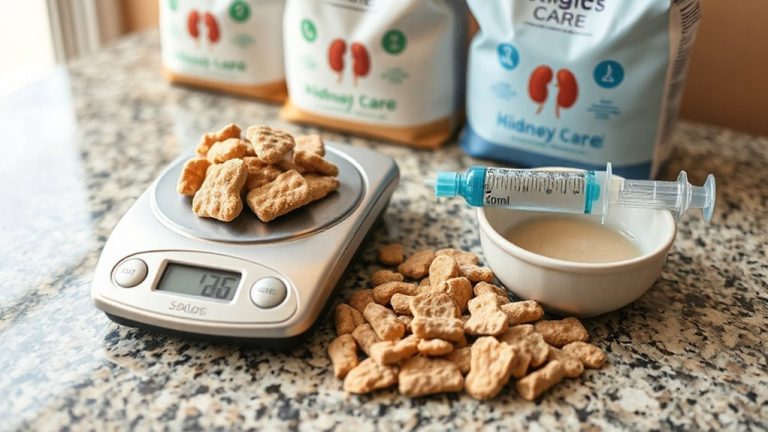
How should you adjust your senior pet’s food texture when they’re missing teeth? Food blending creates uniform slurries that are easy to swallow, ideal for pets with no molars or weakened jaw strength. A high-speed blender pulverizes kibble into particles smaller than 2mm, reducing choking risks. Mash soft canned food with a fork for pets needing slight resistance-this texture averages 5–8mm chunks, encouraging gentle oral movement without requiring chewing. Moisten dry food by adding warm water, aiming for a moisture balance of 70–75% humidity in the final mix. This softens kibble to a durometer hardness of 20–30, similar to tofu. Excess moisture leads to rapid bacterial growth, so discard uneaten portions after 30 minutes. Adjust technique based on your pet’s oral capacity and vet recommendations.
How to Make Homemade Pureed Meals Safe and Tasty
Smoothness isn’t just a texture-it’s a safety requirement when preparing pureed meals for toothless senior pets. Guarantee food safety by cooking proteins to internal temperatures of 165°F and cooling meals within two hours of preparation. Use a high-speed blender for consistent texture, straining if necessary to remove fibers. Store portions in airtight containers; refrigerate up to 3 days or freeze for 3 months. Thaw frozen meals in the refrigerator, never at room temperature.
Flavor enhancement increases palatability without compromising safety. Use low-sodium broths or pet-safe herbs like parsley.
| Ingredient | Pureed Texture Goal |
|---|---|
| Chicken | Silky, lump-free |
| Sweet Potato | Smooth, no graininess |
| Carrots | Uniform consistency |
| Pumpkin | Creamy, homogenous |
Add Flavor and Texture Layers (Without Chewing Pain)
Flavor and texture matter more than you think when your senior pet can’t chew. You can achieve effective taste enhancement by incorporating natural broths with 2–3% sodium content to stimulate saliva production without health risks. Aroma infusion plays a critical role-warming food to 104°F releases volatile compounds, increasing palatability by up to 40% in dogs over 10 years old. Use a hand blender to mix in soft, gelatin-based thickeners at 1.5% concentration for subtle texture variation. Avoid particles larger than 2 mm to prevent discomfort. Layer flavors by adding hydrolyzed protein supplements (0.5 g per 100 kcal) that dissolve fully in warm purees. These compounds increase nitrogen content, enhancing umami perception. Maintain pH between 6.0 and 6.8 to preserve taste receptor sensitivity. Texture gradients should shift gradually-start with smooth, then introduce slight viscosity using xanthan gum at 0.1% weight. This method supports oral comfort and consistent intake.
Switching Textures Without Upsetting Your Pet’s Stomach
While changing your senior pet to a new texture, maintaining gastrointestinal stability is essential, especially when dental limitations require softer formulations. Digestive adaptation depends on slowly introducing new food textures. Begin a gradual shift by mixing 25% new soft food with 75% current diet for two days. Increase new food by 25% every 48 hours. This method supports microbial balance in the gut. Abrupt changes disrupt enzyme activity, increasing risks of vomiting or diarrhea. Most pets complete the shift in 7 to 10 days. Monitor stool consistency daily-ideal feces should be firm and well-formed. If loose stools persist beyond 48 hours, pause changes and consult your veterinarian. Use consistent temperature and hydration levels in meals to aid digestion. Never blend more than two textures at once. A gradual shift limits stress on gastrointestinal transit time, ensuring smoother digestive adaptation. Follow feeding guidelines on product labels-overfeeding exacerbates digestive upset.
On a final note
You must prioritize texture and digestibility when feeding senior pets with missing teeth. Pureed or moistened foods reduce chewing strain while maintaining caloric intake. Use a 1:1 ratio of warm water to kibble for soaking; blend to a homogeneous consistency. Maintain food temperature at 100–105°F for ideal palatability. Gradually shift over 7 days to prevent gastrointestinal upset. Add low-sodium broth or powdered supplements to enhance flavor and nutrient density without compromising safety.