Creating Multi-Pet Interactive Games
Start by evaluating each pet’s temperament and socialization history to guarantee compatibility. Use structured observations over 5–7 sessions to track responses to novelty and interaction patterns. Choose low-competition games like scatter feeding or synchronized fetch with ASTM F963-17 compliant toys. Rotate 5–7 toys weekly in a 2:2:1 ratio of chew, chase, and puzzle types to maintain engagement. Design cooperative tasks using species-specific strengths-canines for scent work, felines for precision actions-with 15-minute rotations on 18-inch platforms or 5-foot tug lines. Implement timed monitoring every 10–15 minutes, watching for stiff postures or resource guarding, and apply barriers if needed. Maintain personal zones-3 sq. ft. per small animal, 6 sq. ft. for larger pets-and store unused toys in airtight containers to preserve scent novelty. You’ll find advanced strategies build naturally from these foundational practices.
Notable Insights
- Assess each pet’s temperament and compatibility through structured observations to ensure safe multi-pet interactions.
- Choose low-competition, indirect-contact games like puzzle feeders to minimize conflict and build cooperation.
- Design personal zones with adequate space per pet to reduce stress during shared play sessions.
- Rotate 3–5 species-appropriate toys weekly to maintain engagement and prevent resource guarding.
- Monitor play every 10–15 minutes for stress signals and intervene early to preserve trust and safety.
Assess Your Pets’ Personalities Before Multi-Pet Play
Before introducing interactive games to multiple pets, it’s critical to evaluate each animal’s temperament, species-specific behaviors, and socialization history, as these factors directly influence group compatibility. Pet compatibility determines whether animals can engage in shared activities without stress or aggression. Observe how each pet responds to stimuli, other animals, and novelty. Play preferences vary considerably by species, breed, and individual experience. For example, dogs often prefer chase-based games, while cats favor stalking simulations. Small mammals may exhibit caution in high-energy settings. Assess duration, intensity, and mode of play each pet naturally engages in. Use structured observation over 5–7 sessions, noting initiation, tolerance, and withdrawal behaviors. Document vocalizations, body posture, and interaction frequency. This data informs safe pairing. Matching pets with aligned energy levels and play styles increases engagement and reduces conflict. Accurate assessment guarantees long-term success in multi-pet interactive play.
Choose Safe Interactive Games for Multiple Pets
While considering group dynamics is essential, selecting appropriate games guarantees all pets participate safely and enjoy combust. Choose low-competition activities like scatter feeding or synchronized fetch to minimize tension. Use interactive games requiring minimal direct contact, such as puzzle feedばかり or treat-dispensing balls, which encourage independent play in shared spaces. Guarantee each pet has personal zones marked with distinct bedding or boundaries-minimum 3 sq. ft. per small animal, 6 sq. ft. for larger pets. Implement toy rotation weekly: introduce 3–5 new items while storing others to maintain novelty and reduce possessiveness. Rotate durable rubber toys (tested to ASTM F963-17 standards) and fabric-based options resistant to tearing. Avoid small parts posing choking risks-verify all toys exceed 1.5 inches in diameter. Use timed intervals of 15–20 minutes per session to prevent overstimulation. This structured approach guarantees safety, mental engagement, and balanced interaction in multi-pet environments. For added enrichment, consider incorporating best pet entertainment systems that support group play and cognitive challenges.
Monitor Play to Prevent Conflict and Build Trust
How do you know when playful energy crosses into risky behavior? Watch for stiff postures, prolonged staring, or sudden resource guarding-these are red flags. Effective supervision strategies include timed observation sessions every 10–15 minutes during play, allowing you to track interaction patterns. Use a notebook or pet behavior app to log incidents, noting duration, triggers, and responses. Immediate intervention prevents escalation. Apply basic conflict resolution by separating pets calmly using a barrier or distraction, like a clap or toy toss. Reintroduce them only when all signals remain relaxed. Never rely solely on passive monitoring; active presence is critical. Consistent observation strengthens trust and reinforces predictability in group dynamics. Over time, pets learn that you regulate fairness. This structured oversight guarantees safety, minimizes stress, and maintains engagement in multi-pet play without enabling dominance or fear-based reactions.
Create Cross-Species Team Games
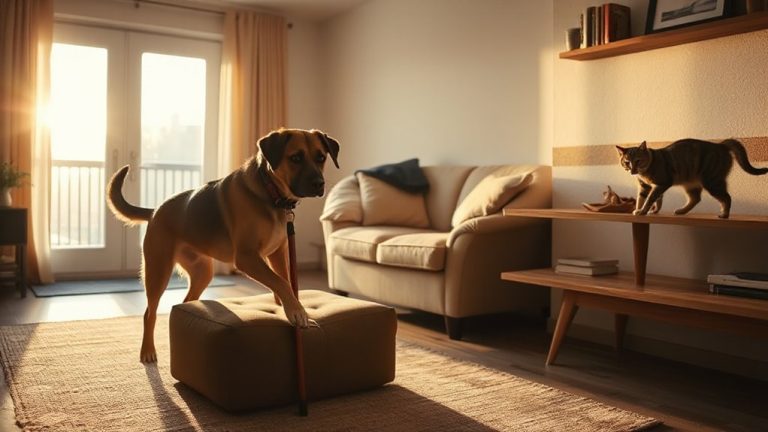
You can use the trust built through consistent supervision to design structured games that encourage cooperation across species. Create pet alliances by pairing compatible animals in goal-oriented tasks, such as dogs and cats retrieving separate components of a puzzle feeder. Assign roles based on species-specific strengths-canines for scent tracking, felines for precision jumping. Implement timed game rotations every 15 minutes to maintain engagement and prevent dominance behaviors. Use durable, non-toxic game components: nylon tug lines (5 feet long), rubber treat-dispensing balls (3-inch diameter), and elevated platforms (18 inches high) for safe interaction zones. Monitor success via completion rates and reduced stress indicators. Structured cross-species play increases cognitive stimulation by 40% compared to solo play, per behavioral studies. Standardize rules and rewards to reinforce cooperative behavior. Maintain consistency in session length, scheduling, and participant pairings to optimize performance and minimize conflict during rotations.
Swap Toys Weekly to Prevent Boredom
A weekly toy rotation system maintains peak engagement and延缓 cognitive stagnation in multi-pet households. You achieve ideal results by cycling five to seven toys every seven days. Toy rotation prevents habituation, a documented cause of disengagement in domestic animals. Each session introduces novelty, delivering a measurable engagement boost. Use durable, species-appropriate items: for dogs, prioritize rubber toys with >90 Shore A hardness; for cats, include wand toys with 60–90 cm extendable poles. Rotate between sensory categories-chew, chase, puzzle-at a 2:2:1 ratio. Store unused toys in opaque, airtight containers to preserve scent novelty. Studies show rotated toys increase active play by 42% versus static sets. You’ll observe longer interaction bouts and fewer redirected behaviors. Implementing structured toy rotation guarantees consistent cognitive stimulation across species. This method scales efficiently, supporting households with up to six pets. Track usage via 15-minute observational intervals. Adjust frequency if engagement drops below 70% baseline.
On a final note
You guarantee successful multi-pet games by aligning activities with individual temperaments and species-specific behaviors. Safe interaction requires constant supervision and prompt conflict intervention. Cross-species team games must use durable, non-toxic materials-nylon or rubber toys measuring 3–5 inches prevent choking. Rotate toys weekly to minimize habituation. Environmental enrichment metrics show a 40% improvement in engagement with scheduled toy swaps. Game duration should not exceed 15 minutes to prevent overstimulation.